Nursing Accessories FAQ for Workplace Problems and Safety Limits
Nursing accessories can support daily work when they align with workplace rules, hygiene expectations, safe use requirements, and the condition of the item itself. This FAQ addresses practical questions about use limits, common problems, maintenance, organization, and replacement in workplace settings. The answers focus on work-support decisions rather than product selection and clarify practical doubts about safe use and safety limits.
Nursing accessories are work-support items that may help with identification, organization, access to commonly used tools, comfort, or shift readiness. Common examples can include badge accessories, tool accessories, organizers, and washable items used during work activities. Whether an item is suitable often depends on local policy, cleanability, fit, and how it affects daily tasks. Nursing accessories should be distinguished from restricted items that may interfere with work, create hygiene concerns, or fall outside workplace use.
When questions arise during shifts, the answer often depends on the situation, the item being used, and the workplace context. A badge accessory that supports identification may be treated differently from an item that is difficult to clean or securely carry. Questions about hygiene, maintenance, organization, troubleshooting, and replacement are usually connected to practical use rather than ownership. For broader context around accessory categories and workplace use, readers can also review the nursing accessories hub.
Local policy and item condition can change the answer to many workplace questions. An accessory that appears suitable in one setting may be restricted in another when contamination concerns, safety risks, or role-specific requirements apply. This FAQ focuses on conditional answers rather than universal permissions. It also separates daily-use nursing accessories from unrelated topics such as gifts, decorative jewelry, student supplies outside workplace use, or nursing-home legal matters.
- Questions about wearing or carrying accessories during shifts.
- Questions about restrictions, workplace rules, and safety limits.
- Questions about common problems, wear, damage, and troubleshooting.
- Questions about hygiene, cleaning considerations, and maintenance.
- Questions about organization, storage, and access during shift use.
- Questions about replacement decisions when an accessory is no longer suitable for use.
What nursing accessories are included in these questions?
Nursing accessories are practical items nurses may use to support identification, basic tools, organization, comfort, hygiene, or shift readiness. Nursing accessories are separate from major clinical devices and are generally associated with everyday workplace support functions. This section defines the scope of the accessories discussed throughout the FAQ.
Nursing accessories include item groups that help nurses carry, organize, access, or maintain commonly used workplace resources. Examples may vary by workplace context, but the focus remains on support functions rather than clinical treatment functions. A broader explanation of what nursing accessories include can provide additional context for category boundaries. What nursing accessories are included in these questions? The grouping below clarifies the scope by function rather than by product type.
What nursing accessories are included in these questions? The image below illustrates common accessory groups based on workplace function and everyday use.
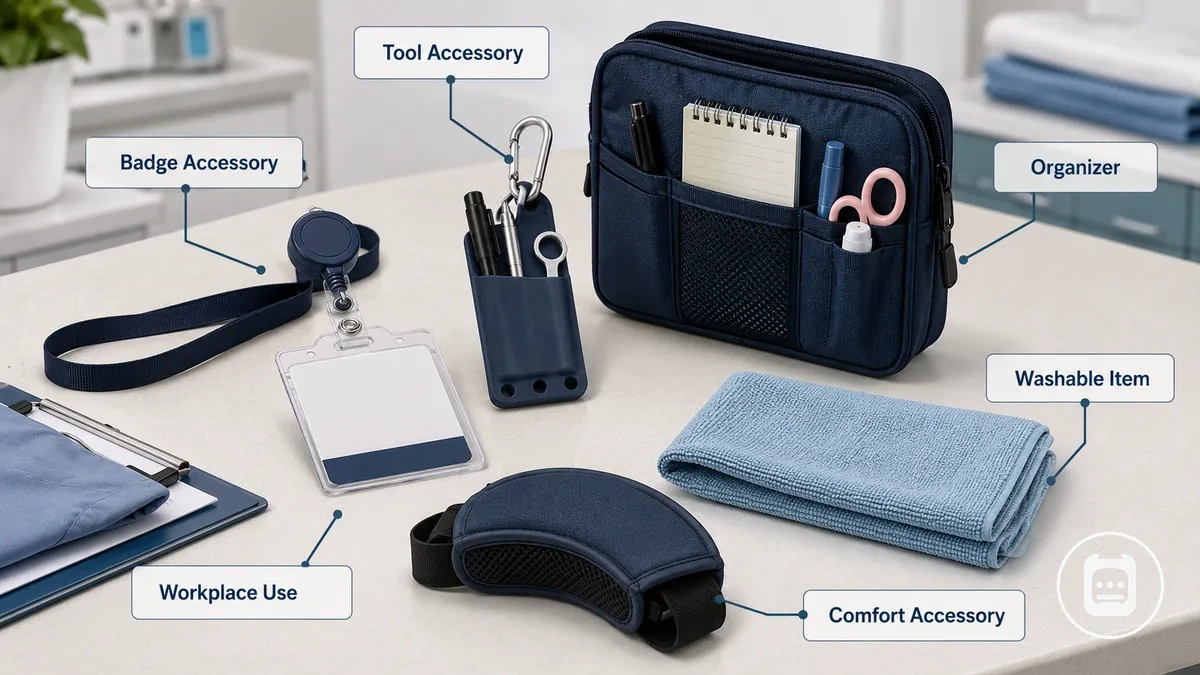
- Badge accessories: Support identification and workplace use; they are discussed as functional accessories rather than decorative items.
- Tool accessories: Help carry, organize, or access basic tools; they support daily work without being treated as clinical equipment.
- Organizers: Support storage and access to small workplace items; their role is organizational rather than clinical.
- Washable items: Support hygiene and maintenance through easier cleaning; suitability may depend on workplace expectations.
- Comfort accessories: May support comfort during work activities; they are considered support items rather than treatment devices.
- Workplace-use items: Support routine nursing tasks and mobility; inclusion can depend on local workplace requirements and permitted use.
A common misunderstanding is that all nursing-related items belong in the same category. Nursing accessories are distinct from clinical equipment, facility-issued supplies, and restricted personal items because those items serve different operational, clinical, or policy-related purposes. Whether a specific item belongs within the accessory scope may depend on workplace expectations and permitted use.
What nursing accessories do nurses commonly need during shifts?
Common nursing accessories often support identification, access, organization, hygiene, and comfort during shifts. A badge holder, pens, a penlight, scissors, and other daily-use items may help nurses manage routine tasks more efficiently. The specific combination can depend on role requirements, facility rules, and what is already available in the workplace.
What nursing accessories do nurses commonly need during shifts? The image below organizes common nursing accessories by practical shift function rather than by product type.
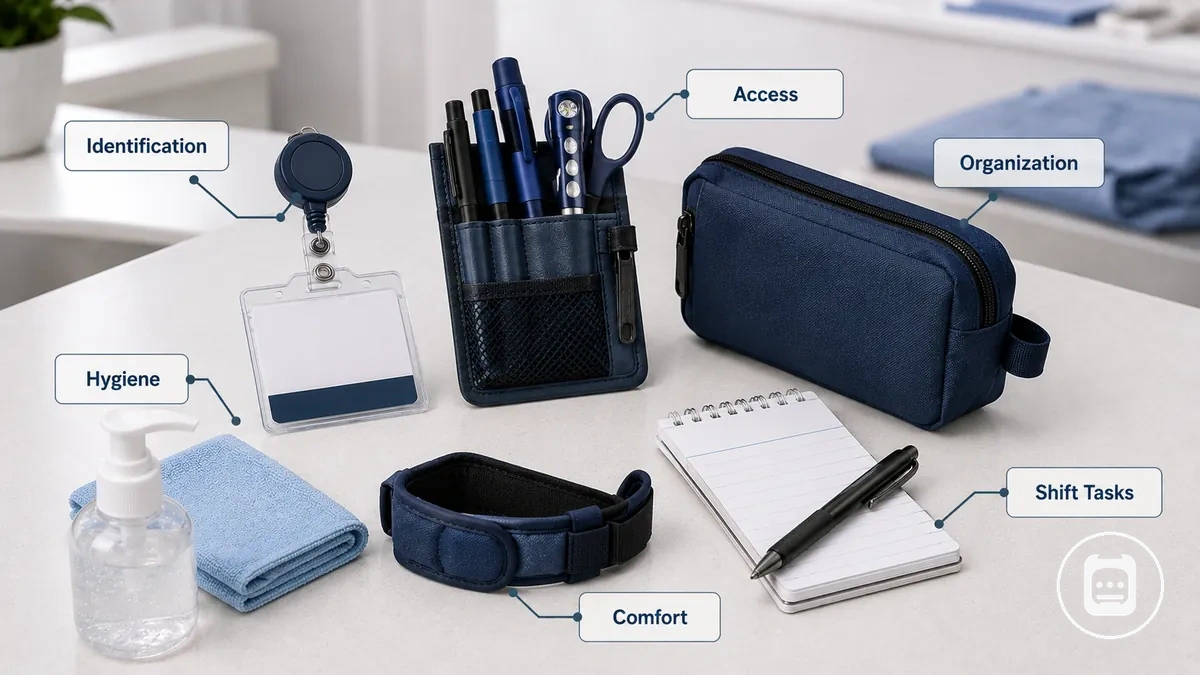
- What common nursing accessories are often used during shifts? Common nursing accessories may include a badge holder for identification and access, along with items such as pens, a penlight, or scissors that support routine work tasks. The practical value depends on daily responsibilities and workplace expectations. Some items may already be supplied or limited by facility rules.
- Should nurses carry the same accessories during long shifts or clinical placement? Long shifts or clinical placement settings may increase the value of comfort accessories, washable items, and basic tools that support access and organization. These items can help reduce unnecessary searching or carrying during busy periods. The exact need may vary when facilities provide equipment or restrict personal nursing gear.
- What should nurses prioritize when pocket or bag space is limited? Identification items and frequently used tools are often prioritized when storage space is restricted. Compact organization can help keep essential items accessible without overloading pockets or bags. The most useful combination depends on task frequency and available storage options.
- When might new nurses or students need different shift accessories? New nurses or students may focus on a smaller set of daily-use items that support identification, access, and basic organization. Clinical placement requirements can influence which accessories are practical to carry. Additional items may be unnecessary when workplace resources are already available.
Which accessories can nurses usually wear or carry at work?
Accessories nurses wear or carry at work usually depend on workplace rules, safety expectations, hygiene needs, and role requirements. Nurses may wear or carry items that support identification, access, organization, or routine tasks when those items fit the work environment and do not create unnecessary interference. Workplace rules and safety expectations are the primary factors that determine whether an accessory is permitted.
When nurses wear badge accessories or carry tools during work activities, suitability often depends on how the item is used and stored. Badge accessories are commonly more appropriate when they support identification through secure attachment. Carried tools may be permitted when they support role requirements and can be stored safely between tasks. Items that are difficult to clean, interfere with movement, or create hygiene concerns may be restricted in certain settings.
Which accessories can nurses usually wear or carry at work? The image below distinguishes secure, cleanable, work-appropriate items from features that may create concerns in workplace settings.
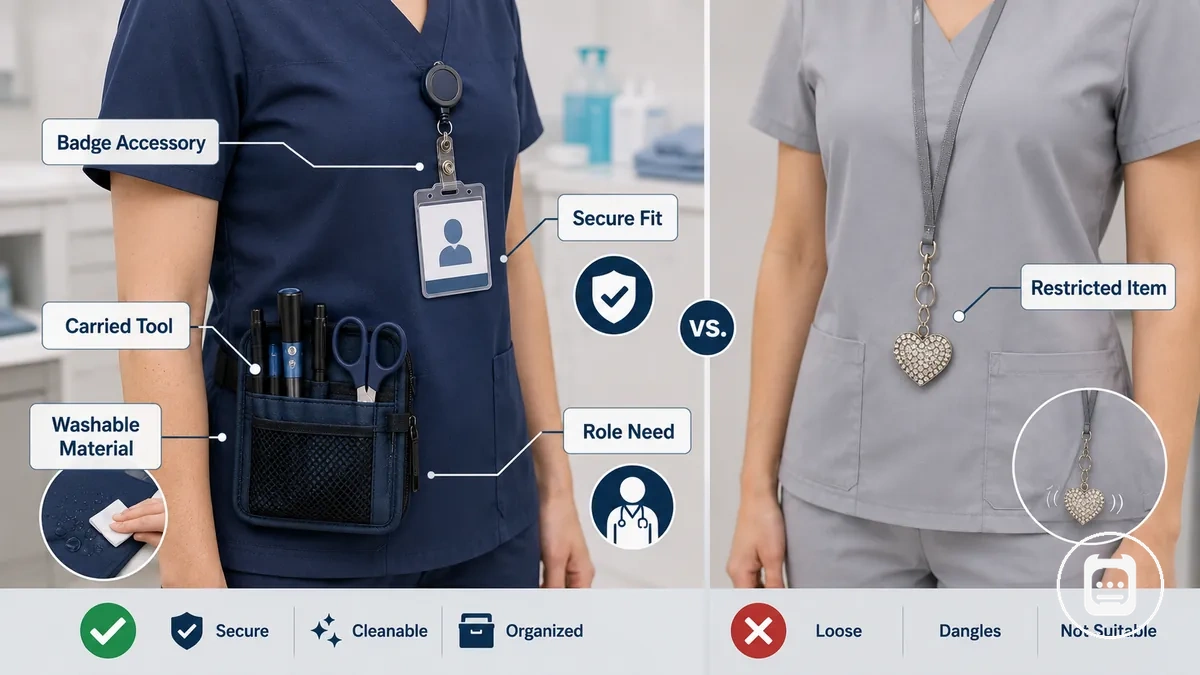
The checklist below organizes permission by work condition rather than by accessory type alone. These criteria are often used when evaluating safe nursing accessories in workplace environments.
- Allowed when the accessory aligns with workplace rules and role requirements.
- More suitable when washable materials support hygiene and routine cleaning.
- Often preferred when badge accessories use secure attachment and remain close to the body.
- May be restricted if the item interferes with tasks, movement, or equipment use.
- Patient-contact situations may require closer attention to cleanability and fit.
- Dangling items or exposed sharp components may be restricted because they can increase risk or interfere with work activities.
- Carried tools are often more appropriate when safe storage supports their intended purpose.
A common misconception is that work-related accessories are either fully allowed or fully restricted. In practice, some accessories may be allowed, others may be conditionally allowed, and certain items may be restricted based on hygiene, secure fit, or interference concerns. The outcome usually depends on the accessory's condition, purpose, and workplace context.
Why are some accessories restricted in nursing settings?
Restricted accessories in nursing settings are usually limited to reduce contamination, injury risk, interference, patient safety concerns, or policy conflicts. An accessory may appear useful but still create challenges if it is difficult to clean, easy to snag, or unsuitable for a specific work environment. The main reason for many restrictions is to reduce avoidable safety concerns during workplace activities.
Contamination and injury risk are common reasons accessories may be restricted. Hard-to-clean surfaces can be less suitable when regular cleaning is important, while dangling parts may increase interference or snagging concerns during bedside care. Sharp tools may be appropriate for certain role requirements when stored securely, but loose items can create handling or access issues. The decision often depends on how the accessory affects safety, hygiene, and daily work activities.
Why are some accessories restricted in nursing settings? The table below connects common accessory features to safety concerns and explains why certain items may be limited in specific situations.
| Accessory feature | Possible concern | Typical condition | Safer response |
|---|---|---|---|
| Dangling parts | Injury risk or interference | Movement during bedside care | Use a more secure attachment |
| Hard-to-clean surfaces | Contamination concern | Frequent workplace contact | Choose easier-to-clean materials |
| Sharp tools | Accidental contact risk | Unsecured carrying method | Store securely when not in use |
| Loose items | Loss or interference | Busy work environments | Use organized storage |
| Jewelry-like accessories | Patient safety or interference concern | Close-contact work activities | Follow workplace suitability requirements |
| Role-inappropriate items | Policy conflicts | Mismatch with role needs | Follow facility requirements |
A common myth is that an accessory that looks harmless should automatically be allowed. In practice, an item may still be restricted if facility rules identify a safety concern, hygiene issue, or operational limitation. When evaluating safe nursing accessories, facility rules and safe-use criteria should guide the final decision even when an accessory appears suitable.
What common problems happen with nursing accessories during use?
Common problems with nursing accessories during use include loss, breakage, contamination, poor fit, difficult access, wear, and interference with tasks. These issues can affect convenience, reliability, or suitability during daily work activities. Troubleshooting starts by identifying the symptom, reviewing the likely cause, and selecting an appropriate next action.
When a problem appears, the likely cause often points toward the most practical response. Poor fit may lead to interference and may require adjustment, while difficult access can result from disorganized storage or workflow challenges. Breakage and wear may reduce reliability over time, and contamination concerns may require cleaning or temporary removal from use. The goal of troubleshooting is to match the symptom to a reasonable next step rather than assume a single fix.
What common problems happen with nursing accessories during use? The table below connects each problem to a likely cause and practical next action to support basic troubleshooting decisions.
| Problem or symptom | Likely cause | Immediate check | Practical next action |
|---|---|---|---|
| Loss | Loose carrying method | Check storage location | Use a more secure organizer |
| Breakage | Wear or physical stress | Inspect damaged areas | Assess whether continued use is suitable |
| Contamination | Dirty or exposed surfaces | Review item condition | Clean or remove from use if needed |
| Poor fit | Incorrect size or attachment | Check positioning | Adjust fit if practical |
| Difficult access | Disorganized storage | Review item placement | Reorganize for easier access |
| Wear | Repeated use over time | Look for deterioration | Monitor condition and reliability |
| Interference | Accessory placement issue | Observe task impact | Reposition or reduce obstruction |
Immediate response choices should reflect the type of issue and its likely cause. If contamination is present or an accessory appears dirty, review cleaning guidance before returning the item to use. If difficult access affects workflow, reorganization may be more useful than adjustment. When poor fit creates interference, a fit change may help if the accessory remains suitable for use.
In certain edge cases, adjustment may not be the best response. If breakage, contamination, wear, or unreliable function continues after reasonable checks, removal from use may be appropriate until the issue is addressed. For accessories that appear damaged, unsafe, or no longer dependable, review replacement guidance to support the next decision.
How should nursing accessories be maintained between shifts?
Maintain nursing accessories between shifts by keeping them clean, functional, dry, identifiable, and ready for use. Routine upkeep helps reduce avoidable problems caused by contamination, wear, disorganization, or unreliable function. The goal is to support storage readiness and consistent access during the next shift.
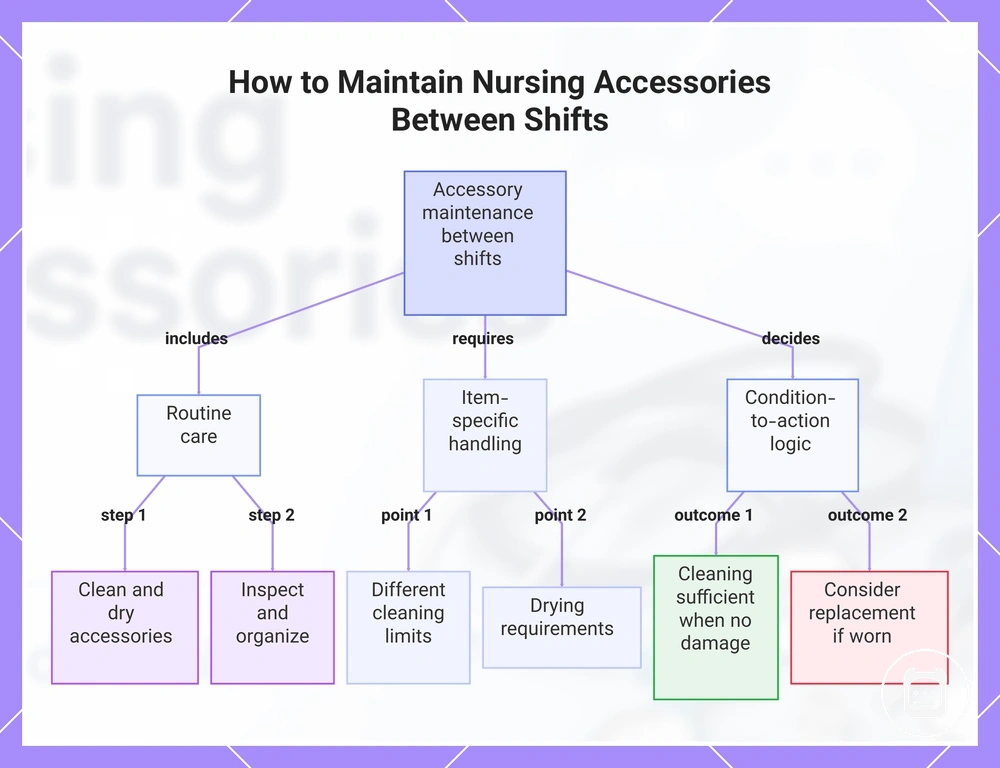
Nursing accessories between shifts often need different levels of care depending on the item and material. Routine care may be enough for organizers, badge items, or cleanable surfaces that show no signs of damage. Item-specific handling may be needed when washable accessories, fabric materials, silicone materials, or tools have different cleaning limits or drying requirements. Separating routine care from item-specific handling helps avoid unnecessary wear and supports readiness.
How should nursing accessories be maintained between shifts? The checklist below separates routine care from item-specific handling and focuses on condition-to-action decisions.
- Empty organizers and remove items that are no longer needed for the next shift.
- Clean washable accessories when the material and condition make cleaning appropriate.
- Allow items to become dry before storage when moisture could affect condition or usability.
- Perform an inspection of badge items, tools, and attachments for wear, looseness, or damage.
- Separate clean items from recently used items when organization or contamination concerns exist.
- Restock commonly used accessories if they are needed for storage readiness and future use.
- Store accessories in an organized location where they remain identifiable and easy to access.
Cleaning may be enough when nursing accessories remain functional and contamination is limited to removable dirt or residue. When material limits, contamination concerns, or cleaning uncertainty affect the next action, review cleaning guidance for more detail. If inspection identifies wear, damage, attachment problems, or unreliable function, routine care may no longer be sufficient. In those cases, replacement may be considered when the accessory is no longer dependable for future use.
This chart shows the key maintenance actions and condition-based decisions for keeping nursing accessories clean, functional, and ready between shifts.
How should nursing accessories be organized to avoid loss or clutter?
Organize nursing accessories by frequency of use, cleanliness needs, safety risk, and speed of access. Frequently used items should remain easy to reach, while less-used items can be stored separately to reduce clutter. Clear placement rules help keep accessories identifiable, support loss prevention, and improve access priority during shifts.
During a shift, pocket items and high-use tools may need faster access than items stored in a pouch or bag storage area. During shift handoffs, keeping commonly used accessories in consistent locations can reduce misplaced items and support readiness. If commuting or shared storage changes how accessories are carried, organization may depend on access needs and cleanliness separation. The goal is to match placement to use frequency rather than carry more items than necessary.
How should nursing accessories be organized to avoid loss or clutter? The table below organizes accessories by access priority and storage condition.
| Accessory group | Access priority | Storage condition | Loss or clutter risk |
|---|---|---|---|
| Pocket items | High | Consistent placement | Higher risk if frequently moved |
| Badge items | High | Secure attachment | Risk of loss if detached |
| Tool accessories | Medium to high | Organized and accessible | Clutter risk when mixed with unused items |
| Organizers | Medium | Grouped by purpose | Lower risk when contents remain sorted |
| Washable items | Varies | Stored according to cleanliness needs | Risk of mixing clean and used items |
| Used items | Low | Separated from clean items | Can create clutter or confusion if mixed |
End-of-shift checks can help confirm that nursing accessories remain organized and ready for the next use period. Review pocket items, verify badge items are still attached, return tools to their intended location, and separate clean items from used items when needed. This simple review supports loss prevention, reduces clutter, and maintains storage readiness without turning organization into a full bag-management process.
When should a nursing accessory be replaced instead of reused?
Replace a nursing accessory instead of reused it when the item is damaged, hard to clean, unsafe to wear, unreliable, contaminated beyond practical cleaning, or no longer fits the work need. A nursing accessory that cannot perform its intended function or creates hygiene or safety concerns may no longer be suitable for continued use. The replacement decision should be based on condition, cleanability, reliability, and safety rather than age alone.
Cosmetic wear does not always mean replacement is necessary. Minor surface marks or normal signs of use may be acceptable when the nursing accessory remains functional, cleanable, and safe. Functional failure, breakage, contamination concerns, or material degradation are stronger replacement signals because they can affect reliability or usability. In some situations, cleaning, temporary removal from use, or reorganization may be enough before replacement is considered.
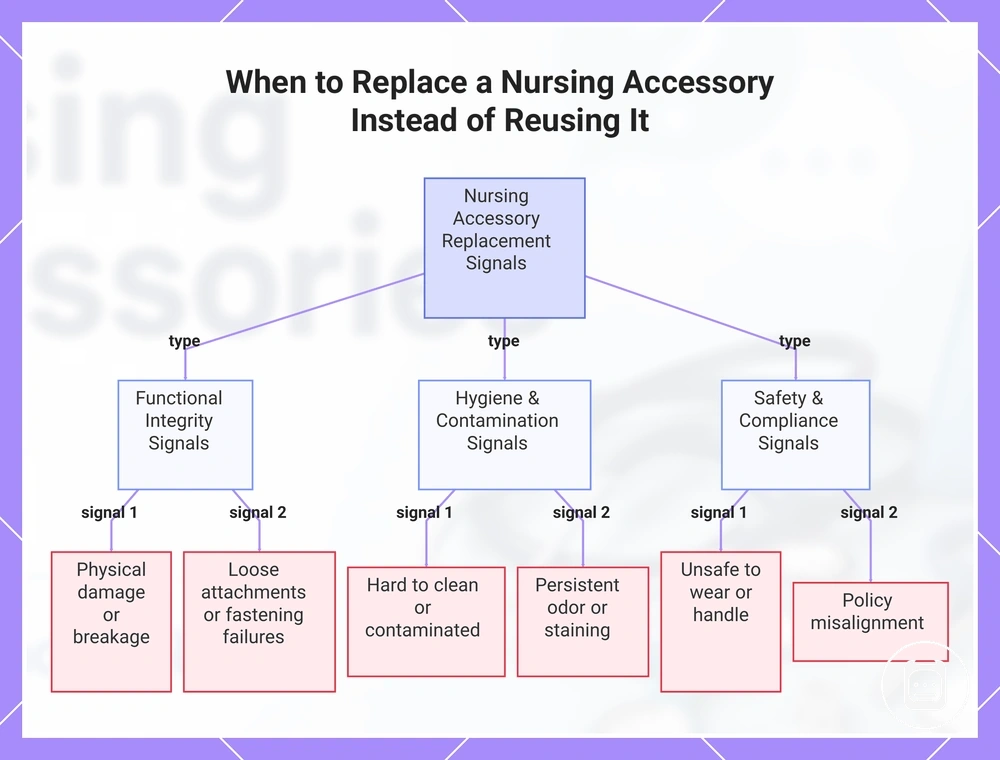
When should a nursing accessory be replaced instead of reused? The checklist below separates cosmetic wear from functional or hygiene-related failure and highlights condition-based replacement signals.
- Replace the item if damage or breakage affects normal use or creates a safety risk.
- Consider replacement when contamination remains a hygiene concern because the accessory is hard to clean.
- Replace the item if loose attachments, broken clips, or fastening failures affect secure use.
- Consider replacement when unreliable lights, reduced sharpness, or other function failures affect normal use.
- Odor or staining may justify replacement when cleaning no longer restores acceptable condition.
- Replace the item when material degradation affects durability, fit, or usability.
- Remove from use if the accessory becomes unsafe to wear or handle.
- Policy-related unsuitability may require replacement when the item no longer aligns with workplace requirements.
For additional condition-based criteria, review replacement guidance. A common myth is that every nursing accessory should be replaced according to a fixed timeline. In practice, condition checks, safety concerns, reliability, cleanability, and contamination risks are usually more useful replacement signals than a fixed replacement schedule.
This chart organizes the main condition-based signals that indicate when a nursing accessory should be replaced, excluding cosmetic wear.