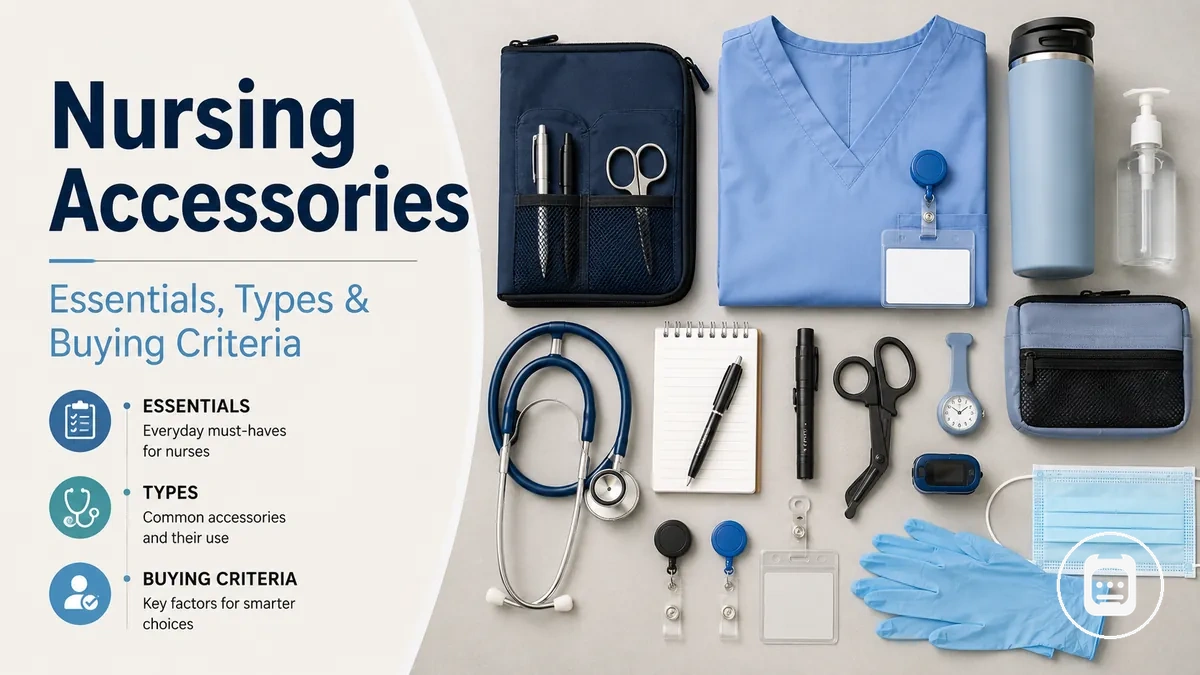
Nursing accessories for nurses: practical overview for essentials, types, and selection
Nursing accessories are practical work-support items that help nurses organize, carry, access, and use everyday tools within a clinical or learning environment. As a category, nursing accessories include items that support preparation, mobility, identification, and routine task management rather than replacing professional equipment or uniforms. This page frames nursing accessories as a decision-support topic focused on usefulness, fit, and daily use. The goal is to help nurses understand and compare accessory options within a practical decision context.
In a typical shift context, nurses may rely on a combination of clinical tools, organizers, badge accessories, and comfort items to support daily use. The most suitable nursing work accessories can depend on role responsibilities, workplace expectations, storage limitations, and how frequently an item is used during a shift. A nursing student may prioritize different accessories than an experienced nurse working in another setting or schedule. Because workplace policies and carry needs vary, accessory usefulness often depends on role, workplace, and shift context.
Nursing accessories are usually compared through broad categories rather than individual products. Common selection and buying criteria include ease of carrying, accessibility during work, compatibility with daily routines, and overall value for the intended work context. Organizers, clinical tools, badge accessories, and comfort items serve different purposes, so selection depends on matching the accessory group to the practical need. Understanding these category-level differences provides a foundation for the more detailed sections that follow.
A useful boundary is that nursing accessories are not the same as medical equipment, uniforms, workplace supplies, or personal items. Many accessories can support organization, convenience, and readiness, but their usefulness may vary by role requirements, facility policies, student status, and individual preferences. Keeping that distinction clear helps separate nurse essentials and optional items from tools or supplies that may be defined by workplace requirements.
What nursing accessories include in a nurse’s daily work context
Nursing accessories are supporting tools, organizers, wearable items, and comfort aids that help nurses perform or prepare for daily work tasks. These items support organization, accessibility, and routine work activities without replacing professional responsibilities, medical equipment, or uniforms. Their role is to assist daily work through practical support and convenience.
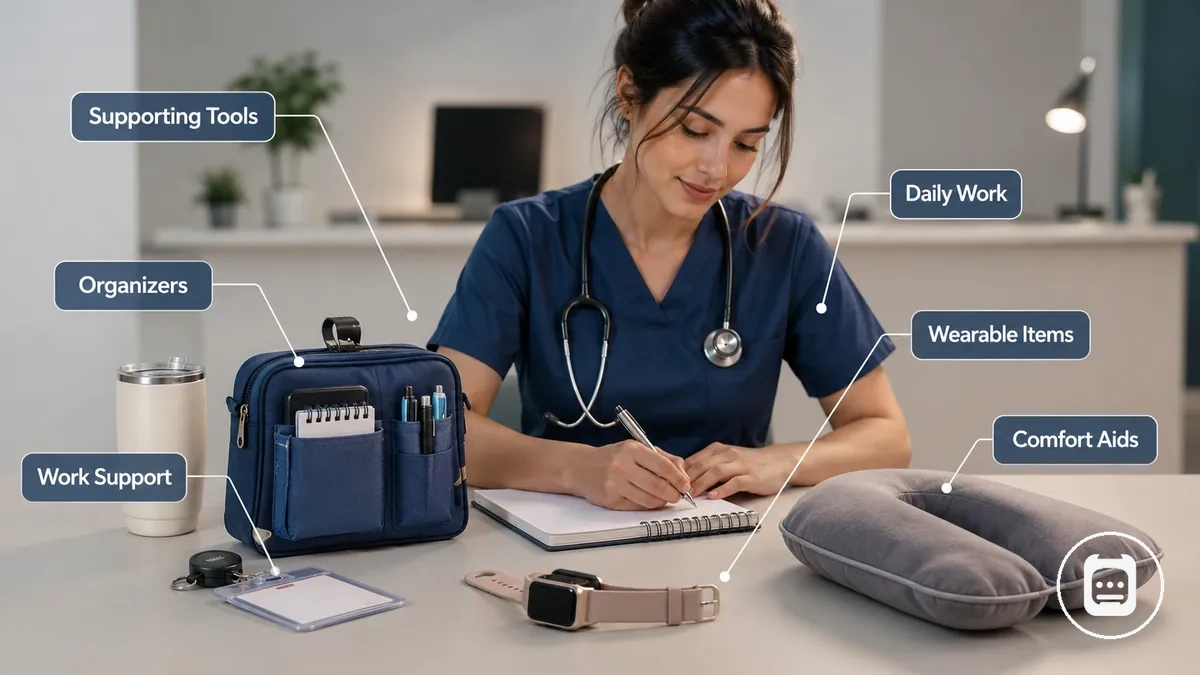
Nursing accessories can include items that support organization, identification, carrying needs, and comfort during a shift. Common categories are grouped by function rather than by individual products, which helps keep the focus on work-related purpose. The list below clarifies the main groups that are typically associated with nursing work accessories. For a focused definition, what nursing accessories include can be understood through the functions they support in nursing work.
- Supporting tools used for routine nursing activities
- Organizers that help manage work-related items
- Wearable items used for identification or accessibility
- Comfort aids that may support extended daily work periods
- Carry and storage accessories that assist with organization
Nursing accessories are distinct from medical equipment and uniforms, which may be governed by workplace requirements. They are also different from personal convenience items that have no clear connection to nursing work. Certain items may fall into a gray area depending on workplace rules, role expectations, or individual requirements, so this definition remains intentionally broad rather than exhaustive.
Core nursing accessory groups nurses commonly compare
Accessory groups help nurses compare nursing work accessories by function, daily use, and practical value before focusing on individual items. The most common comparisons involve how a group supports task access, organization, identification, comfort, or shift-related needs. Understanding these broad categories helps prepare the comparison table below.
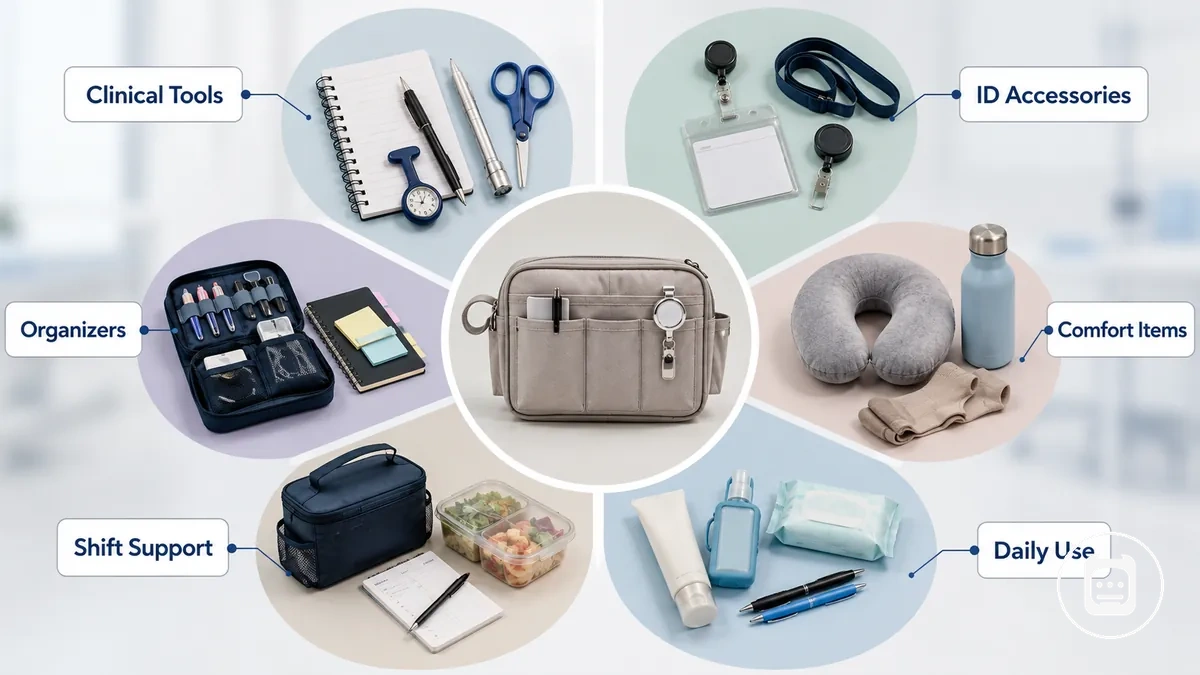
The table below organizes major accessory groups by function, common examples, and decision relevance. Each accessory group is presented as a broad category rather than a specific product type.
| Accessory group | Common examples | Main function | Decision relevance |
|---|---|---|---|
| Clinical tools | Reference aids, measuring aids, note-taking items | Task support and quick access | Depends on work duties and frequency of daily use |
| Identification accessories | Badge holders, ID attachments | Identification and accessibility | May vary according to workplace requirements |
| Organizers | Pouches, pocket organizers, storage accessories | Storage, access speed, and carry setup | Relevant when multiple work items need organization |
| Comfort items | Supportive personal-use accessories | Comfort during daily use | May depend on fit, shift demands, and workplace acceptance |
| Shift-support items | Planning, tracking, or carry-support accessories | Workday organization and readiness | May support changing responsibilities during a shift |
The strongest group-level decision signal is usually the connection between function and work context. Clinical tools often relate to task access, while organizers focus on storage and accessibility. Comfort items and shift-support items are more commonly evaluated according to daily use patterns and workplace expectations. Readers seeking deeper category coverage can explore types of nursing accessories for a more detailed view of nursing accessory categories.
This comparison focuses on broad accessory groups rather than full type coverage. Individual accessory options and detailed selection considerations are addressed in later sections.
Clinical tools for quick patient-care tasks
During routine nursing activities, clinical tools for quick patient-care tasks can help support observation, organization, and time-sensitive work without becoming the focus of care itself. These quick-use tools are typically small, easy to carry, and used when information or basic task support is needed during daily responsibilities. Their value comes from local task support within a nurse’s role scope.
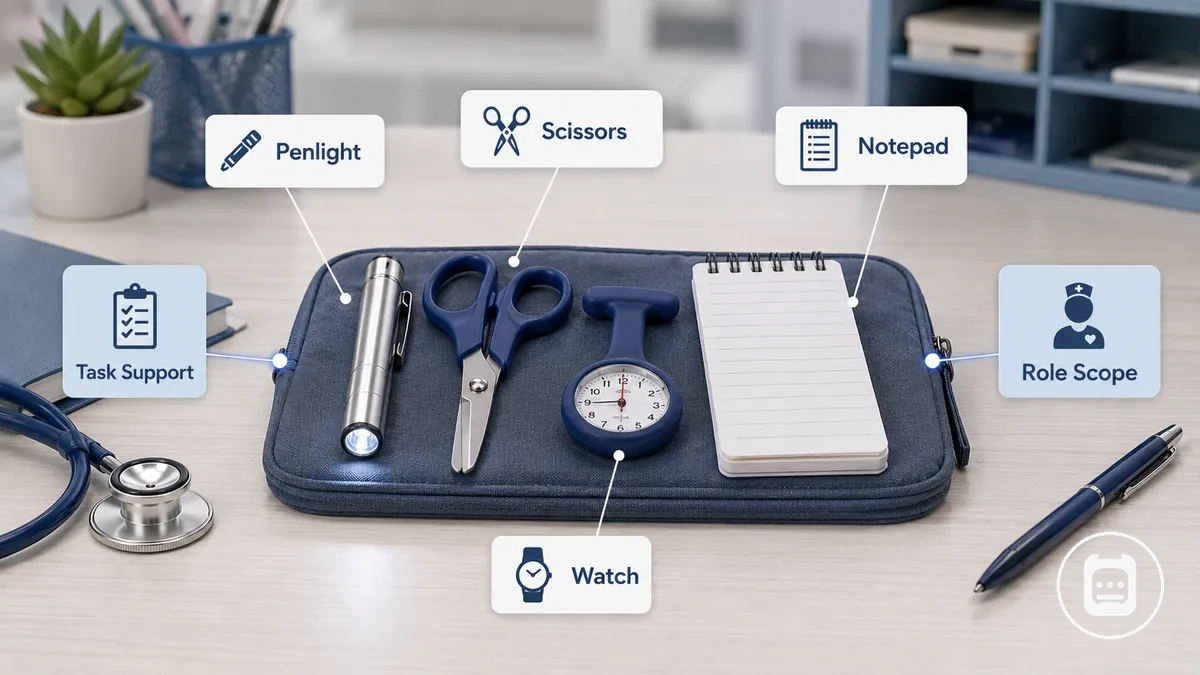
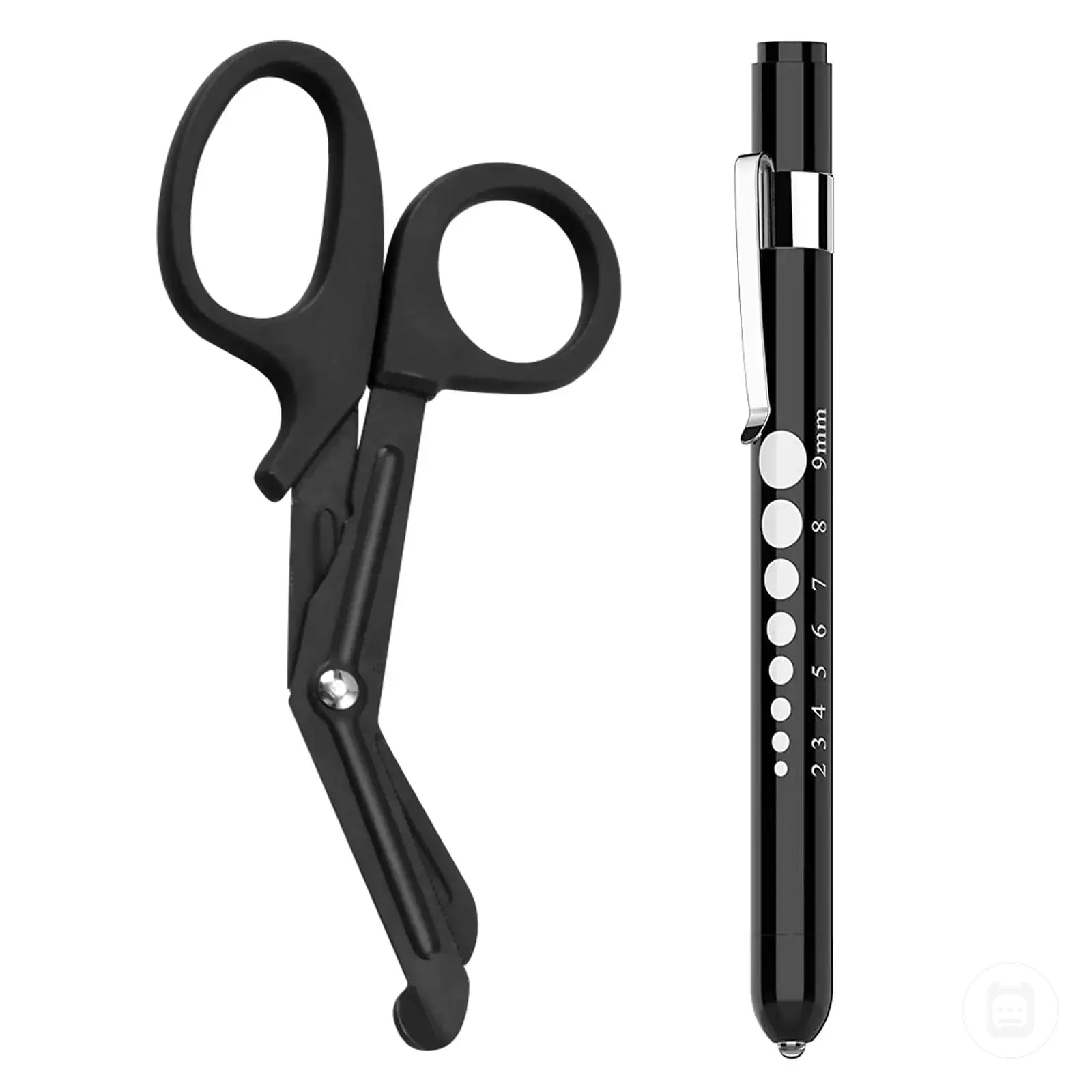
Clinical tools for quick patient-care tasks may include a penlight for visibility-related checks, scissors for handling work-related materials, a watch for time awareness, and a notepad for recording reminders or reference information. These quick-use tools can support organization and accessibility when they fit workplace expectations and assigned responsibilities. Tool selection and appropriateness depend on workplace rules, role scope, and the tasks permitted within a specific work setting.
Badge, watch, and quick-access identification accessories
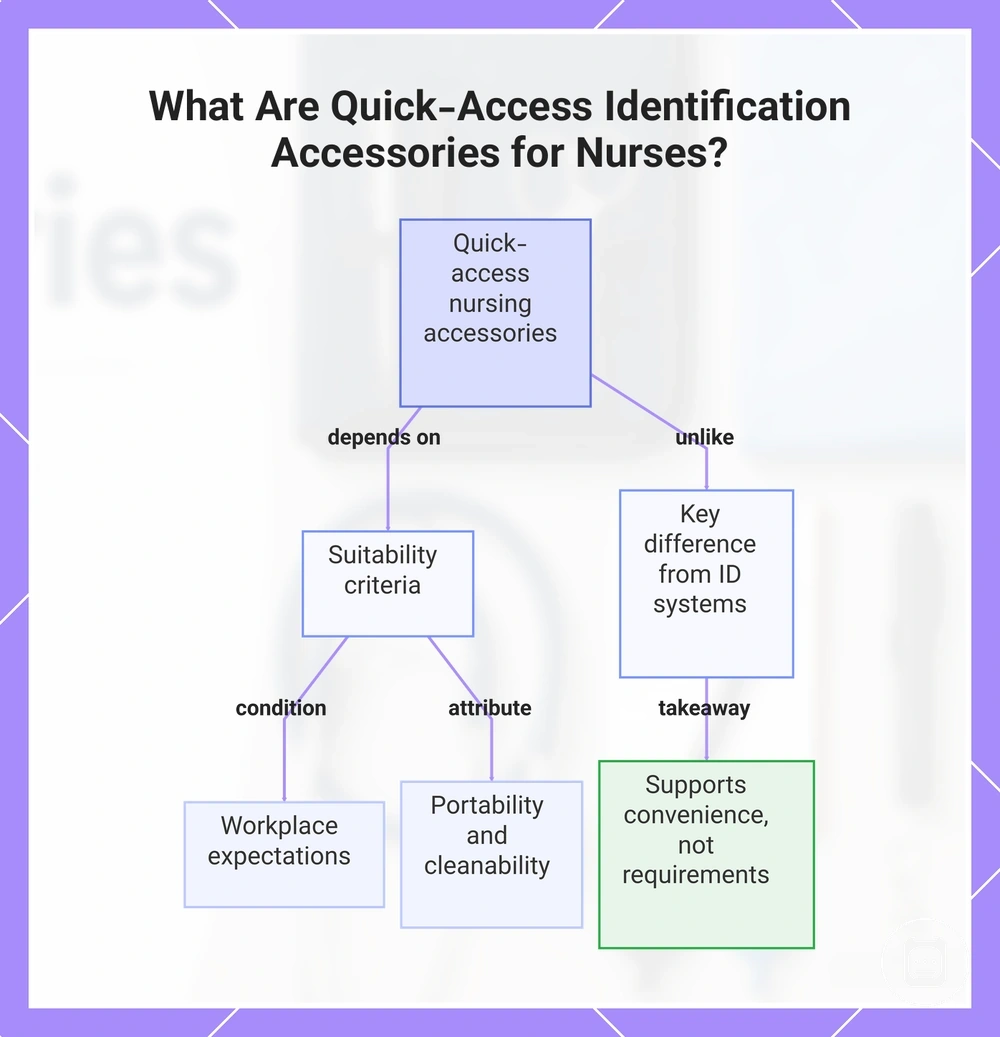
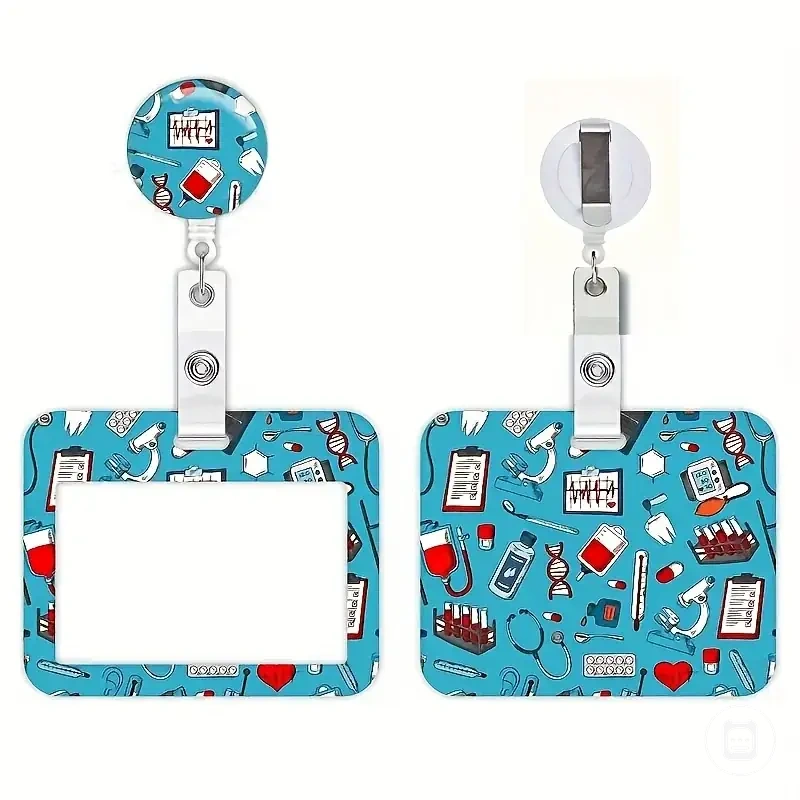
During repeated shift activities, nurses often use nursing accessories that keep identification visible and make time checks easier within the work context. Badge reels, holders, watches, and related shift accessories support quick access during daily use without requiring frequent handling or storage. Their suitability depends on workplace expectations, portability, cleanability, fit, and repeated wear conditions.
When comparing identification and quick-access accessories, practical checks usually focus on visibility, readability, wear condition, and everyday convenience.
- Badge reels and holders support display and access speed when identification needs to remain visible.
- Watches support time checks and may fit different work routines depending on workplace suitability.
- Lanyard-related items can help secure identification accessories when their use aligns with local workplace practices.
- Portability, cleanability, and fit may influence comfort and daily carry preferences during repeated use.
These work accessories differ from required identification systems because they primarily support convenience and accessibility rather than define identification requirements. Workplace rules, durability expectations, replacement needs, and role-specific preferences can affect which option is the most practical choice for a particular role.
This chart shows the main factors that determine suitability, practical checks, and the key difference between quick-access accessories and required identification systems.
Bags, pouches, and organizers for carrying shift items
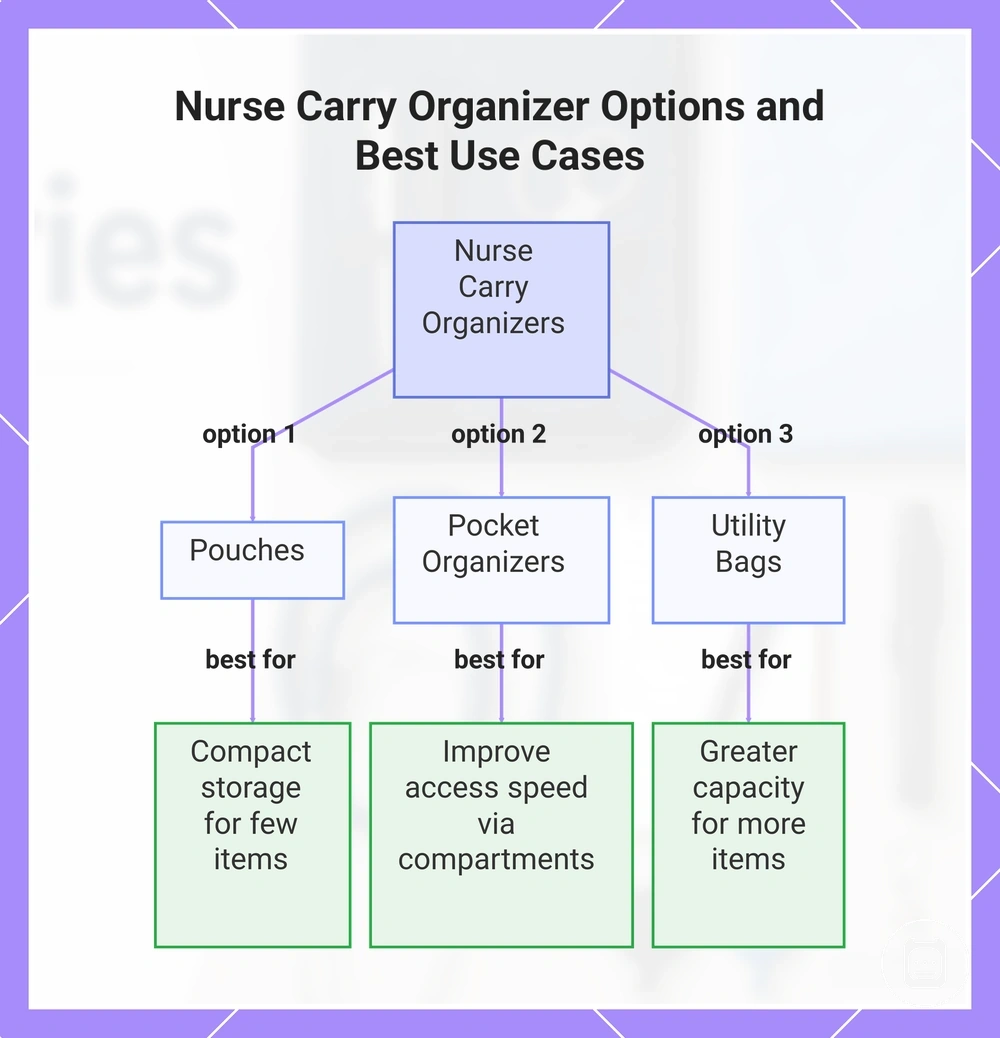
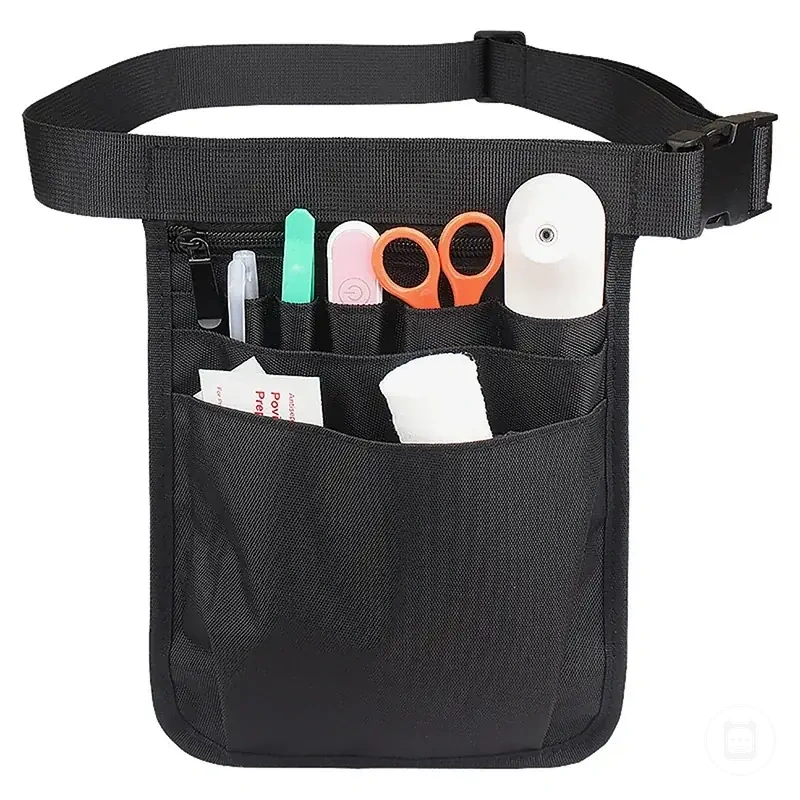
During a shift, nurses may use nursing accessories such as pouches, pocket organizers, and utility bags to keep small work items accessible without overloading pockets or larger bags. These carry-support accessories help organize storage and access needs within a work context while supporting daily use. Their suitability depends on portability, cleanability, fit, storage capacity, and how they align with role-specific needs.
When comparing organizer options, practical checks usually focus on storage layout, access speed, and cleaning practicality.
- Pouches can support compact storage when only a few frequently used items need to be carried.
- Pocket organizers can improve access speed by separating small items into dedicated compartments.
- Utility bags may provide greater capacity when a role requires more storage during daily carry.
- Compartment design, portability, and cleanability can influence fit, comfort, and repeated-use suitability.
Nurses who carry only a small number of work accessories may prefer a simpler organizer, while those managing more items may find a larger storage option more practical. For broader planning around nurse bag organization, storage needs often depend on workplace expectations, daily carry preferences, and the practical choice that fits a specific role.
This chart compares pouches, pocket organizers, and utility bags for nurses, highlighting their best use cases based on storage needs.
Comfort and personal-support accessories for long shifts
During longer work periods, nurses may use nursing accessories that support daily carry comfort, reduce minor friction from repeated use, or help maintain readiness throughout a shift. These comfort-focused work accessories are typically chosen for fit, portability, and ease of use within a work context rather than for guaranteed outcomes. Their suitability depends on shift length, personal preference, workplace expectations, and how well they fit daily use needs.
Comfort-support accessories often focus on practical use conditions rather than performance claims. Comfort aids, wearable supports, lightweight carry choices, and cleanable personal items may support repeated use when their fit and portability align with individual preferences. Cleanability and durability can also influence whether an item remains practical for ongoing daily use.
- Comfort aids may support long-shift readiness when fit and personal preference align.
- Wearable supports can vary in suitability based on workplace acceptance and repeated-use conditions.
- Lightweight carry choices may reduce friction during daily carry when portability is a priority.
- Cleanable personal items can remain more practical when regular maintenance fits workplace expectations.
Comfort value is not universal and may depend on body fit, uniform rules, role requirements, and personal preference. What feels practical for one nurse may differ from the needs of another nurse working in a different shift context.
Essential versus optional nursing accessories
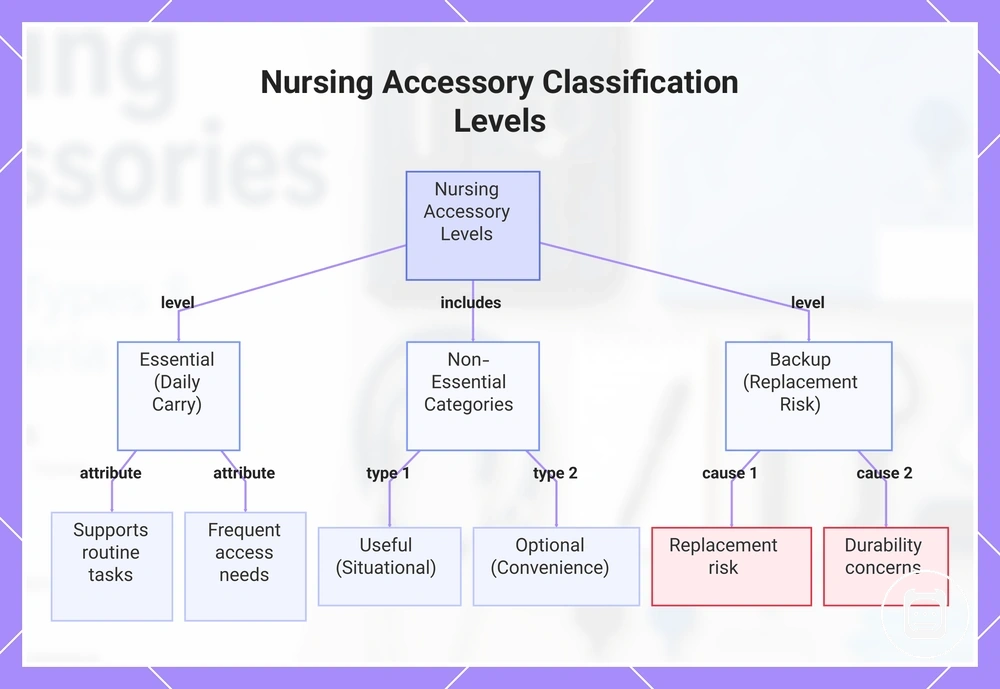
Essential versus optional nursing accessories depends on role responsibilities, workplace expectations, and how frequently an item is used during daily work. Accessories that support repeated tasks, reduce replacement risk, or remain necessary throughout a shift are often prioritized over convenience-focused items. The most practical choice depends on suitability, portability, cleanability, fit, and daily use within a specific work context.
The checklist below separates accessory levels using conditional selection logic rather than a single list for every nurse or workplace.
- Essential: Carried daily because the item supports routine work tasks, frequent access needs, hygiene considerations, or consistent role requirements.
- Useful: Kept available when certain shifts, departments, or workplace situations increase the need for the item.
- Optional: Chosen mainly for convenience, personal preference, or occasional use when suitability and workplace acceptance allow.
- Backup: Considered when replacement risk, durability concerns, or repeated use make a spare item practical.
Items used repeatedly during a shift are more likely to belong in a daily-carry setup, while lower-frequency accessories may be better kept as backups or skipped when they add little value in the work context. For a more focused essential nursing accessories checklist, selection should still reflect role requirements, portability needs, and workplace expectations.
Differences between experienced nurses and those exploring nursing student accessories can also affect what qualifies as essential or optional. Daily use patterns, workplace policies, and practical fit often determine whether an accessory should be carried regularly, kept in reserve, or omitted.
This chart categorizes nursing accessories into essential, useful, optional, and backup levels based on usage frequency, situational need, convenience, and replacement risk.
Buying criteria that affect usefulness, fit, and workplace suitability
Buying criteria that affect usefulness, fit, and workplace suitability depend on how nursing accessories perform within a specific work context rather than on broad recommendations. Nurses often evaluate whether an accessory supports daily use, aligns with workplace expectations, and remains practical through repeated use. The most useful choice depends on suitability, portability, cleanability, fit, and role-specific requirements.
The criteria below provide a broader decision frame for comparing nursing accessories across different shift environments and workplace settings.
| Criterion | What to check | Why it matters |
|---|---|---|
| Durability | Resistance to repeated use and replacement frequency | May influence long-term practicality and replacement needs |
| Cleanability | Ease of routine cleaning and maintenance | Can affect suitability for repeated daily use |
| Fit | Compatibility with carrying preferences and work routines | May influence comfort and usability during a shift |
| Portability | Weight, size, and ease of daily carry | Can affect accessibility and convenience |
| Storage | Capacity and organization features | May support efficient item management |
| Access speed | Ease of reaching frequently used items | Can improve practical use during routine tasks |
| Workplace policy | Acceptance within local workplace expectations | May determine overall suitability |
| Value | Balance between usefulness and expected use frequency | Can help guide practical selection decisions |
The same accessory may be suitable in one shift context and less suitable in another depending on storage needs, portability requirements, or workplace policy. Readers looking for a more detailed framework on how to choose nursing accessories can apply these criteria through role requirements and daily use patterns.
These factors work together rather than independently, which is why no single criterion determines suitability on its own. For broader comparison guidance, nursing accessories buying criteria can be evaluated through practical choice, repeated use conditions, and workplace fit.
Durability, cleanability, and repeated-shift use
Durability, cleanability, and repeated-shift use depend on how nursing accessories handle routine carrying, handling, and storage within a work context. Material, closure, clip, surface, and washable design can affect whether an accessory remains suitable for daily use over time. The most practical choice depends on how these attributes align with expected use frequency, replacement considerations, and workplace demands.
The checklist below helps verify visible criteria that may influence repeated-use suitability.
- Material: A material that withstands frequent handling may remain more suitable for repeated use.
- Closure: A closure that wears slowly may help maintain consistent storage function.
- Clip: A clip that stays secure during daily carry may reduce replacement concerns.
- Surface: A surface that cleans easily may remain more practical under repeated-shift conditions.
- Washable design: A washable design may improve maintenance practicality when routine cleaning is needed.
- Use frequency: Accessories used throughout most shifts may require greater attention to durability and maintenance than occasional-use items.
An accessory may appear durable because of a rigid material or heavy construction yet still be less suitable if its surface, closure, or attached parts are difficult to clean or replace. In these cases, repeated-shift practicality depends on the balance between wear resistance and maintenance demands rather than appearance alone.
Portability, access speed, and storage limits
Portability, access speed, and storage limits determine whether nursing accessories fit a nurse’s actual carry setup during daily use. Size, weight, compartment count, and access frequency can affect suitability because an accessory that fits one work context may be less practical in another. Compatibility depends on how well the accessory load matches available carry space, shift movement, and workplace conditions.
The comparison below clarifies how different carry formats may support different access and storage conditions.
| Carry setup | What fits | Primary limitation |
|---|---|---|
| Pocket carry | Smaller nursing accessories with frequent access needs | Pocket space may limit size, weight, and item count |
| Pouch carry | Accessories that benefit from separated compartments | Pouch capacity may affect access speed when storage becomes crowded |
| Bag carry | Items used less frequently or requiring more storage space | Bag storage may slow access when items are needed during movement |
When nurses have limited uniform pockets or strict storage rules, suitability may depend on carrying only the accessories that support frequent daily use. A larger carry setup does not necessarily provide a better fit because access frequency, available storage, and work context often determine practical compatibility.
Comfort, fit, and policy-safe wearability
Comfort, fit, and policy-safe wearability depend on whether nursing accessories attach securely and remain suitable for daily use within a specific work context. Wear condition, attachment method, and placement can affect how well nursing accessories fit a nurse’s role without restricting movement or access. Suitability depends on the balance between practical wearability, workplace acceptance, and individual fit.
The checklist below organizes common fit and policy-aware wearability checks for accessories carried on the body, uniform, badge area, or pockets.
- Lanyard: A lanyard that attaches securely may support accessibility, but suitability can depend on workplace conditions and how it moves during a shift.
- Badge item: A badge item that fits the designated badge area may support daily use when visibility and attachment remain practical.
- Wearable organizer: A wearable organizer that fits available pocket or uniform space may support access without adding unnecessary restriction.
- Watch: A watch that fits comfortably and remains easy to wear may support routine time checks during repeated use.
- Comfort accessory: A comfort-focused accessory may improve wearability when fit, portability, cleanability, and workplace suitability align.
Personal preference can influence comfort and fit, but facility-approved use may still determine whether a particular accessory is suitable in a workplace setting. An accessory that feels comfortable for one nurse may not be appropriate in another work context if local wearability expectations differ.
Accessory kits versus individual nursing accessories
Accessory kits versus individual nursing accessories depends on whether convenience or selection control is the higher priority in a nurse’s work context. A bundled accessory kit may simplify initial setup by grouping multiple nursing accessories together, while individual accessory selection may provide greater control over fit, portability, cleanability, and daily use suitability. The more suitable buying path depends on role needs, workplace expectations, and how many accessories are already available.
The comparison below highlights the main criteria that distinguish bundled kits from individual item selection.
| Criterion | Accessory kit | Individual accessory |
|---|---|---|
| Convenience | May reduce setup time by grouping multiple items | Requires separate item selection |
| Control | May limit choice over included contents | Allows selection based on role fit and daily use needs |
| Duplication risk | May include items already owned or used infrequently | Can reduce duplication when replacing specific accessories |
| Quality variation | Suitability may vary across included accessories | Each accessory can be evaluated separately for fit and use |
| Replacement flexibility | Replacing one worn item may leave other included items unused | Supports targeted replacement when only one item needs updating |
Accessory kits may fit beginners, students, or nurses entering a new workplace when a broader starting set helps identify which nursing accessories support repeated daily use. Individual selection may be more suitable when replacing a worn item, refining a daily carry setup, or choosing accessories that better match a specific role. Neither path is universally better because suitability depends on item usefulness, workplace fit, and long-term daily use needs.
When a nurse accessories kit is practical
A nurse accessories kit is often practical when nurses need a starting collection of nursing accessories and do not yet know which items will support daily use in their work context. A kit may help cover common accessory needs while reducing the effort of selecting each item individually. Its suitability depends on role fit, existing accessories, replacement expectations, and whether the included items match workplace needs.
The checklist below highlights conditions that may make a kit a practical choice.
- A kit may help when basic nursing accessories are missing and a starting setup is needed.
- A kit can be useful when backup items are preferred for repeated use or replacement planning.
- A kit may fit better when included items match the nurse's role, portability needs, cleanability expectations, and daily carry preferences.
- A kit may be less suitable when existing accessories already cover many included items, creating overlap or duplication.
- Item fit, durability, cleanability, and usefulness may vary across included accessories and should be evaluated individually.
For example, a student entering a new workplace or clinical setting may find a kit practical when it helps identify which accessories support repeated daily use and which items are rarely needed. As work routines become clearer, individual replacement choices may provide a closer match to long-term suitability and daily use requirements.
When individual accessories give better control
When individual accessories give better control depends on whether nurses already know which nursing accessories fit their role, work context, and daily use needs. Choosing individual accessories may provide greater control over fit, portability, cleanability, and replacement priorities because each item can be selected according to a specific requirement. This approach is often more suitable when a known need already exists and item-level selection is the main decision factor.
The checklist below highlights situations where individual selection may be the more suitable choice.
- Fit requirements are already known and need to match personal or workplace preferences.
- Material, cleanability, or durability attributes are important for repeated daily use.
- A replacement item is needed without adding accessories that may not be used.
- Existing nursing accessories already cover most basic needs, helping avoid duplicate items.
- Higher-priority accessories need to be selected based on role fit and practical daily carry requirements.
For example, when a nurse needs to replace a worn accessory or customize part of a daily carry setup, individual selection may provide more control than a bundled set. The advantage comes from choosing for a known need rather than adding accessories that may not match current workplace requirements.
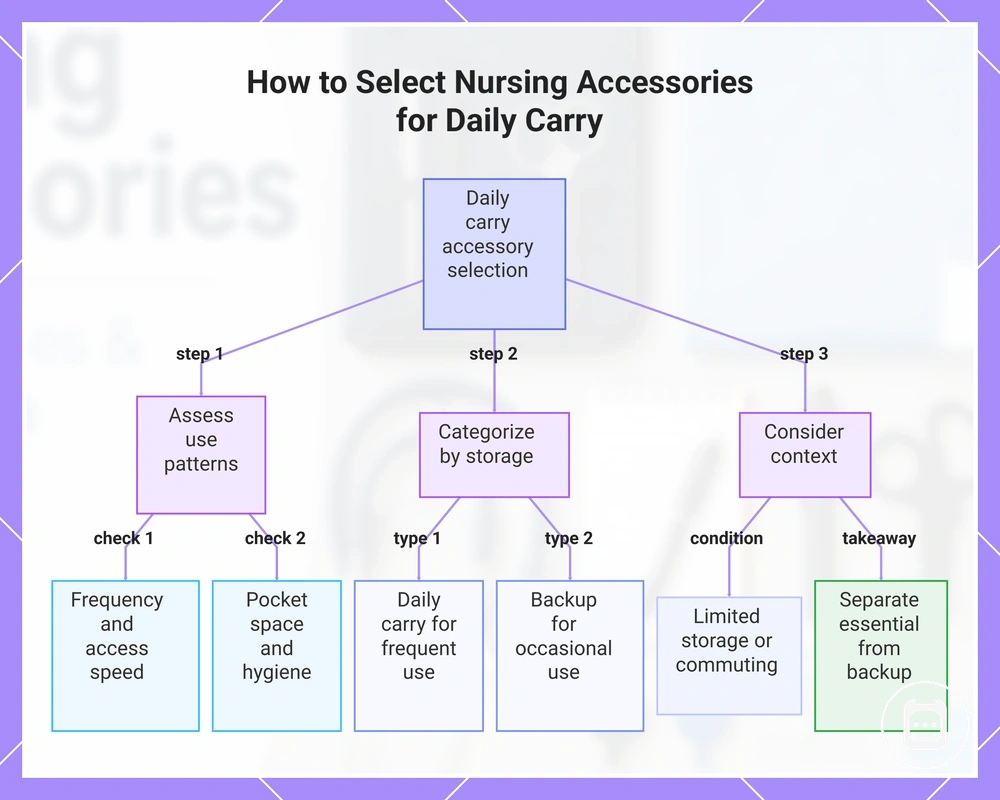
Using nursing accessories without overloading daily carry
During long shifts, commuting periods, or workdays with limited storage space, nurses often benefit from carrying only the nursing accessories they are likely to use repeatedly. Keeping daily carry focused on access speed, portability, cleanability, and fit can help reduce clutter while maintaining suitability for the work context. The practical choice depends on how often an item is used, how quickly it must be accessed, and where it can be stored.
Separating frequently used items from backup storage can improve organization without increasing carrying burden. For nurses evaluating nursing accessories for work, daily use patterns, pocket space, hygiene needs, comfort, and the risk of losing small items often influence what belongs in immediate reach and what can remain stored elsewhere.
- Daily carry: Items used frequently during a shift and requiring quick access.
- Backup storage: Items needed occasionally for replacement, repeated use, or longer shifts.
- Rarely used items: Accessories that are kept available but do not usually justify pocket or daily carry space.
- Limited storage environments: Fewer carried items may improve comfort, portability, and access speed when workplace storage options are restricted.
- Commuting and long shifts: Carry needs may change when nurses balance workplace access requirements with comfort and storage limitations.
An accessory can be useful without needing a place in daily carry. When pocket space is limited or facility-specific storage policies affect what can be carried, suitability often depends on keeping essential access needs separate from backup and low-frequency items.
This chart shows the key steps and categories for deciding which nursing accessories to carry daily versus storing as backup.
Price and value signals before checking nursing accessory options
Price signals are most useful after usefulness, fit, durability, cleanability, and workplace suitability have been evaluated. A higher cost does not automatically indicate greater value, and a lower cost does not always support long-term use. Value depends on whether a nursing accessory matches practical needs, repeated use conditions, and fit within the work context.
The value table below focuses on decision signals rather than products, prices, or merchants. These signals can help identify practical value while reducing the risk of false economy.
| Value signal | What to check | Risk if ignored | Decision effect |
|---|---|---|---|
| Usefulness | How often the accessory supports daily use | Paying for features that are rarely needed | Affects practical value |
| Fit | Compatibility with role and workplace needs | Reduced suitability despite higher cost | May justify added cost when fit improves use |
| Durability | Expected resistance to repeated use | Higher replacement likelihood | Can influence long-term value |
| Cleanability | Ease of routine maintenance | Reduced practicality during repeated use | May affect ongoing suitability |
| Bundle efficiency | Whether included items match practical need | Duplicate items and unused accessories | Affects overall value assessment |
Reusable accessories may offer stronger long-term value when durability, cleanability, and repeated use align with daily requirements. Disposable or short-life items may increase replacement likelihood when used frequently. Value often depends on how long an accessory remains useful rather than on initial price orientation.
Paying more may be justified when improved fit, durability, or cleanability supports a specific workplace need. A basic item may be enough when use frequency is low, replacement demands are limited, and additional features provide little practical benefit. Cost-value decisions depend on matching the accessory to actual use conditions.
Once usefulness, fit, workplace suitability, replacement likelihood, and bundle efficiency have been reviewed, price signals become easier to interpret. This sequence helps focus attention on practical value before comparing accessory options.
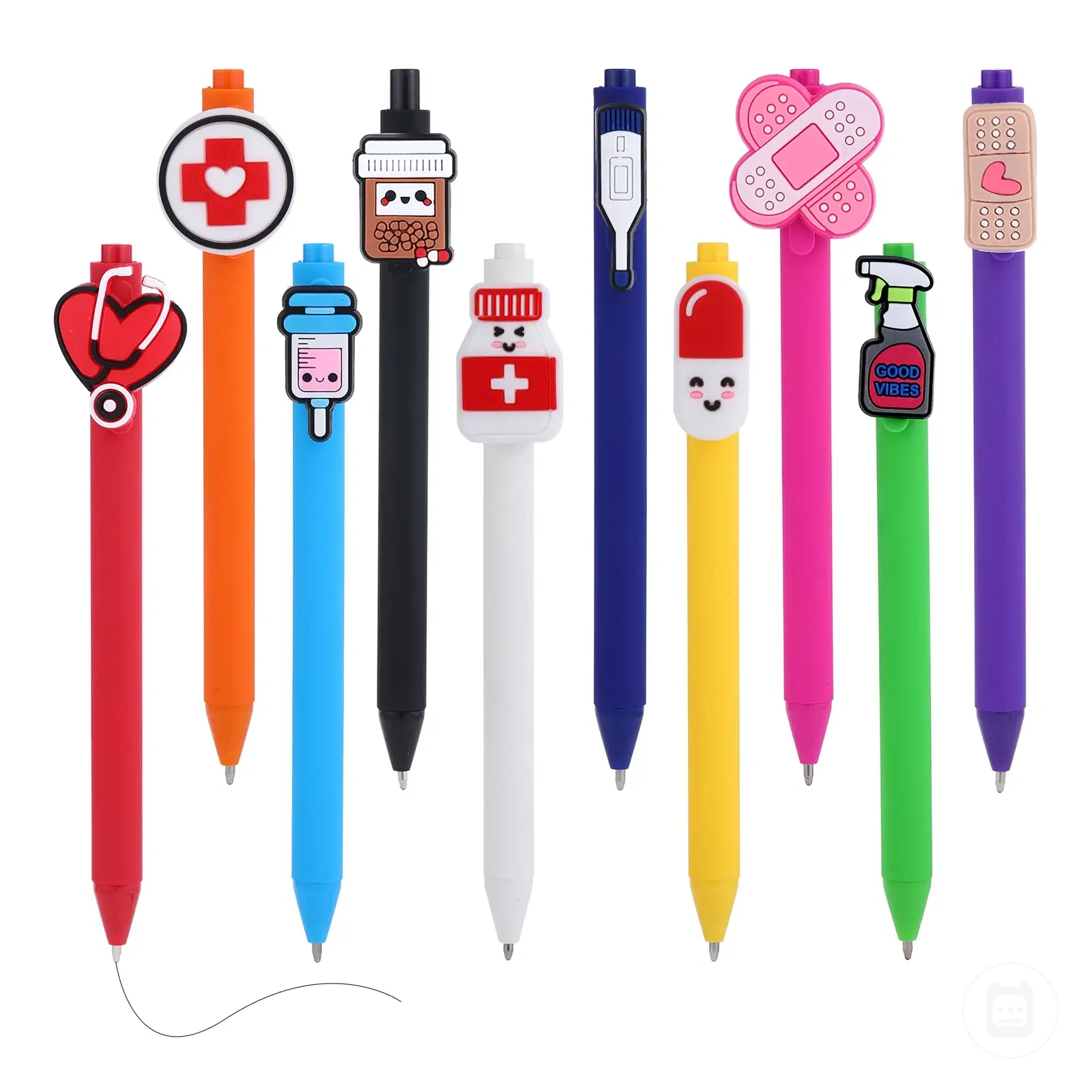
Here are product examples that may make comparison easier. Before buying, always review the compatibility criteria, essential features, and product details.

Nursing accessory paths for work, students, organization, and buying decisions
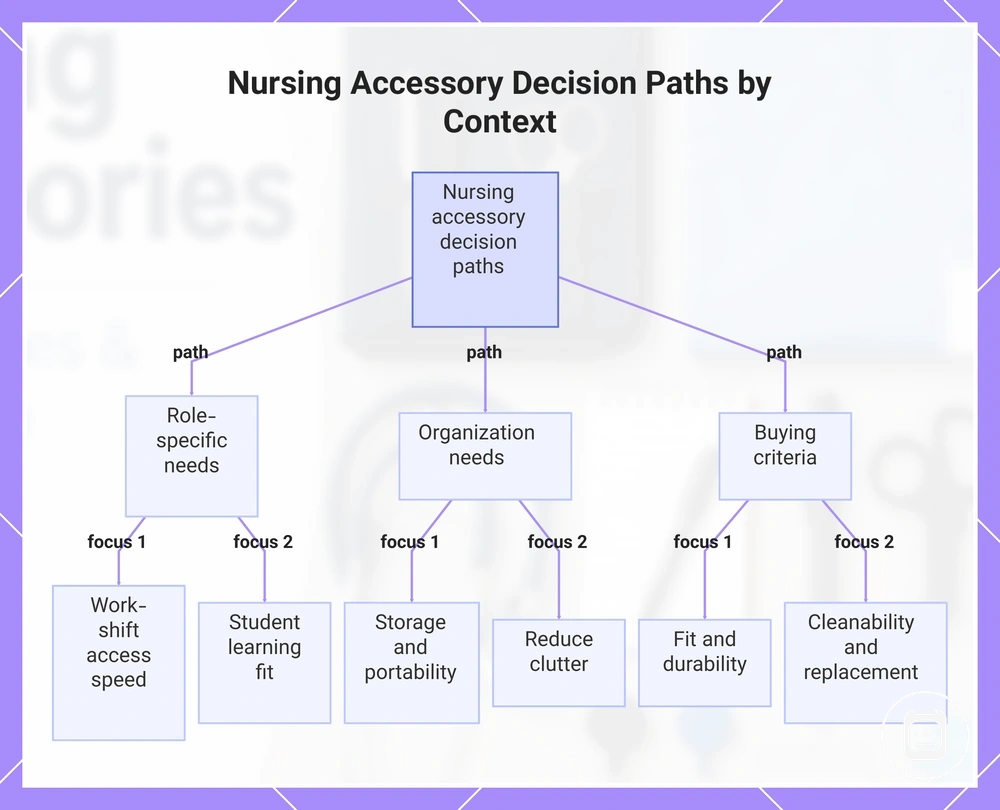
Nursing accessories connect to different decision paths based on role requirements, workplace expectations, and daily use needs. Work-shift needs, student needs, organization needs, and buying-criteria needs all relate to the same central entity while focusing on different aspects of suitability. The most relevant path depends on how nursing accessories fit the nurse's work context, portability needs, cleanability expectations, and practical fit requirements.
These decision paths remain connected but address different priorities.
- Work-shift needs: Focus on access speed, daily carry, repeated use, and workplace suitability.
- Student needs: Narrow attention toward learning environments, early-use priorities, and practical fit.
- Organization needs: Emphasize storage, portability, access speed, and reducing clutter during daily use.
- Buying-criteria needs: Support practical choice through fit, durability, cleanability, replacement likelihood, and overall suitability.
Although these paths differ, nursing accessories remain the shared subject across each context. A work context may place greater importance on repeated use and workplace fit, while another situation may emphasize storage, comfort, portability, or practical choice considerations. Keeping these paths distinct helps nurses evaluate suitability without treating every role or workplace as having the same requirements.
This chart shows how nursing accessory decision paths split into role-specific, organizational, and buying-criteria needs, each with distinct focus areas.