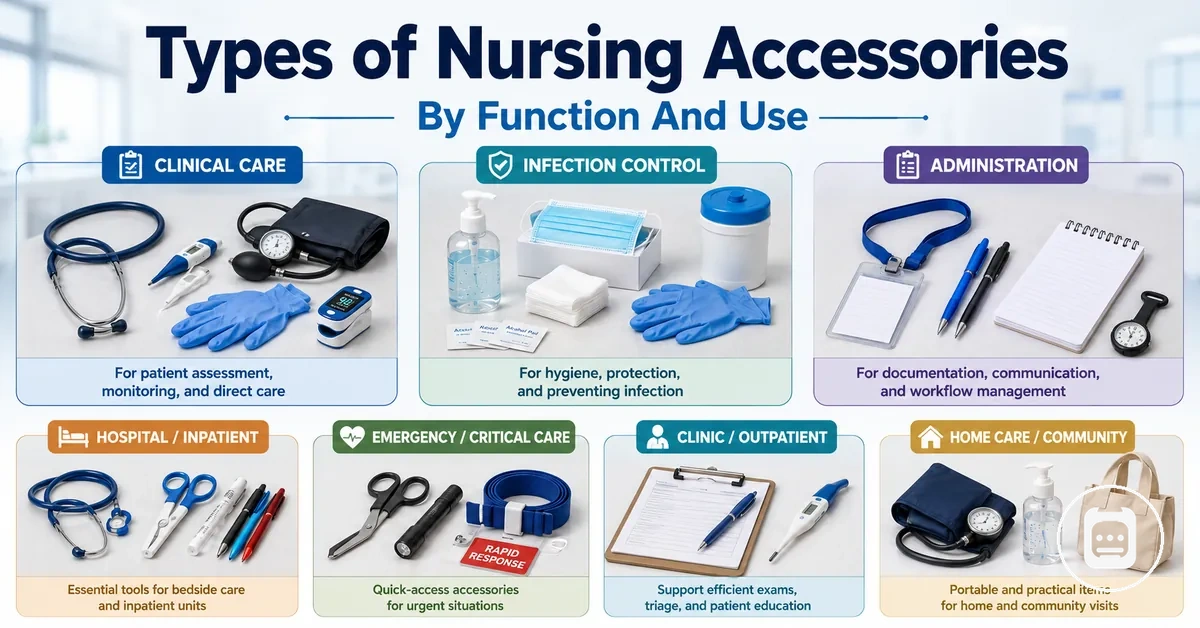
Nursing accessory types by function and workplace use
Nursing accessory types are function-based support items that help organize, identify, carry, access, and manage the tools used during nursing work. Rather than being grouped by brand, model, or purchase category, nursing accessories are classified by the role they perform in daily tasks and shift routines. This approach helps differentiate accessory types according to how they support workflow, documentation, comfort, and shift readiness. Function and workplace use provide the main framework for understanding nursing accessories.
Nursing accessories commonly appear in recurring accessory families such as badge accessories, penlight tools, scissors, clipboard-related items, organizer pouch systems, storage solutions, bags, caps, and comfort-focused work accessories. Each family represents a different type of support, whether for identification, visibility, attachment, quick checks, organization, or task support. For broader context, the nursing accessories overview explains how these categories fit within the wider nursing accessory landscape. These families represent accessory types rather than product rankings or selection criteria.
Function groups become more useful when they are connected to workplace conditions. A penlight may support quick check activities when immediate access and readiness matter, while an organizer pouch may support storage, carry, and retrieval during busy shifts. Other accessory types may relate to documentation through a clipboard, identification through badge accessories, or comfort during long shifts. Understanding how function connects to workplace use provides the foundation for the sections that follow.
The relevance of a specific accessory type can vary by role, facility rules, workplace requirements, and personal workflow. An item that supports one nursing environment may have a different level of usefulness in another. Nursing accessory types are therefore best understood as functional categories that support workplace use rather than as a universal set of items required by every nurse.
What makes an item a nursing accessory type
A nursing accessory type is a functional category of support items used around nursing work rather than a single product or purchase category. The classification focuses on how an item supports tasks, workplace use, portability, attachment method, or organization during daily activities. A nursing accessory type may include items that improve access, identification, carry convenience, or task support without defining a specific brand or model. Function is the primary basis for classification.
A nursing accessory type differs from a tool, supply, or essential item because the classification is based on function rather than necessity. A tool may perform a direct clinical task, and a supply may be consumed or replaced during care activities, while an accessory often supports how work is organized, carried, or managed. Whether a specific item is treated as an accessory can depend on workplace use and purpose, especially when the same item serves different roles in different settings. This distinction creates a practical boundary between accessory categories and general workplace supplies.
What makes an item a nursing accessory type becomes easier to understand when function and workplace use are considered together. The image below clarifies the difference between function-based accessories and general supplies by showing support items grouped according to their role in nursing work.
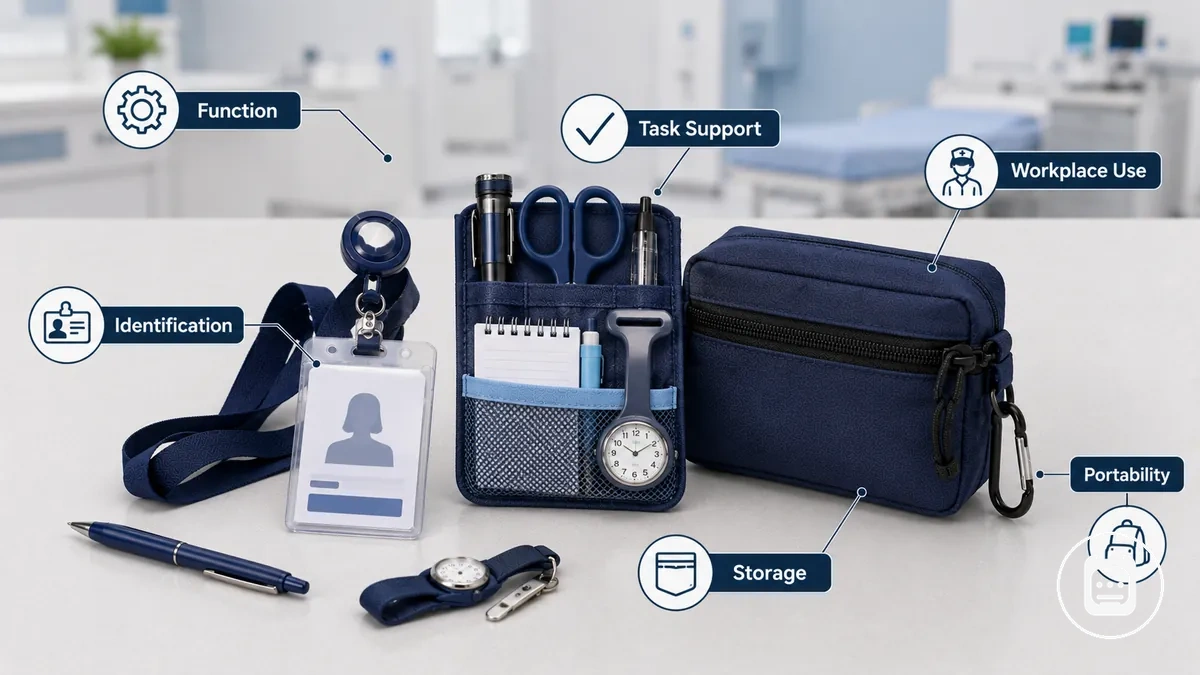
For example, an item used for identification, a portable nursing tool carried for quick access, or a storage accessory that supports retrieval may belong to an accessory category because its primary purpose is task support. Whether a nurse accessory fits a particular category depends on the function it serves within the workplace rather than on the item alone.
Main functional groups of nursing accessories
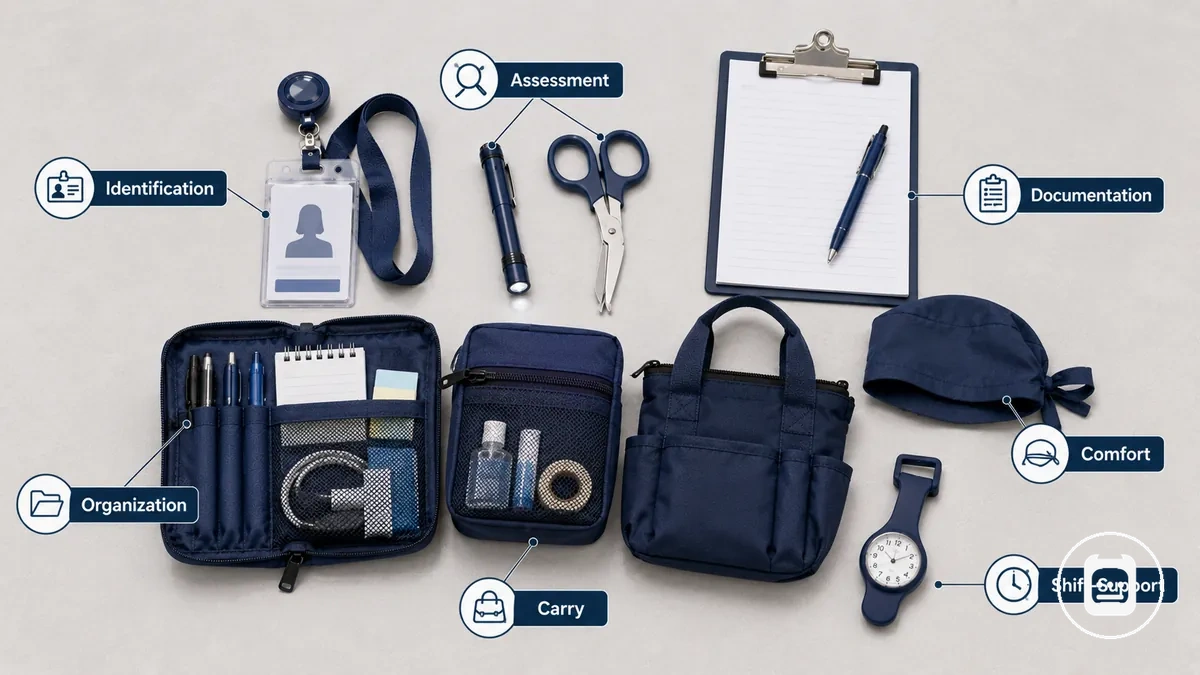
Functional groups organize nursing accessories according to what they help a nurse accomplish during work activities. Instead of grouping items by product style, functional groups connect accessory examples to workplace roles such as identification, assessment, cutting, writing, documentation, organization, storage, carry, comfort, and shift-support. This classification highlights practical outcomes and use conditions rather than product variation. These groups should be understood by function rather than popularity.
Main functional groups of nursing accessories can be organized into a simple map of workplace use and task support. The image below visually organizes the same groups by function and typical workplace role before the table summarizes the classification.
| Functional group | Common accessory examples | Main use | Workplace suitability note |
|---|---|---|---|
| Identification | Badge holder, badge reel | Support visibility and attachment of identification items | May be useful where identification display is required |
| Assessment | Penlight | Support quick checks and readiness | Usefulness depends on workplace tasks and responsibilities |
| Cutting | Scissors | Support routine cutting tasks | Facility rules may influence suitability |
| Writing and documentation | Pens, clipboard | Record and organize information | May vary with workplace documentation methods |
| Organization | Organizer pouch | Improve access and task organization | Can support retrieval during busy shifts |
| Storage | Storage pouch, utility organizer | Keep work items together | Suitability depends on workflow and carry preferences |
| Carry | Work bag, carry organizer | Transport nursing tools and accessories | May be more relevant in mobile work settings |
| Comfort | Scrub cap, compression accessories | Support comfort during long shifts | Usefulness varies by workplace conditions and personal preference |
| Shift-support | Workflow support accessories | Support readiness and daily convenience | Relevance depends on role and shift demands |
These functional groups provide a classification framework rather than a required item list. For checklist-level coverage of commonly used items, see the essential accessory checklist. Workplace requirements and personal workflow can influence which groups are most relevant in a specific setting.
Identification and badge accessories
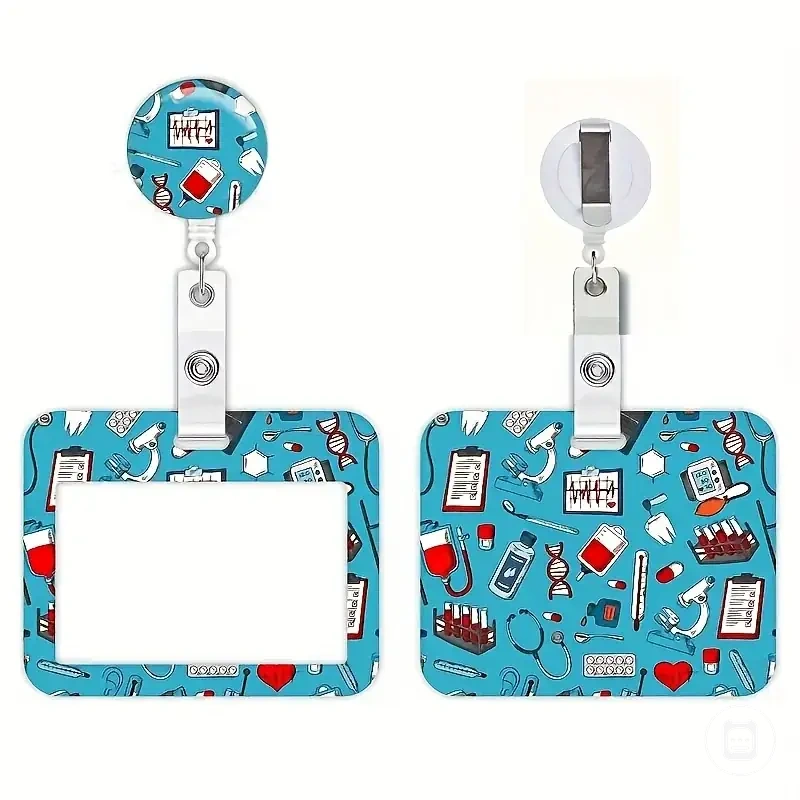
Badge accessories support visibility, identification, and convenient access to an ID badge during daily work activities. These accessories attach, display, or retain an ID badge in different ways, and the most suitable attachment style can depend on workplace rules, clothing design, and shift use. Their primary function is maintaining clear identification and practical badge visibility.
Identification and badge accessories differ mainly by attachment style and how they display an ID badge during use. The image below highlights common attachment points and visibility differences among badge-related accessories.
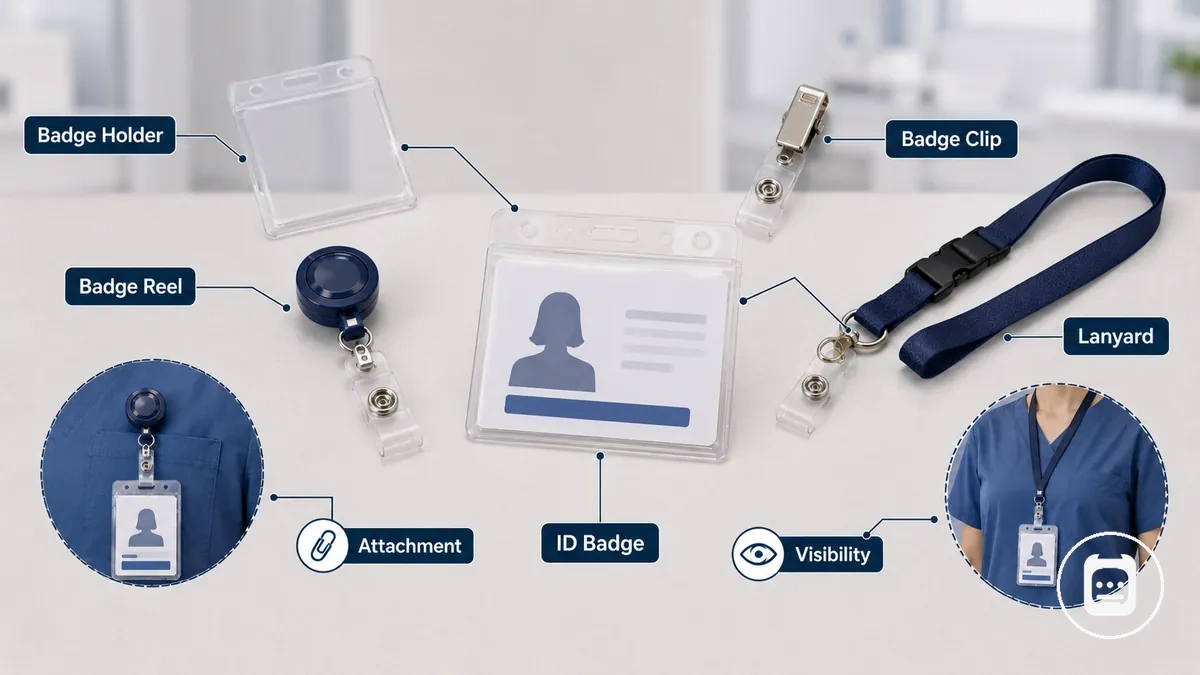
- Badge holder: Supports and displays an ID badge while attaching to clothing, a pocket, or another badge attachment, helping maintain visibility during shift use.
- Badge reel: Uses a retractable attachment style that can support repeated badge access while retaining the ID badge close to the user. Durability needs may vary with frequency of use.
- Badge clip: Attaches directly to clothing and may be suitable when a simple attachment style is preferred or required by workplace conditions.
- Lanyard: Supports an ID holder through a neck-worn attachment and can provide a different visibility position depending on workplace rules and personal comfort preferences.
Assessment and quick-check clinical tools
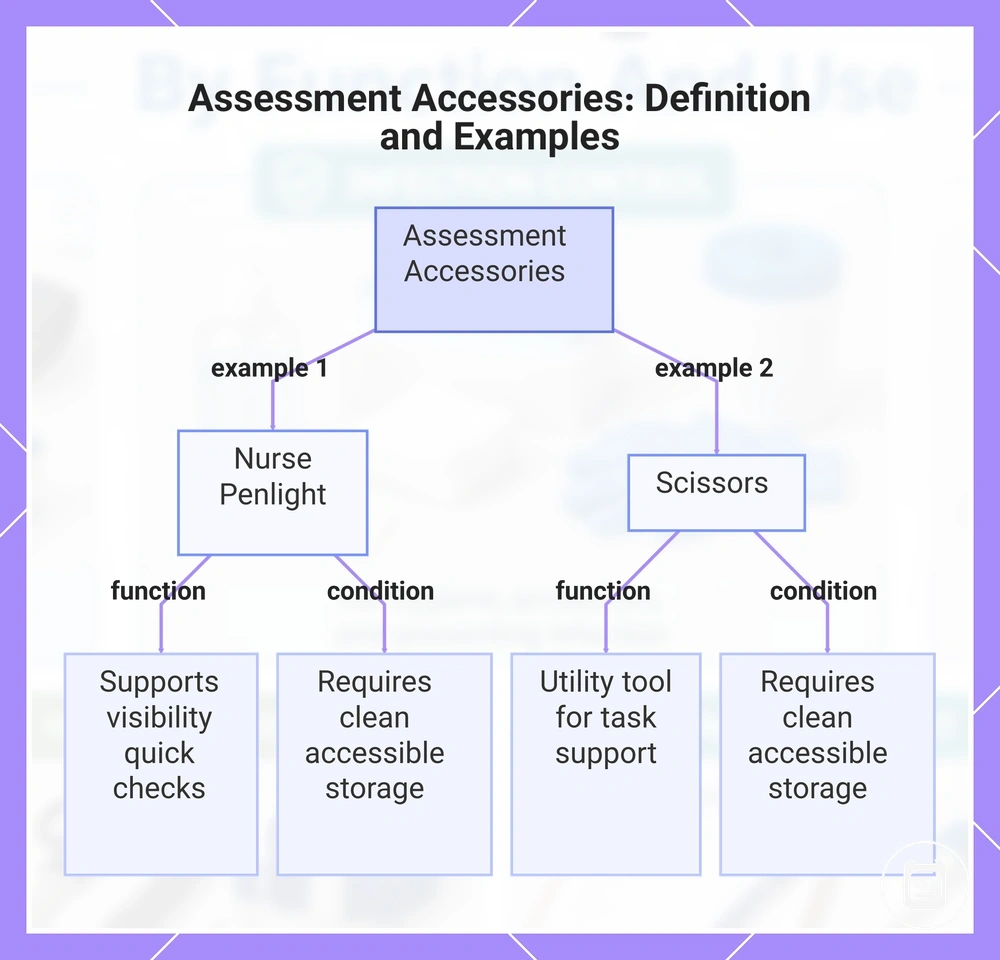
Assessment accessories are quick-use support tools that help maintain task readiness during routine nursing work. Items such as a nurse penlight or scissors can provide convenient access for brief workplace tasks when kept within reach and stored appropriately. Their role is clinical support at the accessory level rather than clinical procedure.
Assessment-related accessories often depend on access, cleanliness, and readiness during repeated use. A nurse penlight may support visibility-related quick checks, while scissors can serve as a utility tool for task support. Hygiene considerations may influence storage practices and continued suitability, but this section explains accessory function only and does not provide diagnosis, treatment, or medical advice.
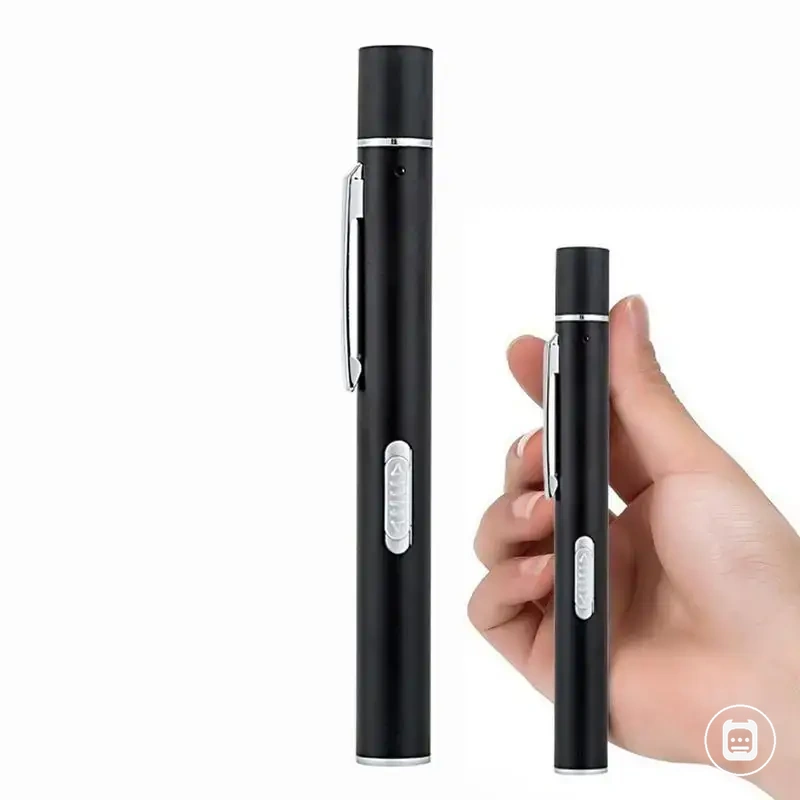
- Nurse penlight: A quick-check tool that supports visibility-related tasks and may help task readiness when accessible and stored on a clean surface.
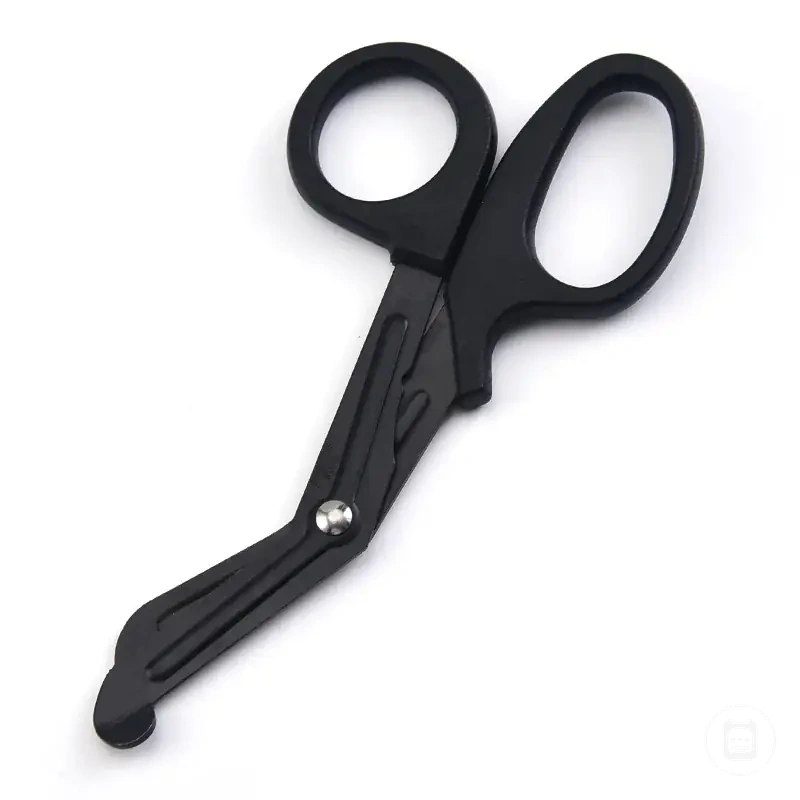
- Scissors: A utility tool that supports task readiness and may require clean storage to maintain accessibility and hygiene during repeated use.
This chart shows the definition of assessment accessories and their two common examples, along with their functions and storage conditions.
Cutting, writing, and documentation tools
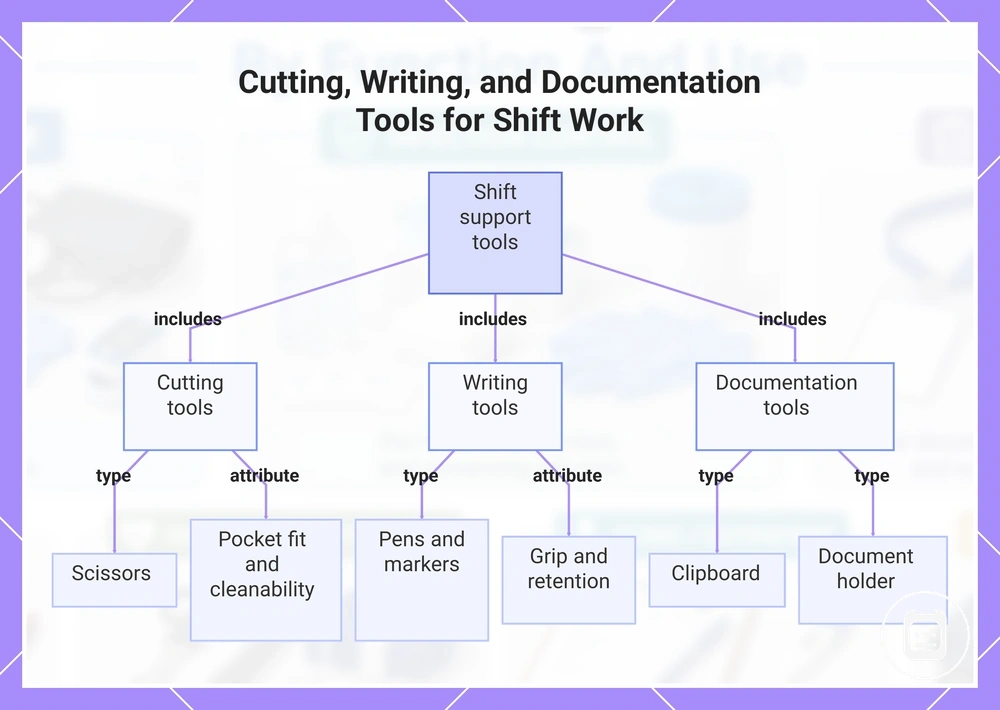
During shifts, cutting, writing, and documentation tools support routine tasks that depend on quick handling and convenient access. Scissors support cutting functions, pens and markers support writing, and a clipboard or document holder supports holding papers when needed. These documentation tools share a common role of supporting simple task organization and item retention during work.
Scissors, writing tools, and documentation accessories differ mainly by grip, pocket fit, cleanability, and retention. Suitability may vary by workplace context, but practical handling attributes often influence how easily an item can be carried, used repeatedly, and returned to storage.
- Scissors: Support cutting tasks, with pocket fit and cleanability affecting practical use during shifts.
- Pens and markers: Support writing tasks, with grip and retention helping keep writing tools available when needed.
- Clipboard: Supports documentation by holding papers, with access and handling comfort depending on workplace conditions.
- Document holder: Helps retain small papers or notes while keeping documentation items together and accessible.
This chart shows the three main categories of support tools used during shifts and their key practical attributes.
Organization, storage, and carry accessories
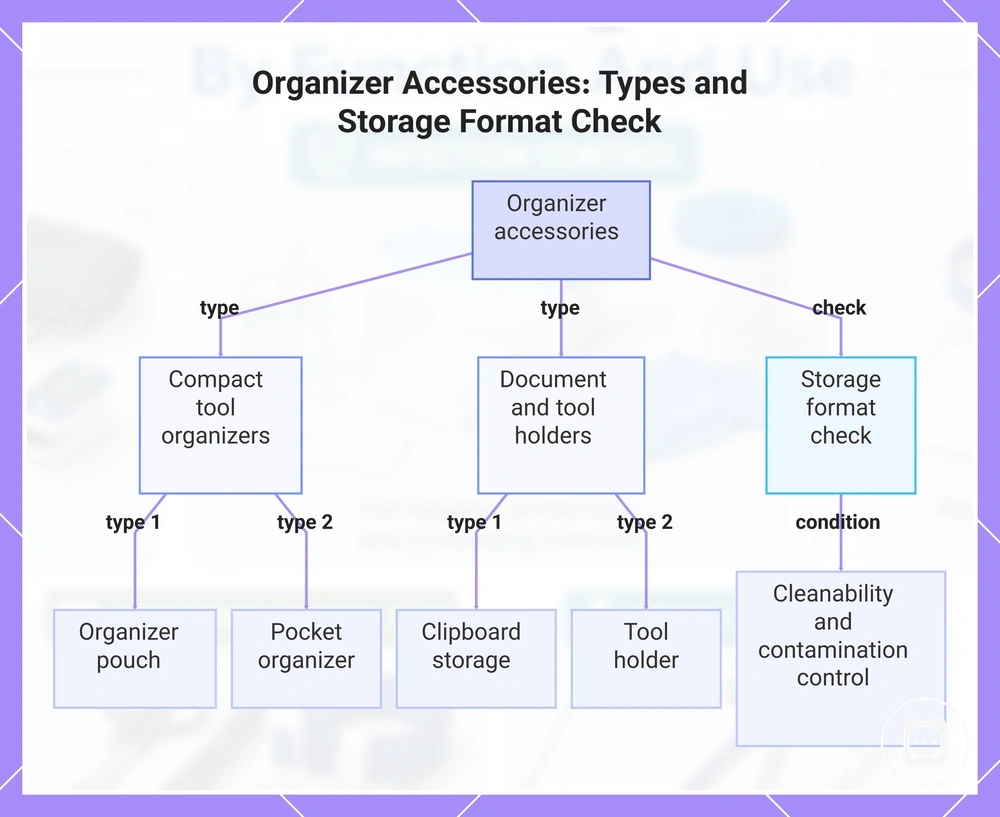
Organizer accessories are storage and carry items that keep smaller nursing tools accessible and separated during work. A pouch, pocket organizer, clipboard storage option, or tool holder uses a different storage format and carry position, but all support accessibility and separation as their primary functions. Capacity and workplace suitability may vary depending on what is carried and the conditions of use.
- ✓ Organizer pouch: Stores multiple small tools in a compact format and supports carry through a pocket, belt, or similar position, with access depending on layout and capacity.
- ✓ Pocket organizer: Separates small tools into dedicated sections and supports reachability within a pocket-based carry position.
- ✓ Clipboard storage: Holds papers or small documentation items while combining document access with limited storage capacity.
- ✓ Tool holder: Retains frequently used tools in a fixed carry position and makes individual items more accessible during routine tasks.
- ✓ Storage format check: Cleanability and contamination-control considerations may depend on material, workplace rules, and the items stored inside.
This chart shows the main types of organizer accessories and a storage format check for cleanability and contamination control.
Wearable comfort and shift-support accessories
Wearable accessories are comfort-adjacent items that assist long-shift practicality through body contact, fit, and material-related characteristics. These shift-support accessories may support day-to-day usability when breathability, duration of wear, and workplace suitability align with individual preferences and work conditions. Within this classification, comfort remains an attribute of accessory type rather than the primary topic.
- Scrub cap: A wearable accessory with direct body contact, where breathability and suitability may depend on material, fit, and workplace rules.
- Compression accessories: Support accessories that may be worn during long shifts, with comfort and suitability depending on fit, duration, and individual preference.
- Wearable support items: Accessories designed for extended wear, where comfort can vary according to material, body contact, and length of use.
- Shift-support accessories: Wearable items that assist practical use during work, with relevance depending on workplace conditions and personal preference.
Relevance may change based on duration, fit, material, and workplace suitability, so comfort and support should be viewed as conditional attributes rather than universal outcomes. For broader discussion focused on comfort selection and extended wear considerations, see comfort-focused nursing accessories.
How workplace use changes accessory type relevance
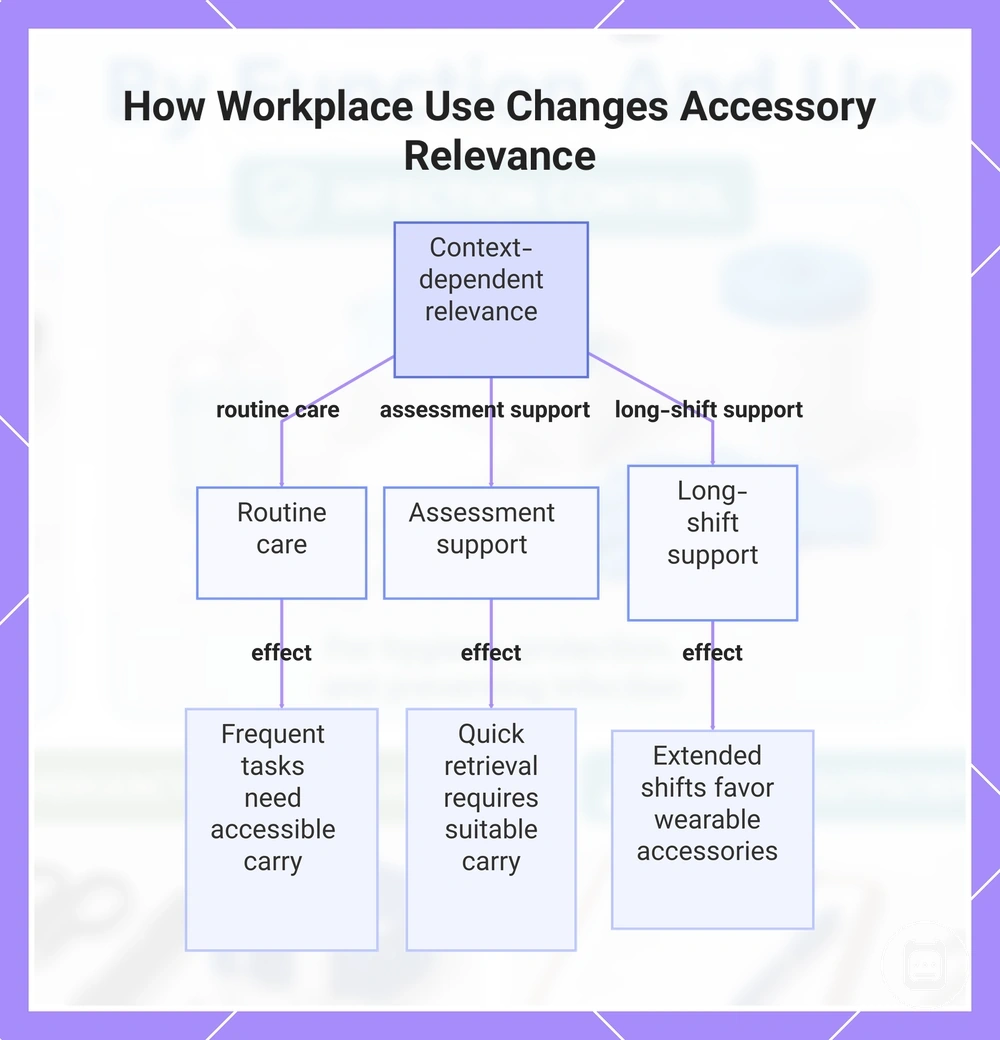
Workplace use changes accessory relevance because task frequency, access needs, workplace rules, and shift conditions can affect how useful a nursing accessory type may be in a specific setting. An accessory type that supports frequent tasks may have greater relevance when quick retrieval is important, while another type may become more relevant when carry method, hygiene condition, or shift duration affects the practical outcome. The same accessory type can matter differently across roles, tasks, and work settings. Accessory relevance depends on use context.
Task frequency often affects how often an accessory is accessed, while access needs can influence whether a carry method supports quick retrieval during work. Workplace rules and hygiene conditions may also qualify suitability when an accessory type must be stored, worn, or handled under specific conditions. Practical outcome depends on how the accessory type aligns with the task context rather than on the category alone.
Scenario-based differences help clarify why accessory relevance can change across task contexts without implying that every setting requires the same accessory mix.
- Routine care: When tasks occur repeatedly, an accessory type that supports accessibility and efficient carry may become more relevant because retrieval happens more often.
- Assessment support: When access speed matters, an accessory type may have greater relevance if the carry method supports quick retrieval while remaining suitable for workplace rules and hygiene conditions.
- Long-shift support: During extended shift conditions, wearable or shift-support accessories may become more relevant when duration of use, comfort conditions, and workplace suitability affect readiness and practical outcome.
This chart shows how accessory relevance depends on three common workplace scenarios: routine care, assessment support, and long-shift support.
Quick access during routine care
During routine care, quick access favors accessory types that remain visible, reachable, and easy to return after use. When routine tasks occur frequently, item location and retention can influence how quickly an accessory is retrieved and used. Quick access may reduce disruption when accessories support consistent reachability and return-to-place behavior.
- Pocket access: A pocket carry position may support fast retrieval when small tools are used frequently and returned to the same location after use.
- Badge access: A badge-mounted accessory may remain visible and accessible when access depends on a fixed carry position and consistent retention.
- Pouch access: A pouch may support retrieval when multiple items need to stay together and access depends on organized retention.
- Clipboard access: A clipboard may support documentation-related tasks when notes or papers need to remain accessible with minimal disruption to task flow.
Clinical assessment and task readiness
Task readiness for clinical assessment depends on having the appropriate tool type available before a quick assessment or support task begins. Accessory availability may support work continuity when visibility, battery status, cleanliness, and safe storage are verified before use. This discussion is limited to readiness conditions and accessory availability rather than clinical procedure or outcome.
The following checklist verifies readiness conditions that may affect accessory availability and work continuity:
- Visibility: Confirm the tool type remains easy to locate so quick access is possible when needed.
- Battery status: For a battery-powered accessory, verify power availability when the tool depends on it for ready-to-use condition.
- Cleanliness: Check that the accessory is clean when workplace expectations or use conditions require cleanliness verification.
- Safe storage: Confirm the accessory is stored in a way that supports accessibility and readiness before use.
- Appropriate accessory: Suitability may depend on a facility rule or role limit when determining which accessory type is appropriate for a specific condition.
Personal support during long shifts
Personal support accessories assist during long shifts when comfort, fit, duration, and workplace allowance align with the intended use. Their practical support depends on accessory type, material characteristics, and how long the item is worn or carried during a shift. Usefulness remains conditional because preferences, workplace limitations, and use conditions can vary.
- Fit: A suitable fit may support wearability during extended duration, with practical support varying by accessory type and individual preference.
- Material: Material attributes such as breathability may influence comfort when an accessory is used for longer periods.
- Workplace allowance: Suitability may depend on workplace allowance or role-specific limitations that affect whether an accessory type can be used in a particular setting.
Attributes that separate similar nursing accessory types
Attributes separate similar nursing accessory types because feature differences can change function, suitability, and use context even when accessories serve a similar purpose. Portability, attachment, storage format, cleanability, durability, material, fit, and workplace suitability may influence access, handling, maintenance, or wear conditions. Similar nursing accessory types are best distinguished through these attributes rather than through appearance alone. These attributes form the primary separation logic.
The table compares attribute differences and their practical effects under different conditions. Each row connects an accessory attribute to a type difference and the situation where it may influence suitability.
| Accessory attribute | What it changes | Example type difference | When it matters |
|---|---|---|---|
| Portability | Access and ease of carrying | Compact carry format versus larger carry format | When movement and retrieval needs differ |
| Attachment | Positioning and accessibility | Clip-based attachment versus retractable attachment | When retrieval frequency or placement conditions vary |
| Storage format | Organization and access trade-offs | Pocket organizer versus pouch storage | When item grouping and retrieval methods differ |
| Cleanability | Maintenance under hygiene conditions | Smooth material versus textured material | When workplace suitability depends on cleaning requirements |
| Durability | Performance during repeated use | Lighter construction versus more robust construction | When use frequency or workplace limitations differ |
| Material | Handling characteristics and wear conditions | Flexible material versus rigid material | When comfort, maintenance, or suitability factors vary |
| Fit | Alignment with user preference and duration | Adjustable fit versus fixed fit | When comfort and use duration influence the decision signal |
| Workplace suitability | Appropriateness for a specific environment | General-use accessory versus setting-specific accessory | When workplace rules or role conditions apply |
Attribute differences may influence practical effect and suitability, but their relevance depends on the condition, use context, and accessory type involved.
Portability, attachment, and storage format
Portability, attachment, and storage format change how an accessory is carried, worn, clipped, stored, and retrieved during work activities. These attributes affect the attachment point, movement condition, storage capacity, and access outcome, which may influence suitability in different situations. Together, portability, attachment, and storage format determine carry and retrieval effects.
The comparison below shows how format differences can change access and use conditions.
| Format | Practical effect |
|---|---|
| Clipped attachment | Uses a fixed attachment point and may support retrieval when an accessory needs to remain accessible during movement. |
| Worn format | Remains attached to the user and may support retention when access depends on consistent positioning. |
| Pouch storage format | Provides storage capacity for multiple items, with retrieval depending on organization and access format. |
| Pocket or clipboard storage format | Keeps items stored in a designated location, with access outcomes depending on available capacity and retrieval conditions. |
Cleanability, durability, and workplace suitability
Cleanability, durability, and workplace suitability affect whether an accessory type remains practical during repeated shift use. A hygiene attribute may depend on material, surface characteristics, and washable parts, while durability can depend on repeated handling and use conditions. Workplace suitability depends on these conditions rather than fixed guarantees.
Material, surface design, seams, washable parts, and battery housing can influence how an accessory type performs under hygiene conditions and repeated shift use. Workplace constraints may also qualify whether an accessory type remains suitable for work in a specific environment.
The following checks help verify how hygiene and durability conditions may affect workplace suitability:
- Material: Material characteristics may affect cleanability under a specific hygiene condition and influence practicality during repeated shift use.
- Surface: Surface characteristics can affect easy-clean potential when maintenance expectations vary because of a workplace constraint.
- Washable parts: Washable parts may support maintenance needs, although suitability depends on the accessory type and use conditions.
- Seams and construction: Seams and construction features can influence durability when an accessory experiences repeated use.
- Battery housing: Battery housing design may introduce maintenance limitations that affect workplace suitability under certain conditions.
- Workplace constraint: Facility rules or role-specific requirements may qualify whether an accessory type is suitable for work.
For deeper evaluation of hygiene, fit, and safety-related considerations, see safe and hygienic nursing accessories.
Where type classification ends and selection criteria begin
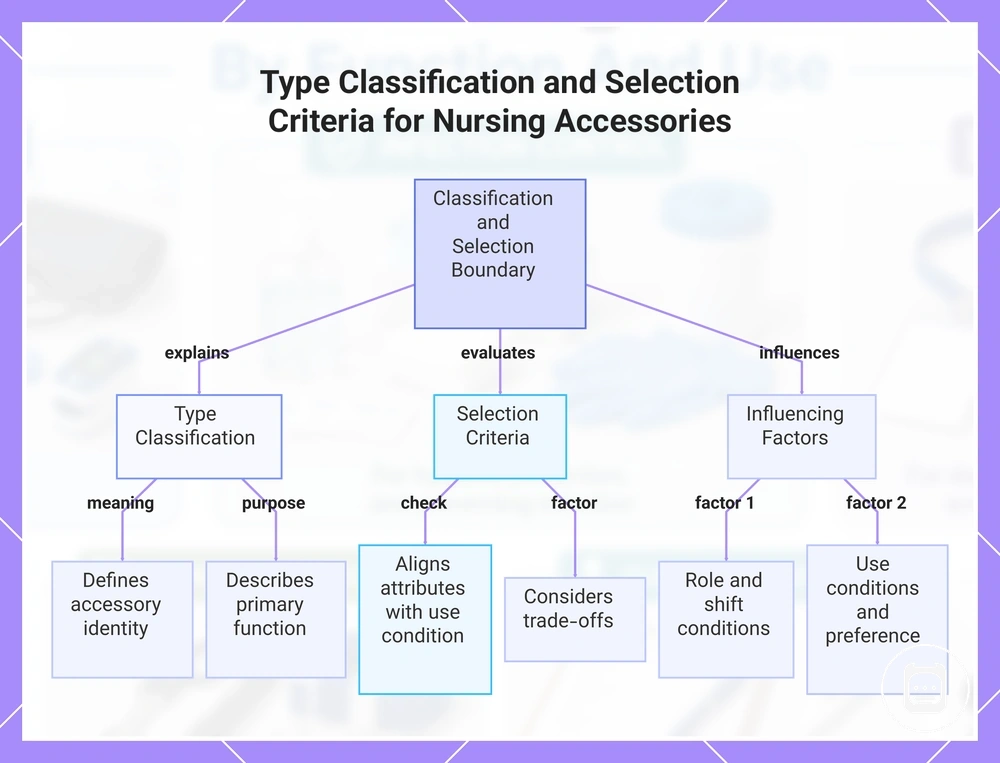
Type classification ends when an accessory is identified by its function and category, while selection criteria begin when attributes are evaluated for a specific role, shift, or preference. Type classification explains what an accessory is and what function it serves. Selection criteria focus on whether attributes align with a particular use condition. This boundary separates classification from selection.
Selection criteria convert function, attribute, use condition, and trade-off into decision signals. A function describes the purpose of an accessory type, while an attribute may qualify how that function fits a specific role or shift. Use conditions and personal preference can influence which decision signal becomes more important during practical selection.
After the distinction between classification and selection is clear, decision signals can be reviewed in a structured way. For broader guidance on applying selection criteria, see choose nursing accessories.
- Type: Defines the accessory category and establishes its primary function.
- Attribute: May influence suitability when a specific use condition applies.
- Role: Can affect which attributes become relevant during work activities.
- Shift: May change the importance of access, durability, storage, or comfort-related considerations.
- Trade-off: Helps guide a decision when one attribute supports a different outcome than another.
Selection criteria guide the next-step evaluation process, but accessory choice may still depend on role requirements, shift conditions, use conditions, and personal preference. Type classification creates the foundation, while selection criteria begin when attributes and trade-offs are assessed together.
The products below are useful examples for comparing available options. Before buying, check that the compatibility criteria, key features, and product details match your needs.

This chart shows the boundary between type classification and selection criteria, explaining how classification defines accessory function and category, while selection criteria evaluate attributes and trade-offs for specific roles and conditions.