Nurse Comfort Accessories for Long Shifts
Nurse comfort accessories are nursing accessories that support comfort, fit, support, breathable materials, and workplace suitability during long shifts. Their role is to help nurses manage common long-shift conditions such as extended standing, repeated movement, heat, and carrying demands while maintaining practical use at work. Nurse comfort accessories may include items associated with leg support, foot pressure management, hair control, or extended wear, but their value depends on individual needs and working conditions. Comfort outcomes can vary based on fit, footwear, uniform requirements, and the specific demands of a shift.
Long shifts can create pressure, heat buildup, movement-related strain, and other comfort challenges that influence accessory selection. In this broader context, the nursing accessories hub helps connect comfort-focused choices to the wider category of nursing accessories and their practical roles. Features such as support, breathable materials, secure fit, and workplace suitability often matter more than appearance alone when comfort is a priority. Nurse comfort accessories can support comfort during demanding shifts, but they do not replace appropriate footwear choices, workplace practices, or professional health guidance.
Nurse comfort accessories for long shifts depend on matching support needs with fit, materials, and work conditions. The most useful comfort-focused accessories are usually those that remain suitable for movement, extended wear, and workplace expectations without creating additional discomfort. Understanding what comfort accessories should support is the first step in making informed selection decisions.
What comfort-focused nursing accessories need to support
What comfort-focused nursing accessories need to support is long-shift comfort by helping reduce avoidable pressure, friction, heat, and carrying strain where an accessory can reasonably help. Nurse comfort accessories are intended to support daily work conditions rather than provide guaranteed outcomes. Their usefulness often depends on fit, workplace suitability, movement demands, and how they are used during a long shift.
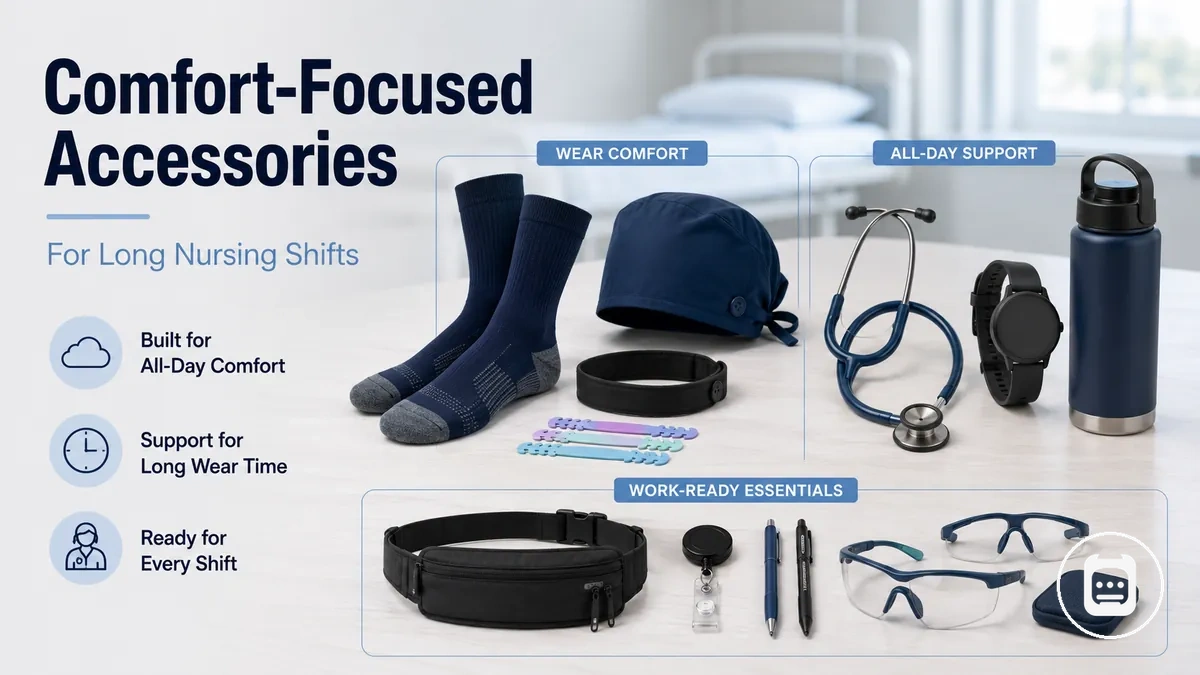
What comfort-focused nursing accessories need to support becomes easier to evaluate when support areas are grouped by the type of discomfort or workload they may address. The image below highlights the kinds of comfort and fit considerations that accessories are designed to organize and support during nursing work.
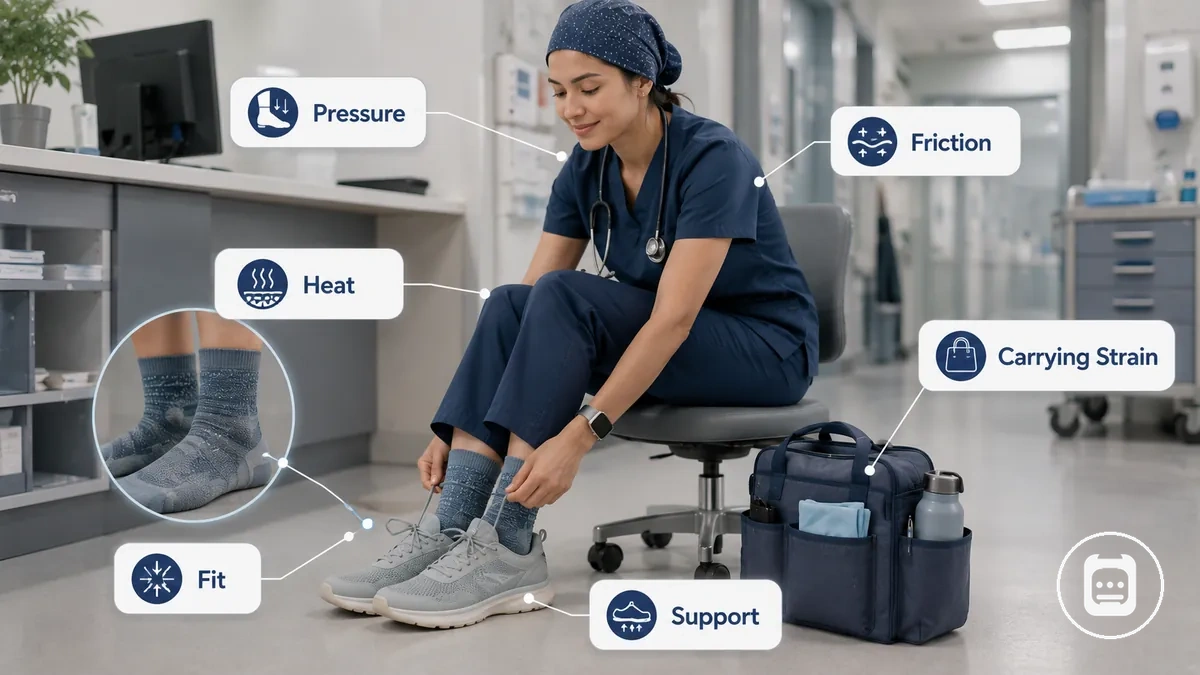
Support areas can be assessed by connecting a nursing accessory to its support function, use condition, and likely comfort effect or limitation.
- Pressure support may matter when long periods of standing increase foot or leg fatigue, although comfort can still depend on footwear fit and individual needs.
- Friction management may help when repeated movement creates rubbing against skin, clothing, or equipment during a long shift.
- Heat control often relies on breathable materials and extended-wear suitability when nurses work in active or warm conditions.
- Carrying strain may be reduced when organizers or carry aids distribute items more efficiently, but the effect depends on load and usage habits.
- Fit and support should remain appropriate for workplace movement, hygiene expectations, and workplace suitability to help maintain comfort during a long shift.
Nurse comfort accessories can support specific comfort areas, but they do not replace proper footwear selection, broader workplace ergonomics, staffing conditions, or professional health guidance. For a wider view of practical workplace-focused options, see nursing accessories for work shifts.
Long-shift comfort factors that shape accessory choice
Long-shift comfort factors that shape accessory choice depend on the conditions a nurse experiences during a long shift and the type of support an accessory is expected to provide. Standing time, heat, movement, and head covering needs often influence which nurse comfort accessories are more suitable for a specific work environment. The goal is not to find a universal solution but to match comfort factors with appropriate support attributes.
Long-shift comfort factors that shape accessory choice become easier to assess when comfort conditions are linked to specific selection signals. The image below highlights the types of work conditions that can influence accessory decisions and comfort priorities during nursing shifts.
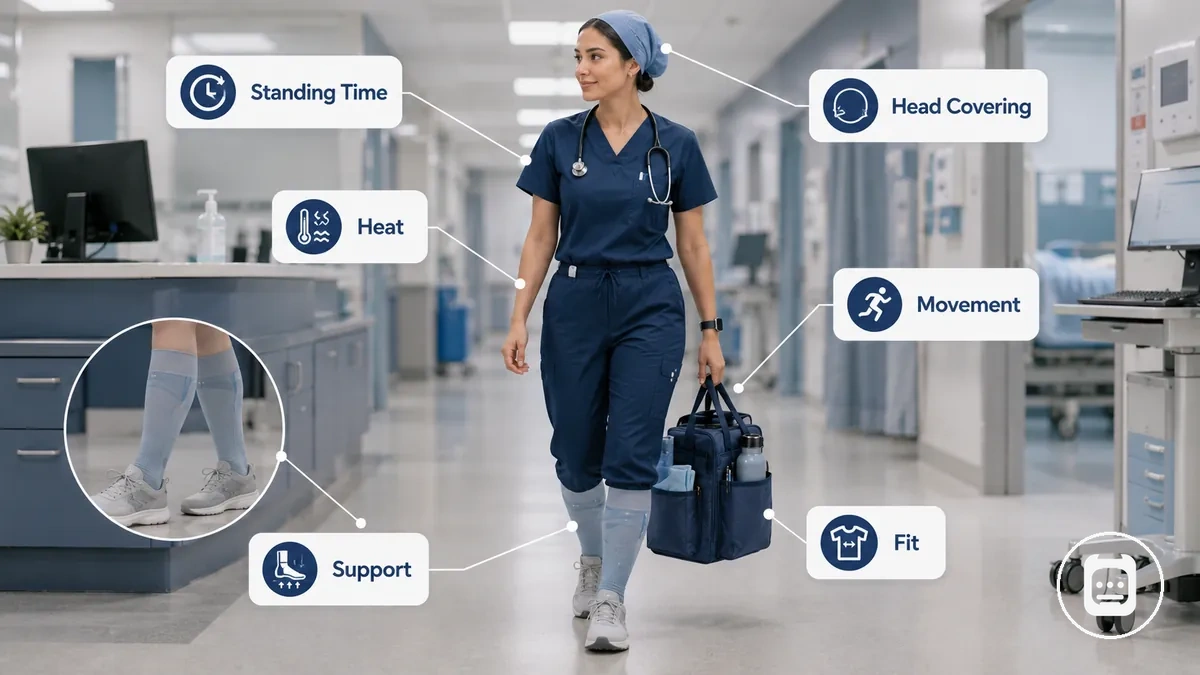
Different comfort factors can affect different body areas or work conditions. Selection decisions are often more useful when accessory attributes match the demands of standing time, movement, heat exposure, or extended head covering rather than focusing on appearance alone.
Long-shift comfort factors that shape accessory choice can be organized by condition, accessory attribute, and decision implication. The table below maps comfort factors to selection signals.
| Factor | Condition | Accessory Signal | Decision |
|---|---|---|---|
| Standing Time | Extended periods on foot | Support-focused fit | Prioritize accessories that may help improve comfort during prolonged standing |
| Heat | Warm or active work conditions | Breathable materials | Consider comfort accessories intended for airflow and extended wear |
| Movement | Frequent walking, bending, or reaching | Secure fit and flexibility | Choose accessories that can remain comfortable during repeated motion |
| Head Covering | Extended cap or hair-cover use | Lightweight construction | Look for options that balance comfort and workplace suitability |
| Carrying Strain | Regular transport of work items | Organized load support | Select accessories that may help manage carrying demands during a long shift |
Comfort factors can guide accessory choice, but they do not replace broader considerations such as workplace ergonomics, break routines, footwear selection, or individual comfort preferences. The most useful decisions are usually based on matching work conditions with accessory attributes, fit requirements, and practical limitations.
Standing time, foot pressure, and leg fatigue
When standing duration increases during a long shift, standing and foot pressure often become important factors in choosing nurse comfort accessories. Extended time on hard surfaces can create pressure signals in the feet and legs, while movement demands may influence overall comfort and support needs. The local purpose is to match standing duration and pressure conditions with accessory attributes that may support comfort and workplace suitability.
Standing time, foot pressure, and leg fatigue are easier to assess when support needs are connected to fit and use conditions. The image below clarifies how pressure, shoe fit, and support-related attributes can influence accessory selection during a long shift.
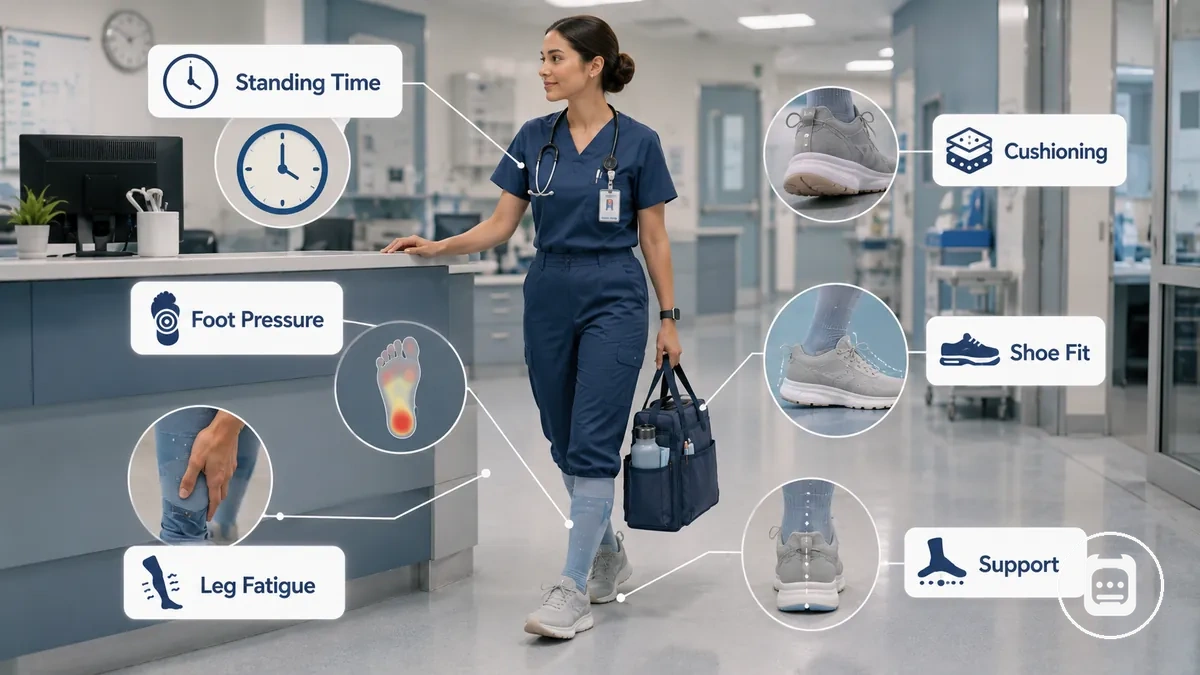
Standing time, foot pressure, and leg fatigue can be evaluated through a few practical selection signals.
- Long standing duration may increase pressure concerns, making cushioning-focused comfort accessories worth considering when additional underfoot support is desired.
- A swelling tendency during a long shift may influence how compression-style support options are evaluated, depending on comfort preferences and workplace suitability.
- Shoe fit should remain compatible with any added comfort accessory, since fit changes can affect comfort and movement during work.
Nurse comfort accessories for standing and foot pressure are often easier to evaluate when standing duration, pressure signals, swelling tendency, and shoe fit are considered together. Compression-oriented options and supportive footwear accessories may provide comfort-support value in certain situations, but outcomes depend on individual fit, movement patterns, and long-shift conditions.
Heat, sweat, friction, and extended wear
When heat and friction increase during a long shift, nurse comfort accessories often depend on material and construction attributes that remain comfortable during extended wear. Sweat, repeated movement, and prolonged skin contact can influence how an accessory feels throughout the day. The local purpose is to connect contact-area conditions with material attributes that may support comfort and help limit irritation risk.
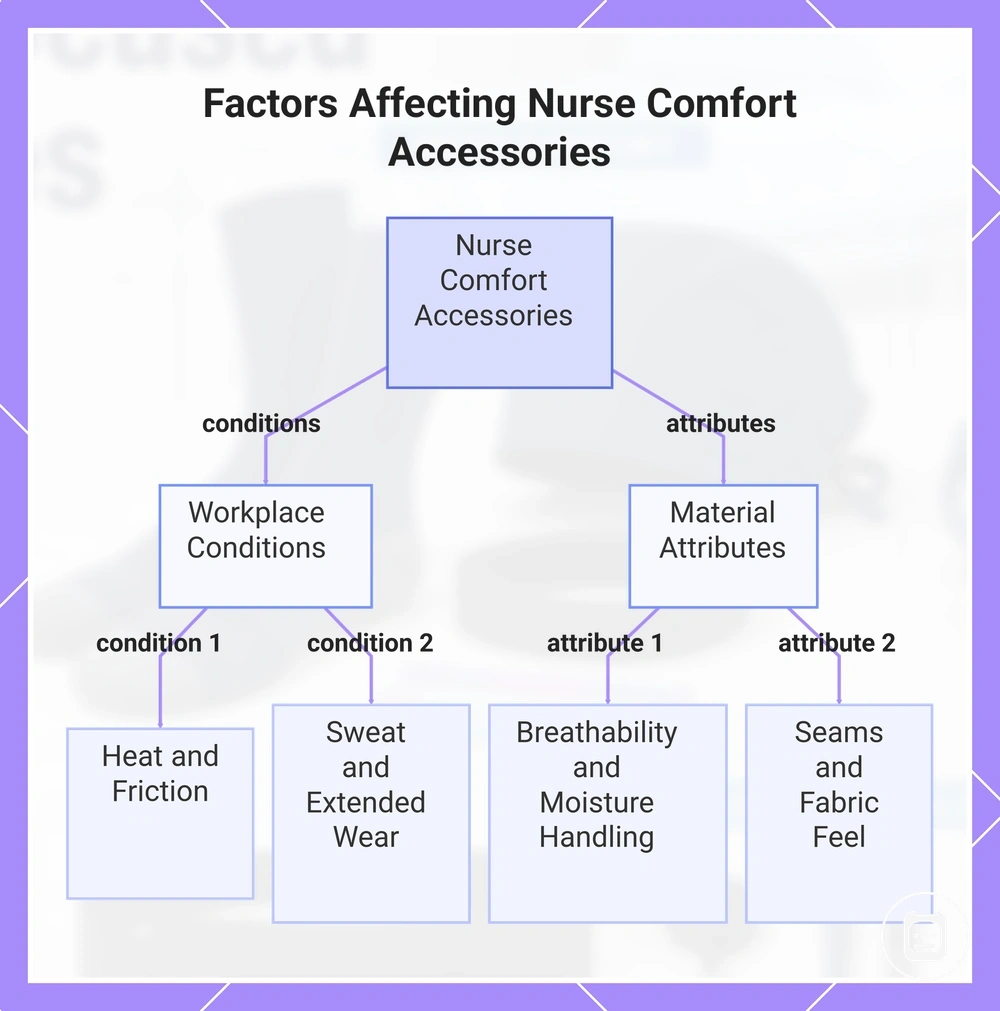
Heat, sweat, friction, and extended wear are easier to evaluate when material choices are linked to specific comfort conditions. Breathability, moisture handling, fabric feel, and seams can affect comfort differently depending on workplace activity, fit preferences, and the amount of time an accessory remains in contact with the body.
- Higher heat and friction exposure may increase the importance of breathable materials that help manage warmth during extended wear.
- Sweat accumulation can make moisture handling a useful attribute when selecting comfort accessories for active work conditions.
- Seams in frequent contact areas may influence irritation risk, especially during repeated movement and extended wear.
- Soft or flexible fabric construction may support comfort for some nurses, although preferences can vary by fit, movement, and contact area.
Nurse comfort accessories are often easier to evaluate when heat and friction, sweat, seams, breathability, and moisture handling are considered together. Material attributes should be assessed in relation to comfort, fit, workplace suitability, and individual preferences rather than assuming any single material is suitable for every nurse or climate.
This chart shows how workplace conditions and material attributes jointly influence comfort and irritation risk for nurse comfort accessories.
Repeated movement, reach, and carried-tool strain
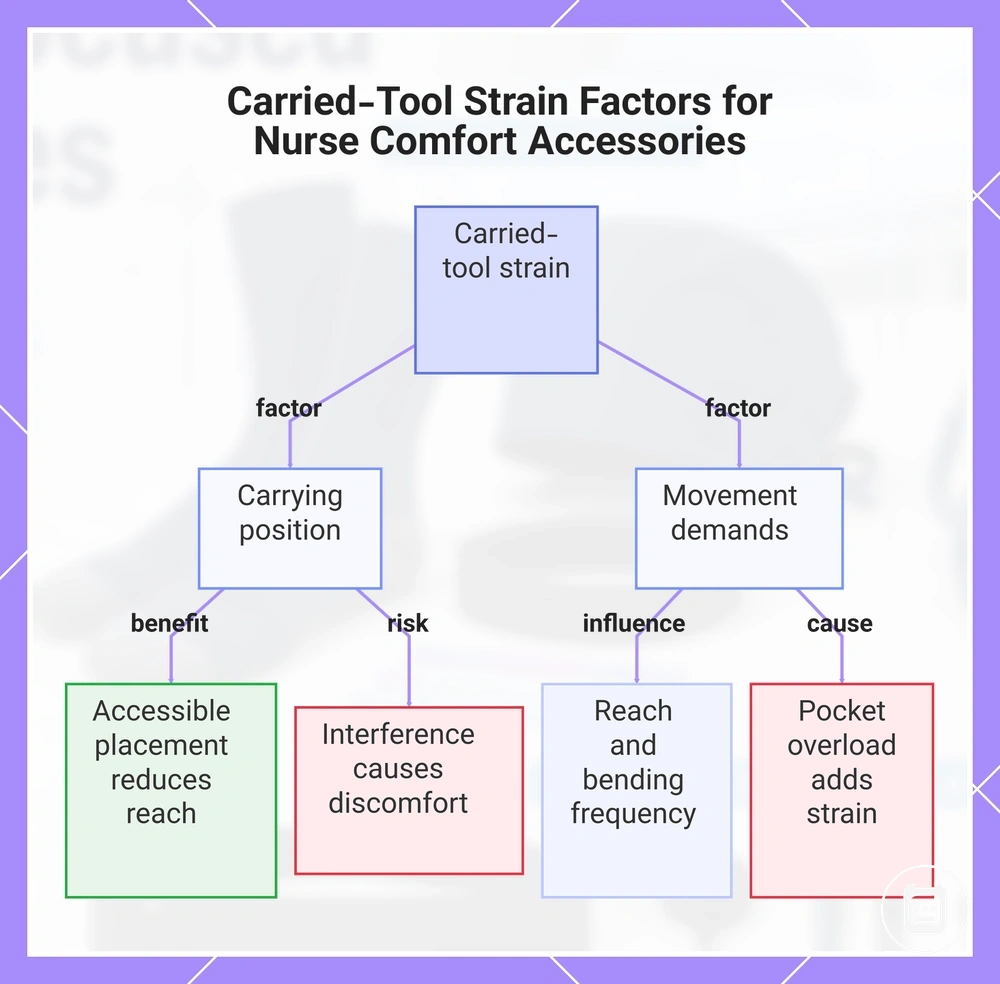
When repeated movement occurs throughout a long shift, movement strain often depends on how nurse comfort accessories are positioned and carried during daily tasks. Frequent reach, bending, and item access can influence comfort when tools or accessories interfere with natural movement. The local purpose is to connect work movement patterns with carrying methods that may support comfort and workplace suitability.
Repeated movement, reach, and carried-tool strain are easier to evaluate when carrying position is linked to access needs and movement demands. A carrying method that keeps frequently used items accessible may help reduce unnecessary reach, while placement that creates interference during bending or walking can contribute to discomfort over time.
- Frequent reach for work items may make carrying position an important selection factor when access and movement comfort both matter.
- Repeated bending can increase awareness of how accessories sit against the body, influencing comfort during extended wear.
- Pocket overload may affect movement strain when carried items add bulk or create uneven weight distribution.
- Accessory placement that limits interference with walking, reaching, or bending may improve suitability for a long shift.
Nurse comfort accessories are often easier to evaluate when movement strain, reach patterns, bending frequency, pocket overload, and carrying position are considered together. The most suitable carrying method depends on workplace movement, access requirements, and whether the accessory remains comfortable during routine tasks throughout a long shift.
This chart shows the key factors that influence movement strain from carried tools and accessories during nursing shifts, focusing on carrying position and movement demands.
Comfort accessory types for long nursing shifts
Comfort accessory types for long nursing shifts are comfort accessory groups that support different comfort needs during extended work periods. The local purpose is to organize nurse comfort accessories by their practical comfort role so long-shift comfort decisions can be matched to fit, support, movement, and workplace suitability. Rather than functioning as a product checklist, these groups help connect common long-shift conditions with relevant comfort attributes and limitations.
Comfort accessory types for long nursing shifts are easier to evaluate when each accessory group is considered in relation to comfort function, fit concern, and use conditions. Comfort outcomes can vary based on individual preferences, workplace demands, footwear compatibility, movement patterns, and extended-wear conditions.
Comfort accessory types for long nursing shifts can be organized by practical comfort role. The table below groups common options by accessory group, comfort function, fit concern, and limitation.
| Accessory Group | Comfort Function | Fit Concern | Limitation |
|---|---|---|---|
| Compression socks | Provide support-focused comfort for extended standing and wear | Fit and comfort preference can influence suitability | Comfort outcomes may vary by individual use conditions |
| Shoe inserts | Support underfoot comfort during a long shift | Must remain compatible with footwear fit | Comfort value can depend on shoe design and personal preference |
| Scrub caps | Support comfort during extended wear and workplace movement | Fit, fabric feel, and hair volume may affect comfort | Material preferences can vary by heat levels and work conditions |
| Ergonomic carry accessories | Support carrying comfort and item access during movement | Carrying position should suit workplace movement patterns | Comfort depends on carried load and daily activity demands |
Comfort accessory groups are usually easier to assess when the comfort function aligns with a specific need rather than attempting to address every long-shift condition at once. The most suitable nurse comfort accessories depend on comfort priorities, fit requirements, workplace movement, and the conditions experienced during a long shift.
Compression socks for leg support and swelling control
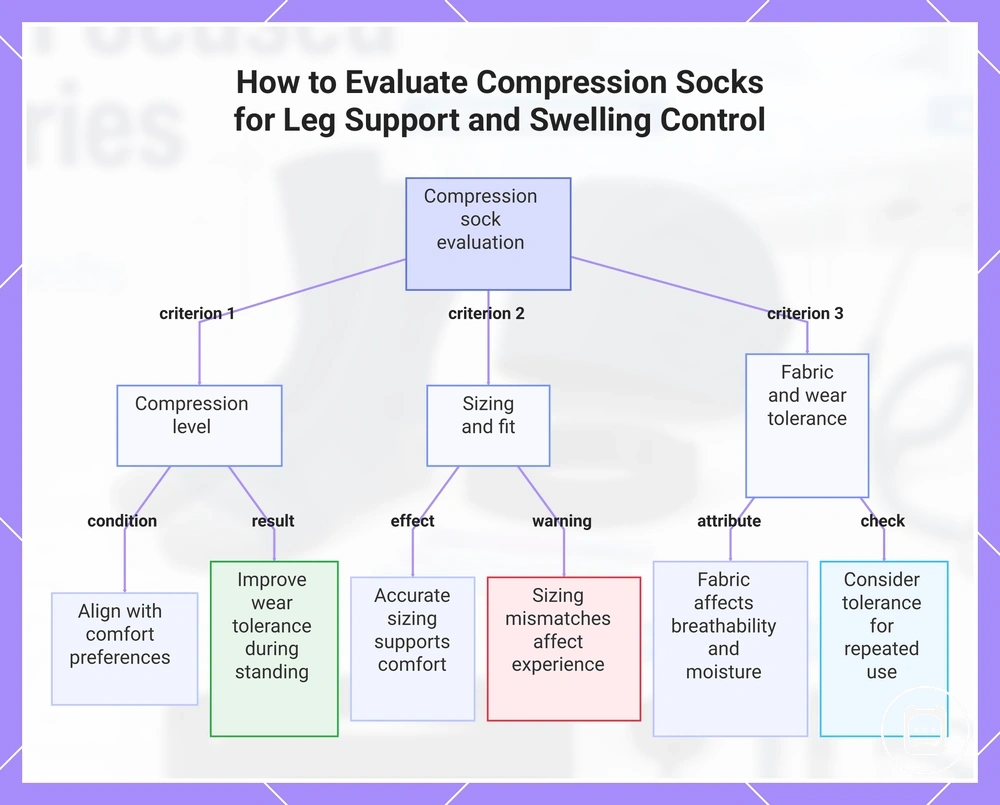
Compression socks are nurse comfort accessories that may support leg comfort during a long shift when standing or walking for extended periods. The local purpose is to explain how compression socks can be evaluated through compression level, sizing, fabric, and wear tolerance rather than assumed outcomes. Comfort and support can vary based on fit preferences, workplace movement, and extended-wear conditions.
Compression socks for leg support and swelling control are easier to evaluate when selection criteria are connected to use conditions. Compression level, sizing, fabric, and tolerance can influence whether compression socks remain comfortable throughout a long shift and whether they suit workplace demands.
- A compression level that aligns with comfort preferences may improve wear tolerance during extended standing or walking.
- Accurate sizing can support comfort and fit, while sizing mismatches may affect the overall wear experience.
- Fabric choice may influence breathability, moisture handling, and comfort during extended wear.
- Wear tolerance should be considered when selecting compression socks for repeated use during workplace movement.
Compression socks are usually easier to assess when compression level, sizing, fabric, and tolerance are considered together. The most suitable option depends on comfort priorities, fit preferences, workplace conditions, and how the socks feel during a long shift.
This chart shows the key criteria for evaluating compression socks, including compression level, sizing, fabric, and wear tolerance, to ensure comfort during long shifts.
Shoe inserts and foot-support accessories
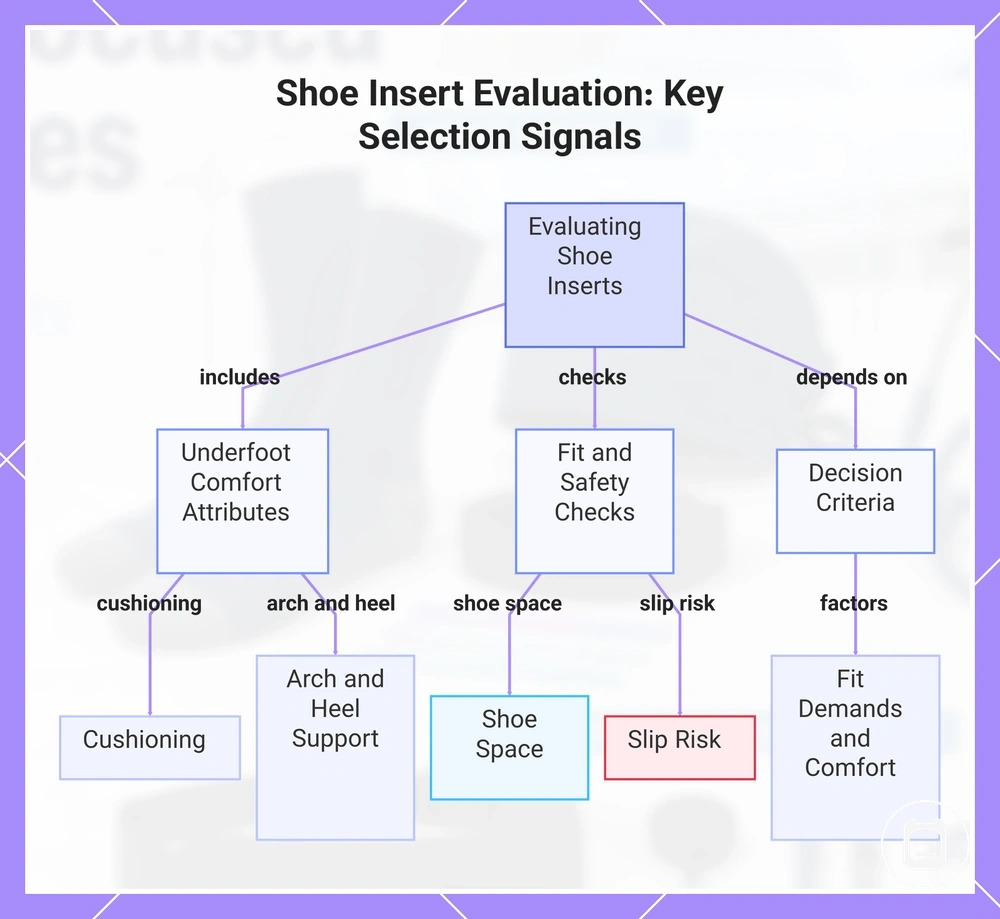
Shoe inserts and foot-support accessories are nurse comfort accessories that may modify underfoot comfort during a long shift when shoe fit and workplace movement allow suitable use. The local purpose is to explain how shoe inserts can be evaluated through cushioning, arch feel, heel support, shoe space, and compatibility conditions rather than assumed outcomes. Comfort outcomes can vary based on footwear design, movement patterns, and individual fit preferences.
Shoe inserts and foot-support accessories are easier to assess when support attributes are connected to shoe compatibility and daily use conditions. The checklist below highlights practical selection signals that can influence comfort and pressure awareness during a long shift.
- Cushioning may support underfoot comfort when extended standing increases pressure awareness during workplace movement.
- Arch feel should align with personal comfort preferences, as too much or too little support may affect wear tolerance.
- Heel support can influence how comfortable a shoe feels during repeated walking or standing.
- Shoe space should remain adequate after adding a shoe accessory, since reduced space may affect fit and comfort.
- Slip risk should be considered when a shoe insert changes foot position or affects how securely the shoe fits.
Shoe inserts are usually easier to evaluate when cushioning, arch feel, heel support, shoe space, and compatibility conditions are considered together. The most suitable option depends on shoe fit, workplace demands, movement patterns, and whether the accessory remains comfortable throughout a long shift.
This chart shows the main attributes to consider when evaluating shoe inserts for nurse comfort during long shifts.
Soft scrub caps for hair control and head comfort
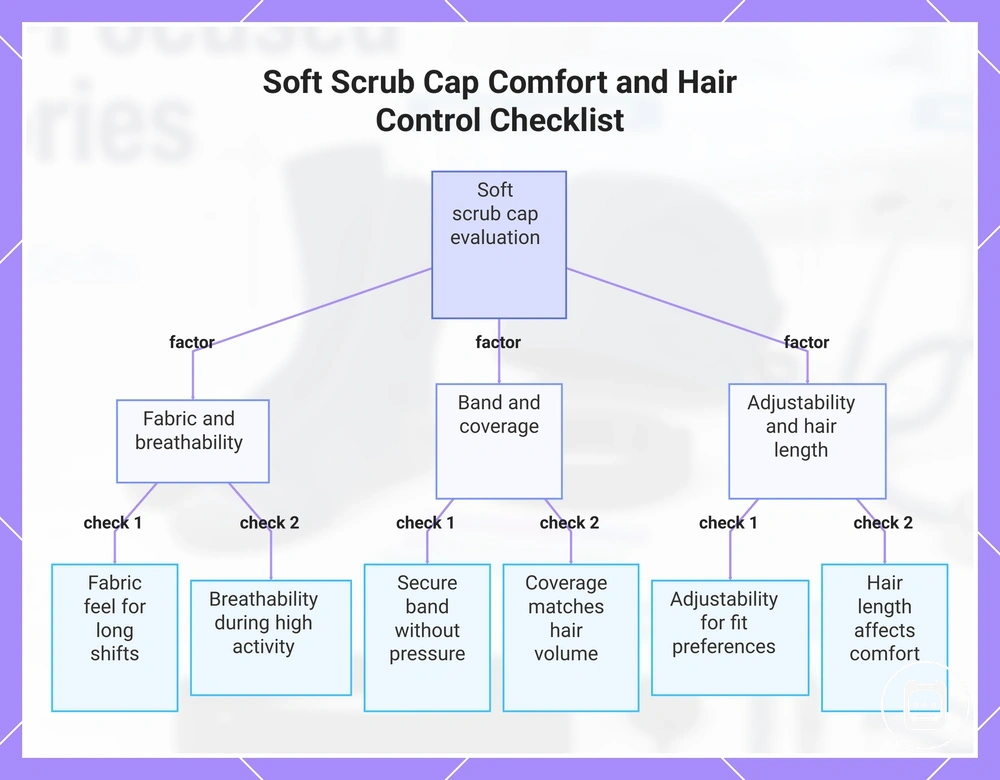
Soft scrub caps are nurse comfort accessories that may support hair control and head comfort during a long shift through fabric, coverage, and fit-related features. The local purpose is to explain how soft scrub caps can be evaluated through fabric feel, band design, coverage, and adjustability rather than appearance alone. Comfort outcomes can vary based on hair length, workplace movement, and individual fit preferences.
Soft scrub caps for hair control and head comfort are easier to assess when comfort conditions are connected to practical wear requirements. The checklist below highlights selection signals that may influence comfort and hair management during extended wear.
- Fabric feel may affect comfort during a long shift, especially when a scrub cap remains in contact with the head for extended periods.
- A band that feels secure without excessive pressure may improve fit stability during workplace movement.
- Coverage should align with hair length and volume, as limited coverage may affect comfort and hair control.
- Breathability can influence extended-wear comfort when warmth and activity levels increase during a shift.
- Adjustability may help accommodate different fit preferences and hair-control needs while maintaining workplace suitability.
Soft scrub caps are usually easier to evaluate when fabric feel, band design, coverage, breathability, and hair length needs are considered together. The most suitable option depends on comfort preferences, fit requirements, workplace movement, and whether the scrub cap remains comfortable throughout a long shift.
This chart shows the key factors to consider when selecting a soft scrub cap for comfort and hair control during long shifts.
Ergonomic carry accessories that reduce daily strain
When frequently used items must be carried throughout a long shift, ergonomic carry accessories may help manage reach demands, pocket overload, and repeated carrying strain. The local purpose is to explain how ergonomic carry accessories can be evaluated through placement, weight distribution, access, and movement-related factors rather than convenience alone. Nurse comfort accessories in this category are intended to support carrying comfort, but outcomes depend on workplace movement, carrying habits, and individual preferences.
Ergonomic carry accessories that reduce daily strain are easier to assess when practical use conditions are connected to carrying attributes. The checklist below highlights selection factors that may influence comfort and workplace suitability during a long shift.
- Placement should allow convenient access while reducing unnecessary reach during routine tasks.
- Weight distribution may influence carrying comfort when work items are used throughout the shift.
- Access should remain practical without requiring repeated adjustment or awkward movement.
- Movement interference should be limited, as bulky or poorly positioned accessories may affect walking, bending, or reaching.
- Capacity should match carrying needs, since excess storage space can encourage unnecessary load while limited space may reduce convenience.
Ergonomic carry accessories are usually easier to evaluate when placement, weight distribution, access, movement interference, and capacity are considered together. The most suitable carry accessory depends on workplace movement patterns, carrying requirements, and whether it remains comfortable throughout a long shift.
How to select nurse comfort accessories by fit, support, and shift condition
How to select nurse comfort accessories by fit, support, and shift condition depends on comparing comfort needs against practical selection criteria rather than focusing on a single feature. The local purpose is to help convert long-shift comfort concerns into clear decision factors before evaluating options. Fit, support, material, and shift condition should be compared together because an accessory that suits one workplace situation may be less suitable in another.
How to select nurse comfort accessories by fit, support, and shift condition becomes easier when each criterion is linked to an acceptable condition and a likely decision effect. The table below organizes common selection criteria into a practical evaluation framework.
| Factor | Condition | Accessory Signal | Decision |
|---|---|---|---|
| Fit | Remains comfortable during movement and extended wear | Secure but not restrictive fit | Prioritize accessories that can remain comfortable throughout a long shift |
| Support | Matches the identified comfort need | Support-focused design or construction | Choose support features that address the primary comfort concern |
| Material | Suitable for workplace activity and wear duration | Comfort-oriented fabric or construction | Consider material attributes that align with heat, friction, or contact conditions |
| Shift Condition | Reflects standing time, movement, or carrying demands | Attribute suited to the work environment | Select accessories based on actual workplace requirements |
| Suitability | Compatible with workplace expectations and daily use | Practical long-shift design | Separate necessary support from optional comfort features |
Selection criteria are usually more useful than feature comparisons alone because they connect a nurse comfort accessory to a specific condition and decision outcome. Necessary support features should generally take priority when they address a clear comfort need, while additional comfort features may be considered after fit, support, material, and shift condition requirements have been evaluated.
The most suitable nurse comfort accessories depend on workplace demands, movement patterns, wear duration, and individual preferences. Using selection criteria can help narrow options without assuming that any single accessory is suitable for every long-shift condition.
Fit and sizing signals for all-day wear
Fit and sizing signals for all-day wear depend on whether nurse comfort accessories remain comfortable, secure, and non-restrictive throughout a long shift. The local purpose is to identify practical fit and sizing conditions that may influence comfort during extended wear. Tightness, slipping, bunching, shoe space, cap security, and movement range can affect how an accessory feels during workplace movement and repeated use.
Fit and sizing signals for all-day wear are easier to evaluate when observable conditions are checked during normal workplace activity. The checklist below focuses on fit attributes that may influence comfort or irritation outcomes during a long shift.
- Tightness should feel supportive without creating excessive pressure that may reduce comfort during extended wear.
- Slipping may indicate that an accessory is not maintaining secure placement during movement.
- Bunching can affect comfort when material gathers against the body, inside footwear, or beneath a uniform item.
- Shoe space should remain adequate when foot-support accessories are used, since limited space may affect fit and comfort.
- Cap security should remain stable during routine movement without requiring frequent adjustment.
- Movement range should remain comfortable, as fit and sizing that restrict natural motion may reduce workplace suitability.
Nurse comfort accessories are usually easier to assess when fit and sizing are evaluated during realistic long-shift conditions rather than through appearance alone. A secure and comfortable fit may support extended wear, but comfort outcomes can vary by movement patterns, workplace demands, and individual preferences.
Compression level and support strength
Compression level and support strength depend on matching the support accessory to comfort needs, wear tolerance, and long-shift conditions. The local purpose is to help evaluate support strength as a comfort-selection factor rather than assuming stronger support is always more suitable. Nurse comfort accessories with different support strength levels may feel different during extended wear, depending on workplace movement, fit, and individual tolerance.
Compression level and support strength are easier to assess when support levels are compared against comfort expectations and shift conditions. The comparison below separates support strength into practical decision categories.
| Factor | Condition | Accessory Signal | Decision |
|---|---|---|---|
| Light Support | Preference for a less restrictive feel during a long shift | Lower support strength sensation | May suit users who prioritize flexibility and wear tolerance |
| Moderate Support | Balance between support and comfort | Noticeable but manageable support strength | May suit long-shift comfort needs when tolerance remains acceptable |
| Stronger Support | Preference for a firmer support sensation | Higher support strength feel | Tolerance should be assessed carefully because excessive support strength may contribute to discomfort for some users |
Support strength is usually easier to evaluate when comfort needs, tolerance, and shift condition are considered together. A support accessory that aligns with wear tolerance may remain more suitable for extended use, while stronger support is not automatically the preferred choice for every nurse or workplace situation.
Soft, breathable, and moisture-managing materials
Soft, breathable, and moisture-managing materials are material attributes that can influence comfort during a long shift across socks, caps, inserts, and carry accessories. The local purpose is to show how materials affect comfort, wear conditions, and maintenance needs. Material choice may influence heat buildup, friction, moisture handling, and how well nurse comfort accessories tolerate repeated use and cleaning.
Soft, breathable, and moisture-managing materials are easier to evaluate when material attributes are connected to wear conditions and maintenance expectations. The checklist below highlights practical material criteria that may affect comfort and suitability during extended wear.
- Softness may improve comfort when an accessory remains in contact with the body for extended periods.
- Breathability can help manage warmth during workplace movement and prolonged wear.
- Moisture handling may influence how comfortable socks, caps, or fabric-based accessories feel when heat and perspiration increase.
- Washability can affect maintenance convenience when nurse comfort accessories require regular cleaning.
- Material durability may influence whether an accessory maintains its intended feel after repeated wear and washing.
Materials are usually easier to assess when softness, breathability, moisture handling, washability, and wear conditions are considered together. Material selection depends on comfort preferences, workplace conditions, maintenance expectations, and the demands of a long shift rather than any single material attribute alone.
Compatibility with shoes, scrubs, hair length, and work movement
Compatibility with shoes, scrubs, hair length, and work movement depends on whether nurse comfort accessories fit comfortably within daily workplace conditions during a long shift. The local purpose is to evaluate compatibility as a selection filter before comfort claims are considered. An accessory may feel comfortable on its own but still be unsuitable if it interferes with shoes, uniform fit, hair coverage needs, or routine movement.
Compatibility with shoes, scrubs, hair length, and work movement is easier to assess when key conditions are verified before choosing an accessory. The checklist below highlights practical compatibility factors that may support an accept-or-reject decision.
- Shoes should maintain adequate space and comfort when inserts or foot-support accessories are added.
- Scrubs should allow accessories to fit without creating excess bulk that may affect uniform fit during a long shift.
- Hair length should remain compatible with cap coverage, adjustability, and comfort requirements.
- Work movement should remain unrestricted when using carry accessories, organizers, or support-focused comfort accessories.
- Accessory placement should suit workplace tasks without creating repeated interference during walking, bending, or reaching.
- A comfortable accessory may still be unsuitable if it affects shoe fit, cap security, uniform fit, or movement efficiency during routine work.
Compatibility is usually easier to evaluate when shoes, scrubs, hair length, work movement, and workplace suitability are considered together. Nurse comfort accessories that align with these conditions may be more suitable for extended wear, while accessories that create fit or movement conflicts may be rejected despite initial comfort.
Comfort accessories versus broader long-shift comfort habits
Comfort accessories versus broader long-shift comfort habits depends on recognizing that nurse comfort accessories may support comfort during a long shift but do not replace rest, footwear suitability, hydration, posture awareness, or workplace practices. The local purpose is to keep accessory selection realistic and decision-safe. Comfort accessories can influence fit, support, and wear conditions, while many broader comfort factors remain outside accessory control.
Comfort accessories versus broader long-shift comfort habits becomes clearer when accessory support is compared with the habits and conditions it complements. The comparison below separates what accessories may influence from what still depends on workplace conditions and personal habits.
| Factor | Condition | Accessory Signal | Decision |
|---|---|---|---|
| Leg comfort | Extended standing or walking during a long shift | Support-focused accessories may contribute to comfort | Use accessories as a complement to broader comfort habits |
| Foot comfort | Footwear suitability remains appropriate for workplace demands | Foot-support accessories may influence wear comfort | Assess accessories together with shoe fit and suitability |
| Heat and moisture conditions | Hydration and workplace conditions may still influence comfort | Material-related accessories may support moisture handling | Avoid assuming accessories control all comfort conditions |
| Movement comfort | Posture awareness and daily work movement vary by task | Carry accessories may support organization and accessibility | Consider whether accessory placement aligns with movement needs |
For nursing accessory selection, the key comparison is accessories versus habits rather than accessories instead of habits. Nurse comfort accessories may support a specific comfort need, but rest, footwear suitability, hydration, posture awareness, and workplace conditions remain important factors outside direct accessory control.
When comfort accessories help and when they are not enough
When comfort accessories help and when they are not enough depends on whether the discomfort signal is linked to an accessory-relevant cause or requires a broader adjustment. The local purpose is to separate situations where nurse comfort accessories may support comfort from situations where additional workplace, fit, or habit-related factors may need attention. During a long shift, foot pressure, heat irritation, hair or cap discomfort, and carrying strain may sometimes be influenced by accessory selection, while other discomfort sources can remain outside accessory control.
When comfort accessories help and when they are not enough becomes clearer when discomfort signals are compared with likely next decisions. The comparison below separates accessory-supportable conditions from situations that may require a broader adjustment.
| Factor | Condition | Accessory Signal | Decision |
|---|---|---|---|
| Foot pressure | Comfort concern appears related to cushioning, support, or fit | Foot-support accessories may influence wear comfort | Assess accessory fit and compatibility before considering broader changes |
| Heat irritation | Warmth or moisture buildup affects comfort during a long shift | Breathable or moisture-managing accessories may support wear conditions | Evaluate material-related comfort attributes alongside workplace conditions |
| Carrying strain | Discomfort appears connected to how work items are carried | Carry accessories may support organization or accessibility | Review carrying methods and accessory placement |
| Persistent discomfort | Discomfort may relate to factors beyond accessory fit, support, or material | Limited accessory influence may be apparent | Consider whether a broader adjustment is needed rather than relying on accessories alone |
Nurse comfort accessories are usually most useful when the discomfort source aligns with comfort, fit, support, or carrying needs. If discomfort appears linked to factors beyond accessory-related conditions, a broader adjustment may be more appropriate than changing long-shift comfort gear alone.
Accessory choices that should stay inside workplace-safe use
Accessory choices that should stay inside workplace-safe use depend on whether nurse comfort accessories remain suitable for workplace conditions throughout a long shift. The local purpose is to evaluate comfort accessories through practical safety and hygiene attributes before treating them as suitable for daily use. Workplace-safe use is commonly connected to cleanability, secure fit, interference risk, uniform compatibility, and routine workplace expectations.
Accessory choices that should stay inside workplace-safe use are easier to assess when each accessory is checked against workplace conditions. The checklist below highlights practical suitability factors that may support an acceptance, adjustment, or avoidance decision.
- Cleanability should remain appropriate for routine use when an accessory is exposed to daily workplace conditions.
- Secure fit may help an accessory stay in place during movement without requiring repeated adjustment.
- Interference should remain limited so the accessory does not unnecessarily affect routine duties, movement, or item access.
- Uniform compatibility should be considered when an accessory adds bulk, changes fit, or affects how work clothing is worn.
- Hygiene expectations may influence whether an accessory remains suitable for repeated wear during a long shift.
Workplace-safe use serves as a suitability check within comfort selection rather than a complete safety review. When comfort, fit, support, and workplace conditions align, an accessory may be a more appropriate choice, while broader considerations can be explored through safe and hygienic accessory choices.
Comfort and value tradeoffs before checking options
Comfort and value tradeoffs before checking options depend on how well a nurse comfort accessory matches its comfort role, durability expectations, cleanability needs, use frequency, and replacement likelihood. The local purpose is to evaluate comfort value after fit, support, compatibility, and workplace suitability have already been considered. A higher-cost accessory is not automatically a higher-value option when long-shift needs are limited or infrequent.
Comfort and value tradeoffs before checking options become clearer when value attributes are compared against expected use conditions. Comfort value often depends on how frequently an accessory is used, how well it tolerates repeated wear, and whether maintenance requirements remain practical over time.
| Factor | Condition | Accessory Signal | Decision |
|---|---|---|---|
| Comfort Role | Used regularly during a long shift | Supports a recurring comfort need | Additional spending may be more justifiable when use frequency is high |
| Durability | Repeated wear or cleaning is expected | Maintains usability over time | Consider durability alongside replacement likelihood |
| Cleanability | Frequent maintenance is required | Practical cleaning and care needs | Evaluate long-term convenience rather than initial cost alone |
| Use Frequency | Occasional use during specific conditions | Limited wear pattern | A simpler option may be sufficient |
| Replacement Likelihood | Accessory may require periodic replacement | Wear-related lifespan considerations | Compare expected use against replacement expectations |
For many nurses, comfort and value tradeoffs are easier to assess when comfort outcomes are weighed against durability, cleanability, and expected use rather than price alone. Paying more may be reasonable when an accessory supports a frequent long-shift need, while a simpler option may be adequate when use is occasional or comfort requirements are limited.
Comfort value is usually strongest when the accessory's comfort role aligns with workplace demands, wear frequency, and maintenance expectations. Selection decisions should focus on suitability and long-term use conditions rather than assumptions about quality based solely on cost.
Here are product examples that may make comparison easier. Before buying, always review the compatibility criteria, essential features, and product details.