
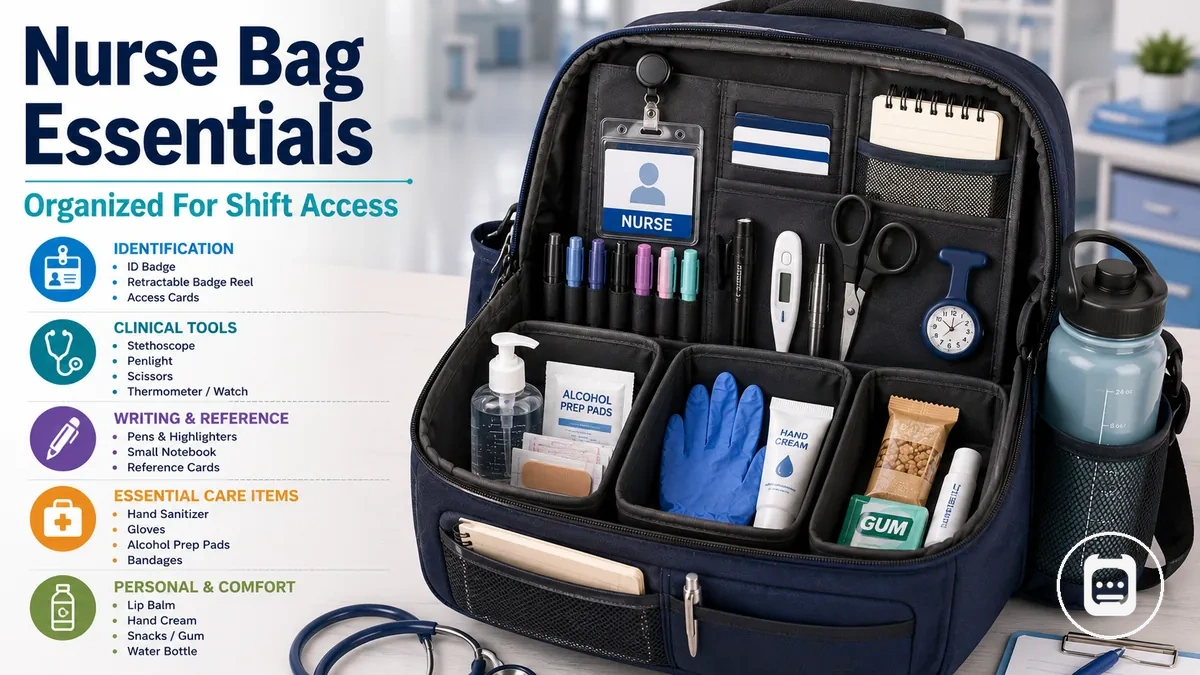
Nurse Bag Essentials for Organized Shift Use
Nurse bag essentials are the nursing accessories and carry solutions that support organized shift use through readiness, fast access, hygiene separation, and backup planning. A well-arranged nurse bag helps keep frequently used items easier to reach while reducing clutter across compartments. This page focuses on bag-specific carry and organization rather than covering every nursing accessory or serving as a product catalog.
Organized shift use depends on how a nurse bag supports access during routine tasks and changing work conditions. Fast access is often easier when tools, personal items, and backup items are stored in separate compartments rather than mixed together. Hygiene separation can help reduce unwanted contact between clean carry items and everyday personal belongings. The exact setup may vary by role, facility expectations, bag size, and carry volume.
Nurse bag essentials involve more than contents alone. A nurse bag organizer, accessory pouch, nursing tool organizer, or medical organizer bag can support different organization needs depending on access priorities and storage requirements. The goal is usually to create arrangement logic that supports retrieval without making the bag difficult to manage during a shift. The following sections examine contents, organizer formats, buying criteria, and organization decisions in greater detail.
Buying criteria, organization choices, and product examples should function as decision-support tools rather than fixed rules. Different nurses may prefer different layouts based on workflow, commuting habits, or workplace routines. The focus throughout this page remains on practical organization and informed selection without product promotion.
What Belongs in a Nurse Bag for Daily Work
A nurse bag for daily work should carry shift-use items that support access, documentation, hygiene, comfort, and backup needs during a shift. Nurse bag contents are usually selected to support daily routines rather than create a fixed collection of nursing accessories. The exact combination of carry items often varies by role, personal routine, and facility rules.
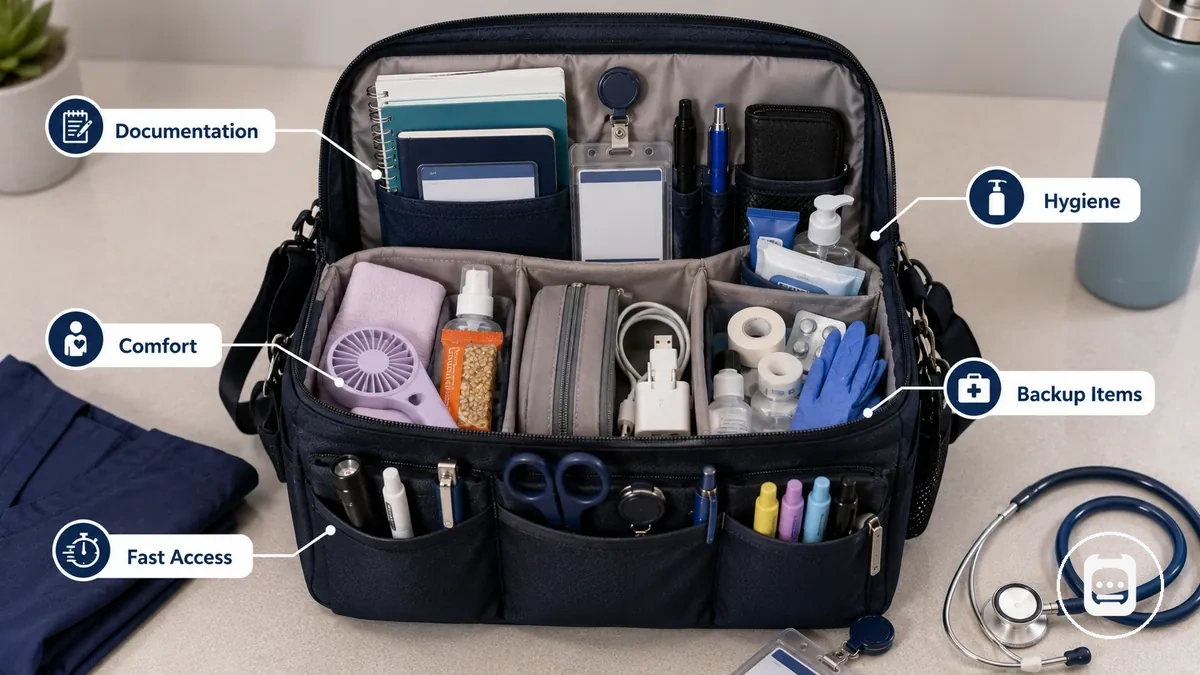
Daily work needs can differ between nurses, but most nurse bag setups are organized around a few practical functions. Documentation items are often placed where they remain easy to access during a shift routine, while hygiene-related items are commonly separated from personal items. Comfort-focused carry items and backup needs may be included when workflow, storage space, and facility rules allow. The goal is to support organization and access through bag-specific carry logic.
The categories below show how shift-use items are commonly grouped inside a work bag. Exact contents depend on role variation, workplace expectations, and personal routines rather than a single standard setup.
- Documentation items — carried to support note-taking or work-related record tasks; placement may depend on how frequently they are used.
- Hygiene items — carried to help maintain separation between clean-use and personal items; storage needs can vary by facility rules.
- Personal comfort items — carried to support longer work periods; the type and quantity may depend on individual preferences.
- Backup items — carried as reserve supplies for routine situations; carry volume often depends on available bag space.
- Frequently accessed tools — carried where retrieval is easier during a shift; placement may change based on workflow needs.
A nurse bag focuses on bag-specific carry planning, while broader work-shift preparation can include nursing accessories that are not necessarily stored in the bag. For a wider overview of related categories, see the nursing accessories hub. Additional context on workplace-focused carry options is covered in nursing accessories for work.
Nurse Bag Essentials by Use Category
Nurse bag essentials are easier to organize when they are grouped by use category instead of by individual accessory names. A category-based packing check helps connect each accessory group to an access need, work function, carry condition, and shift-readiness effect. This approach supports practical packing without assuming the same setup fits every nurse.
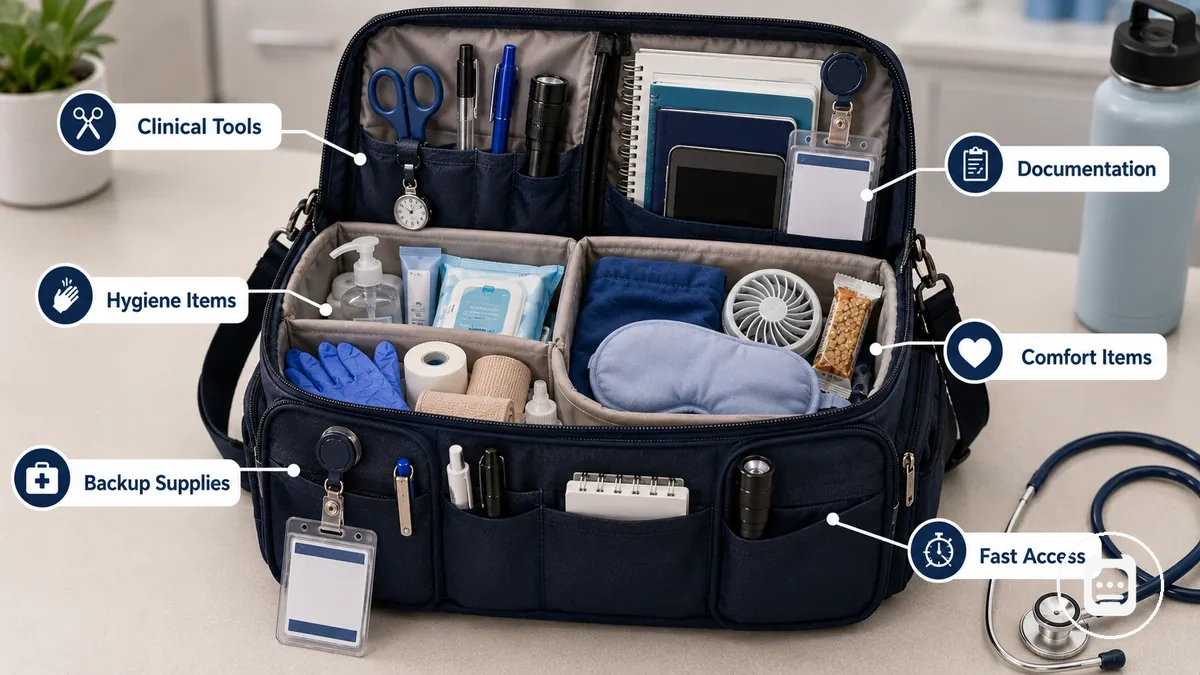
Reviewing nurse bag essentials by work-use group can make pre-shift preparation easier to verify. The checklist below focuses on carry categories and their purpose rather than creating an exhaustive list.
- Clinical tools — examples may include commonly used work tools; carry them where fast access supports routine work function and efficient placement.
- Documentation items — examples may include note-taking or record-support materials; carry them in an accessible location when documentation is part of the shift routine.
- Hygiene items — examples may include personal hygiene supplies; carry them in a separate area when hygiene separation is part of the carry condition.
- Comfort items — examples may include personal-use items that support longer work periods; carry them when available space and personal preferences allow.
- Backup supplies — examples may include reserve-use items; carry them when shift readiness benefits from having alternatives available.
- Frequently used accessories — examples may include items accessed throughout the day; carry them where retrieval is easier when workflow requires repeated access.
These examples illustrate packing logic rather than define a fixed set of contents. Access need, work function, and carry condition can vary by role, workplace expectations, and personal workflow. For a broader category-focused reference, see the essential accessories checklist, while recognizing that nurse bag essentials are not universal for all nurses.
Clinical Tools and Documentation Items
Clinical tools and documentation items are work tools and documentation supplies that often need reliable placement inside a nurse bag to support shift access and loss prevention. Items with higher access frequency are usually easier to manage when stored in consistent locations. Reliable placement helps keep frequently used items easier to find during routine tasks.
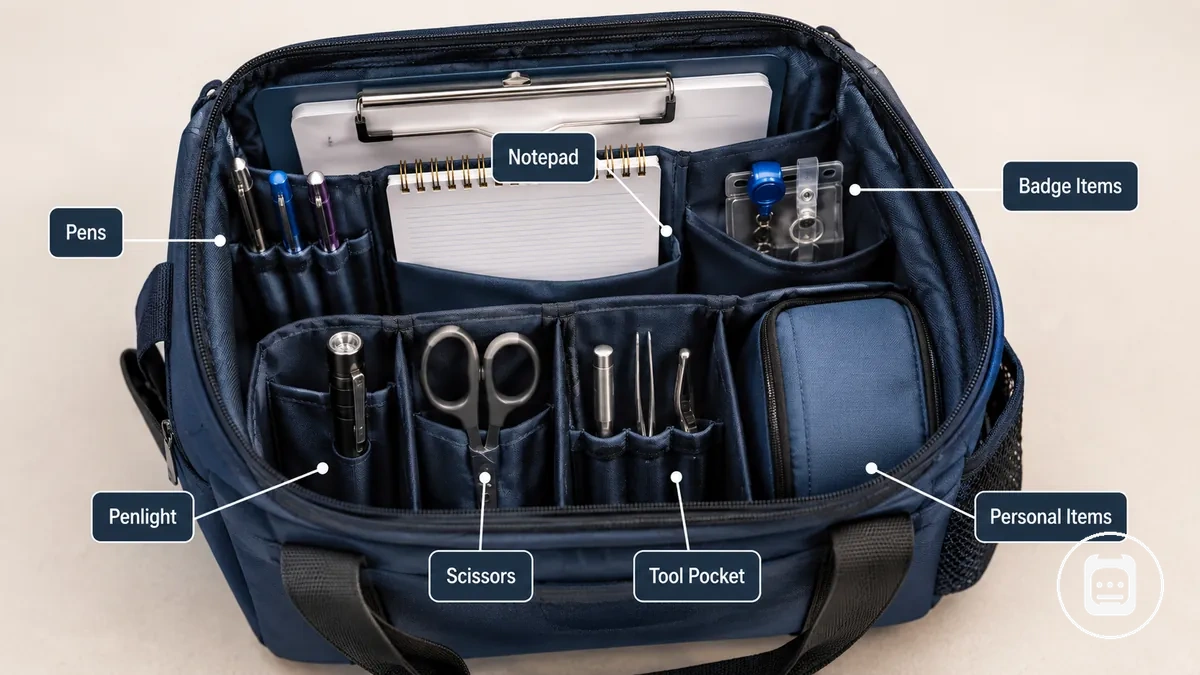
Personal carry needs can differ from facility-supplied resources, so carrying certain clinical tools or documentation items often depends on workplace routines and individual preferences. For example, a facility may provide some work tools, while personal carry items may still be included when convenient access is preferred. The examples below focus on practical placement decisions rather than a full tool inventory.
- Pens — often used for shift notes and documentation tasks; carry them in a dedicated pocket when access frequency is high to support faster retrieval.
- Notepad or clipboard — may support documentation and quick reference needs; carry it in a flat compartment when organized storage helps manage shift notes.
- Badge items — commonly accessed throughout a shift; carry them in a consistent location when quick identification access is needed.
- Penlight — may be used during specific work functions; carry it in a secure compartment when loss prevention is a concern.
- Scissors and small tools — may support routine work tasks; carry them separately from personal items when easier retrieval and organization are priorities.
Hygiene, Protection, and Quick-Clean Items
Hygiene items, protection items, and quick-clean items can support daily work preparation when a nurse bag includes organized storage and separation. When clean carry items are mixed with unrelated belongings, access and cleanup may become less convenient. Separation helps keep hygiene-related items easier to locate and manage during routine use.
Carry conditions can vary by workplace rules, personal preferences, and bag organization needs. The checklist below focuses on item type, hygiene attribute, use condition, and practical convenience or contamination-control considerations within a nurse bag.
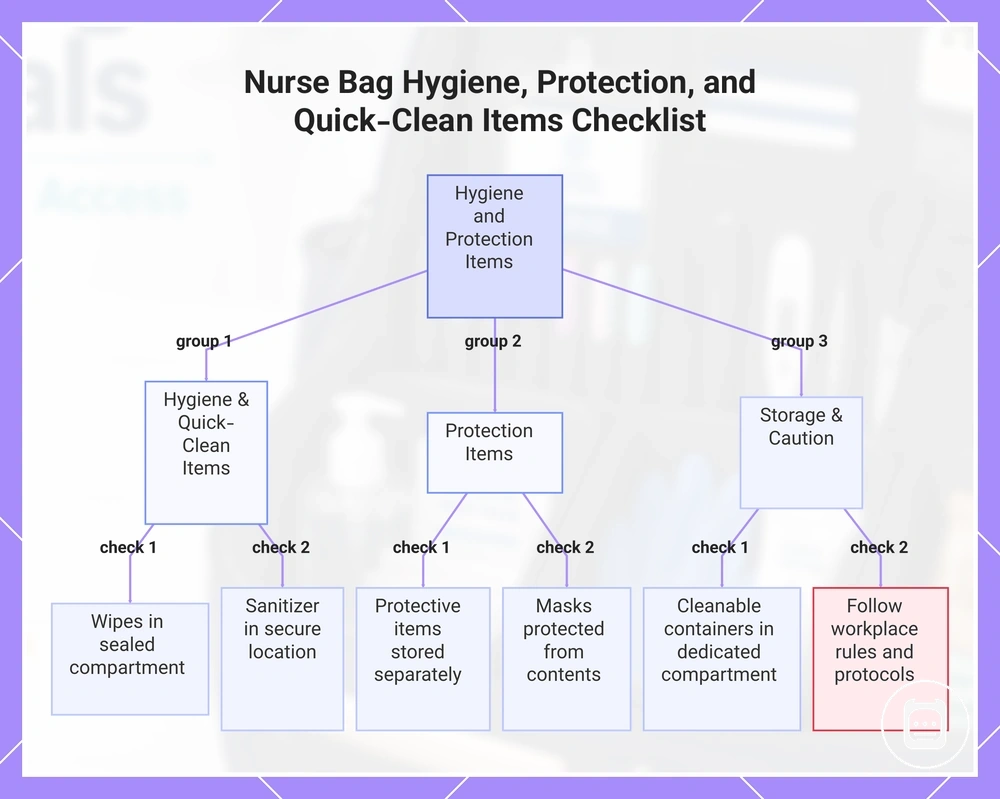
- Wipes — may support quick-clean needs; carry them in a sealed compartment when convenient access and separation are priorities.
- Sanitizer — may be useful for routine personal carry situations; keep it in a secure location when spill prevention is a concern.
- Small protective items — may be carried when workplace rules and personal carry preferences allow; store them separately to support organization.
- Spare masks — may be included when appropriate for the work setting; keep them protected from unrelated bag contents when clean storage is preferred.
- Cleanable containers — may help organize hygiene items and quick-clean items; place them in a dedicated bag compartment when separation supports convenience.
Caution: workplace rules and clinical protocols should guide what is personally carried. Hygiene items, protection items, and quick-clean items can support organization and preparation, but personal carry choices often depend on local requirements and work conditions.
This chart shows the main categories of hygiene, protection, and quick-clean items for a nurse bag, with carry conditions and a caution about workplace rules.
Comfort, Hydration, and Backup Items
When a shift extends beyond the expected routine or access to personal storage is limited, comfort items and backup items can support shift continuity without becoming the primary purpose of a nurse bag. These items are typically carried for occasional needs rather than frequent use. Storage priority should remain with fast-access tools needed during routine work tasks.
Comfort items, hydration supplies, and backup items are often easier to manage when stored in secondary compartments. For example, in a crowded bag, backup supplies may be easier to locate when separated from clinical tools or clean carry items. This approach supports clutter control and keeps storage priority focused on frequently accessed equipment through clear separation.
The checklist below focuses on item needs, storage priority, and shift-use effect.
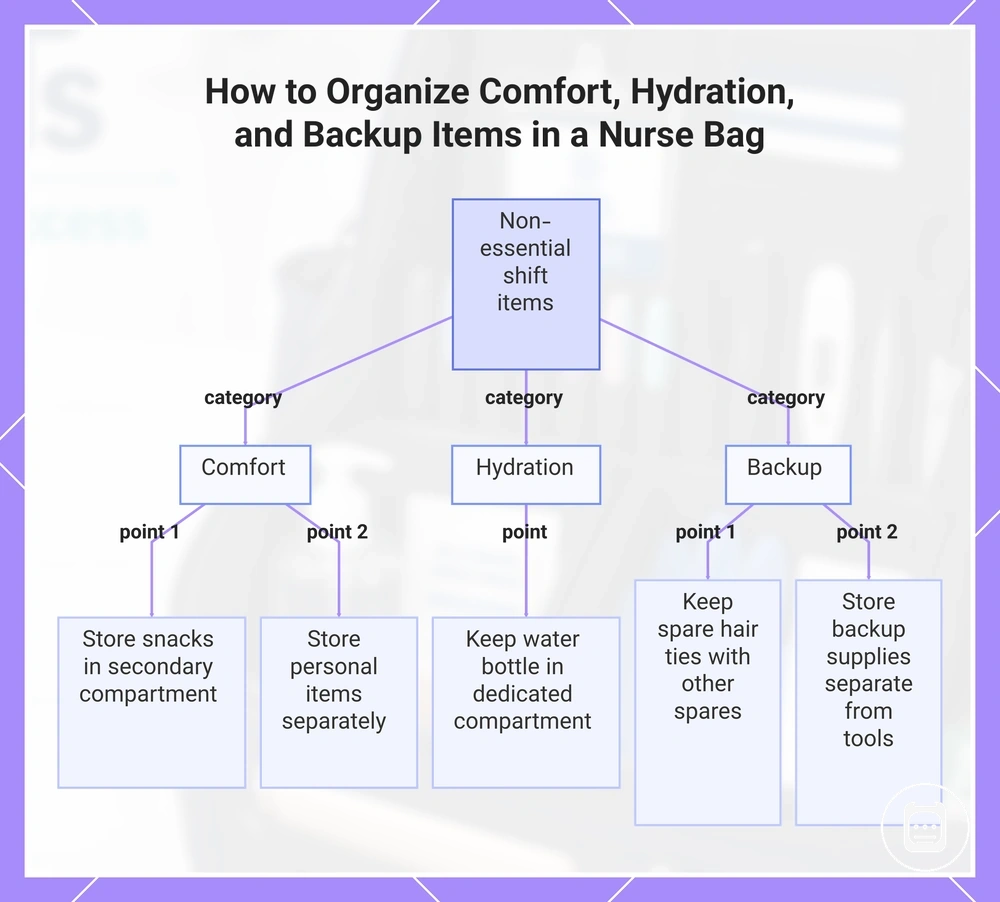
- Comfort: Snacks — may help address short-term need states during a shift; store them in a secondary compartment when fast-access space is limited.
- Hydration: Water bottle placement — may support convenient hydration access; keep it in a dedicated compartment when spill risk is a consideration.
- Comfort: Personal items — may provide convenience during longer work periods; store personal extras separately when organization is a priority.
- Backup: Spare hair ties — may be useful when an unexpected replacement is needed; keep them with other spare items to reduce clutter.
- Backup: Backup supplies — may support contingency needs during a shift; store them in a separate area when preserving storage priority for frequently used tools.
This chart shows the recommended storage placement for comfort, hydration, and backup items to maintain clutter control and prioritize fast-access tools.
Organizer Formats for Nursing Accessories
Organizer formats depend on shift routine, carry volume, and access frequency rather than a single preferred option. A nurse tote organizer may support larger carry setups, while a pouch, pocket organizer, utility pouch, or fanny pack may prioritize faster access to selected items. The main comparison axis is the trade-off between access, capacity, portability, and bag fit.
Different organizer formats balance storage and retrieval in different ways. A tote insert or insert organizer may provide more compartments and bulk storage, but it can occupy more bag space. A pouch or pocket organizer may improve access to frequently used items, though capacity is often more limited. A utility pouch and fanny pack can offer portable organization, but the trade-off depends on how many nursing accessories need to remain accessible versus stored.
| Option | Access Strength | Capacity Limit | Best-fit Use Case |
|---|---|---|---|
| Nurse tote organizer | Compartment-based access | Usually requires more bag space | Higher carry volume with separation needs |
| Pouch | Fast retrieval of grouped items | Limited storage volume | Small accessory categories kept together |
| Pocket organizer | Quick access to frequently used items | Lower capacity | Items accessed repeatedly during a shift |
| Utility pouch | Portable organization | Depends on pouch size | Mixed accessory storage with moderate capacity |
| Fanny pack | Wearable access | Typically limited bulk storage | Situations where portability is prioritized |
Selection often depends on whether access or storage capacity has higher priority. A nurse tote organizer may suit larger bag layouts, while a small organizer or pouch may fit nurses who carry fewer items. For users comparing bag-focused organization with broader portable nursing accessories, the choice usually depends on how much organization needs to stay inside the bag versus remain immediately accessible.
Nurse Tote Bags and Insert Organizers
Nurse tote bags and insert organizers are carry solutions that help create compartmentalized carry inside a larger nurse bag. Their usefulness often depends on capacity needs, compartment visibility, and how frequently items need to be accessed during a shift. Together, they can support organized storage through compartments, pocket structure, and compartmentalized carry.
Fit and capacity conditions vary by bag layout and carry volume. Insert organizers may help keep items grouped when a larger bag has limited internal structure, while tote inserts with removable dividers can adapt to changing storage needs. When multiple item categories need to remain visible, an insert organizer may be more suitable than loose pouches because compartments can remain easier to identify at a glance.
The features below illustrate how specific attributes can affect access, organization, and daily use.
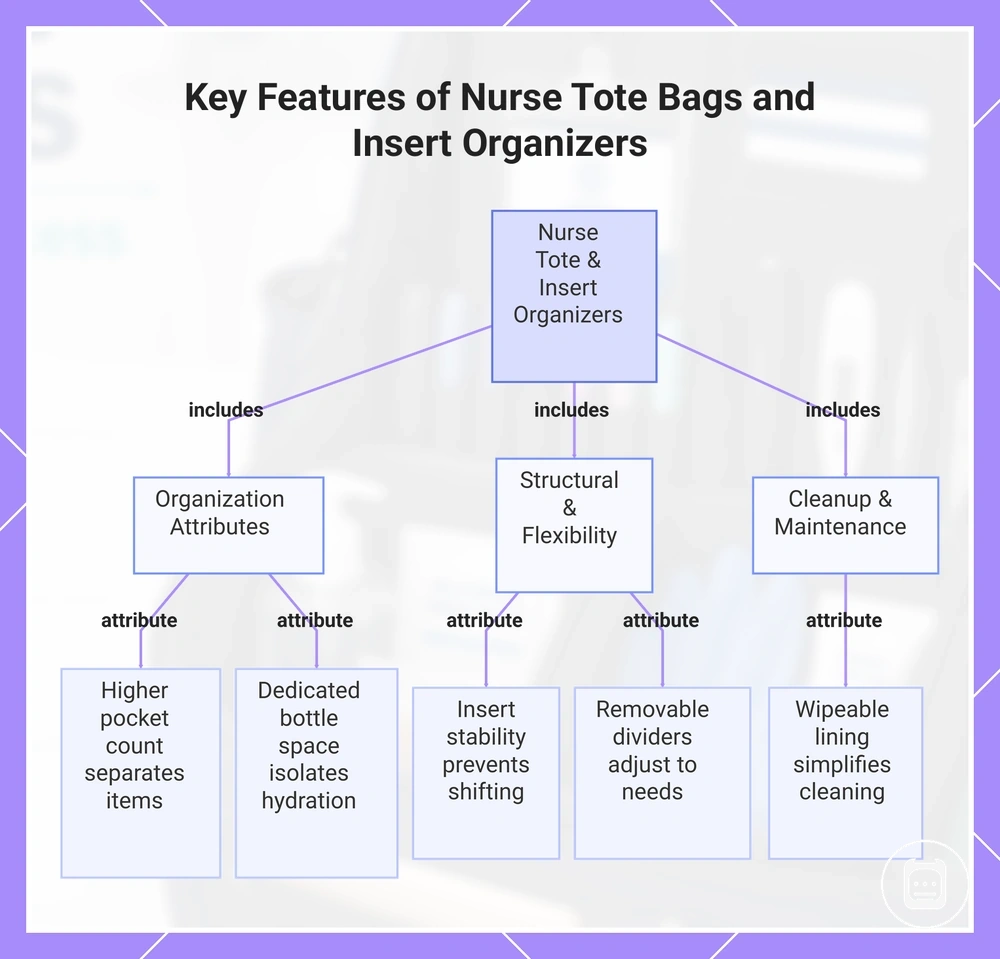
- Pocket count: Higher pocket count may improve organization when multiple item categories need separate storage.
- Insert stability: Greater insert stability can help compartments remain in place when the bag is moved frequently.
- Removable dividers: Removable dividers may support flexible organization when storage needs change between shifts.
- Bottle space: Dedicated bottle space can help separate hydration items from other bag contents during daily use.
- Wipeable lining: A wipeable lining may support easier cleanup when cleanliness and routine maintenance are priorities.
This chart identifies the main attributes of nurse tote bags and insert organizers that affect access, organization, and daily use.
Pouches, Pocket Organizers, and Fanny Packs
Pouches, pocket organizers, and fanny packs differ primarily by access location, capacity limit, and how quickly items can be reached during a shift. These small organizers address different carry needs than a main tote or insert because they emphasize proximity and retrieval speed rather than larger storage volume. The central trade-off is proximity versus capacity.
Small-format organization often depends on workflow, workplace acceptance, and personal comfort preferences. A utility pouch or accessory pouch may help keep related items together inside a larger bag, while pocket organizers can provide fast access to small tools with more limited storage. A fanny pack functions as a wearable organizer, but workplace rules, facility dress expectations, and comfort should influence whether that access location is appropriate for a particular use condition.
Comparison of small organizer formats:
| Format | Strength | Limitation | Best Use |
|---|---|---|---|
| Pouches / Utility Pouch | Flexible access location within a larger bag | Capacity limit varies by pouch size | Keeping related accessories grouped together |
| Pocket Organizers | Fast access to small tools | Limited storage capacity | Frequently accessed items that benefit from quick retrieval |
| Fanny Packs | Wearable organizer with close access location | Capacity limit and comfort may vary by use condition | Situations where immediate access is useful and workplace acceptance permits |
Buying Criteria for a Nurse Bag Organizer
Buying criteria for a nurse bag organizer depend on how pocket layout, capacity, cleanability, durability, closure design, and access points support daily use. The most suitable organizer often varies by bag size, carry volume, and retrieval needs rather than by product claims. The decision should focus on how organizer features affect access, storage control, and day-to-day usability.
Selection criteria become easier to evaluate when each organizer feature is linked to a practical use condition. Pocket layout, material choice, closure type, and weight can influence organization, retrieval speed, and how well the organizer fits an existing bag routine.
| Criterion | Useful Condition | Watch-out | Decision Effect |
|---|---|---|---|
| Pocket layout | Compartments align with item categories and access frequency | Poor layout may increase clutter and slow retrieval | Can improve organization and retrieval speed |
| Material | Material supports cleanability under regular use conditions | Hard-to-maintain surfaces may require more upkeep | Influences maintenance effort and use condition suitability |
| Closure | Closure matches movement, storage, and access needs | Complicated closures may reduce convenience | Affects the balance between access and item retention |
| Weight | Organizer weight remains appropriate for expected carry volume | Excess weight may reduce carrying comfort | Influences overall bag manageability |
| Capacity | Storage volume matches routine carry requirements | Oversized organizers may add unnecessary bulk | Helps balance storage needs with portability |
| Access points | Frequently used items remain easy to reach | Restricted access may slow routine retrieval | Supports more efficient item access during daily use |
| Durability | Construction suits expected handling and use conditions | Durability expectations may vary by workload and carry habits | Influences long-term usability expectations |
A compact pouch may suit routines with lower carry volume and a smaller set of accessories. An insert organizer may fit users who need structured compartment separation inside a larger bag. A larger medical organizer bag may be more suitable when multiple item categories need dedicated storage areas. The decision depends on role requirements, bag size, and daily carry patterns rather than a single preferred format.
Pocket Layout, Capacity, and Access Points
Pocket layout, capacity, and access points affect whether an organizer supports fast retrieval and reduced clutter during a shift. A layout that matches carry volume and access frequency can make items easier to locate, while a mismatched layout may slow retrieval or waste space. Effective organization depends on matching pocket structure to actual use conditions rather than assuming more pockets are always better.
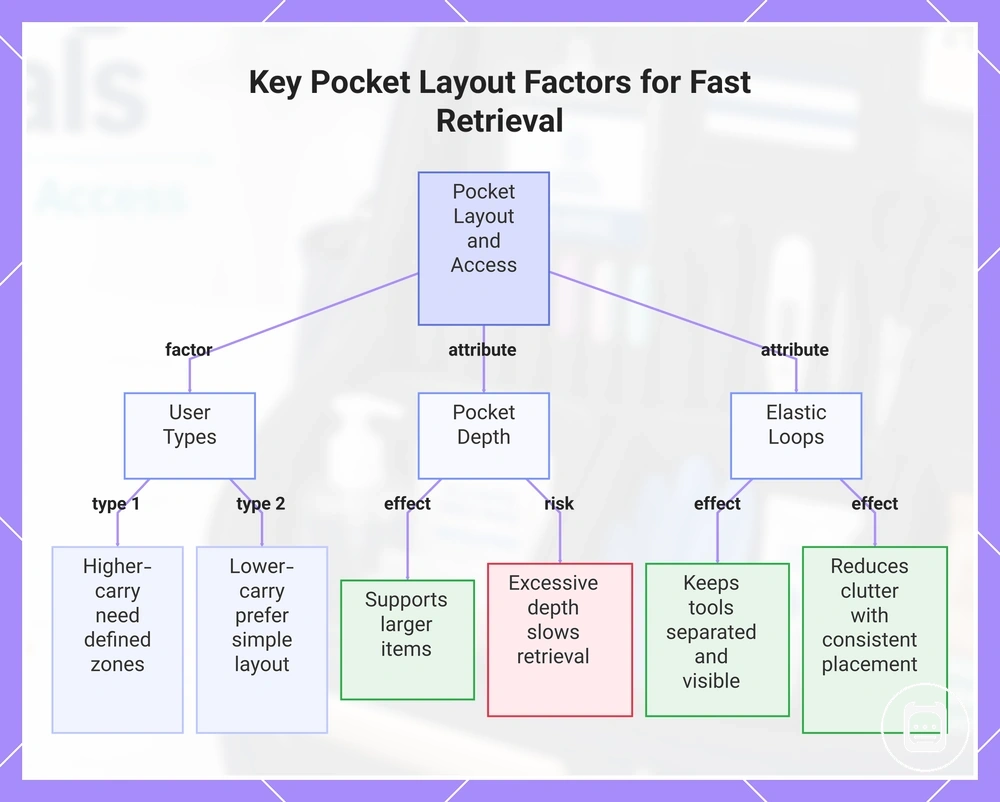
Capacity should align with carry volume rather than simply maximizing storage. Higher-carry users may benefit from more defined access zones and compartment layout, while lower-carry users may prefer a simpler pocket structure with fewer barriers between tools and access points. For users who carry fewer tools but need faster reach, a compact layout with direct access can sometimes be more practical than a larger organizer with additional compartments.
The following attributes connect layout conditions to access outcomes:
- Pocket depth: Greater pocket depth may support storage of larger items, but excessive depth can reduce retrieval speed when smaller items settle below easy reach.
- Elastic loops: Elastic loops can keep tools separated and visible, helping reduce clutter when frequently used items need consistent placement.
- Zip sections: Zip sections may improve item separation and visibility control, though repeated access can be slower when items are opened frequently.
- Transparent compartments: Transparent compartments can improve visibility and identification speed when quick visual confirmation is useful.
- Outer pockets: Outer pockets may provide easier access for frequently used items when retrieval speed has higher priority than enclosed storage.
- Bulk limits: Capacity and bulk limits should remain proportional to carry volume because excess bulk can affect fit, access, and organization efficiency.
This chart shows how user type, pocket depth, and elastic loops influence whether an organizer supports fast retrieval and reduced clutter.
Water Resistance, Washability, and Daily Durability
Water resistance, washability, and daily durability affect how easily a nurse bag organizer can be maintained during regular use. These material qualities influence cleanability, wear patterns, and upkeep requirements under different conditions. Water resistance and washability are different practical attributes because splash resistance does not necessarily mean an organizer is intended for full washing.
Material parts such as fabric, lining, seams, and zippers can influence how an organizer performs during daily use. A cleanable lining may support wipeability when minor spills occur, while drying behavior can affect how quickly the organizer is ready for reuse after cleaning. Seams and zippers are common wear points, so their condition may influence daily durability over time. Material performance often depends on use conditions, handling frequency, and maintenance habits.
The checklist below connects material attributes to practical selection considerations:
- Fabric: Water resistance may help limit the effect of light splashes, while washability depends on the material and construction.
- Lining: A cleanable lining can support wipeability when routine cleanup is needed during daily use.
- Seams: Durable stitching may help maintain structure when the organizer is opened, closed, and carried frequently.
- Zippers: Consistent zipper function can support regular access, while zipper condition may influence long-term usability.
- Drying behavior: Faster drying behavior may reduce downtime after cleaning, though results can vary by material and cleaning method.
Contrast: Splash resistance focuses on helping manage brief moisture exposure during routine use, while washability relates to how the organizer can be cleaned and dried when maintenance is required.
How to Arrange Nursing Accessories Inside the Bag
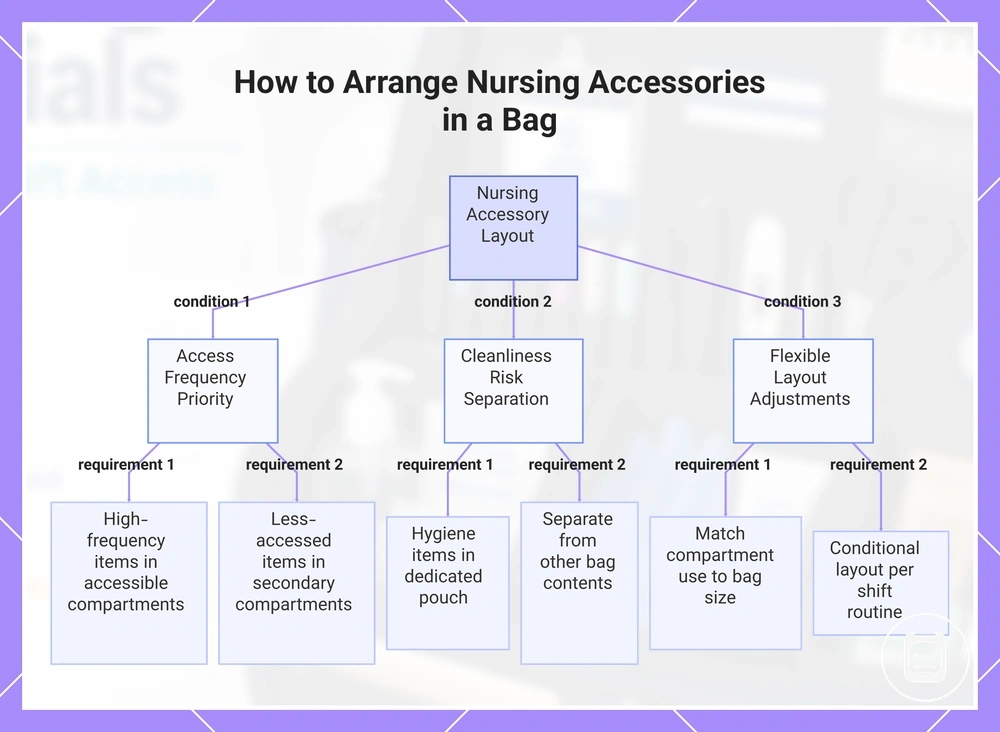
To arrange nursing accessories inside the bag effectively, placement should follow access frequency and cleanliness risk rather than a fixed layout pattern. Frequently used accessories benefit from easier retrieval, while items with a higher cleanliness risk often benefit from separation. A practical organization method starts with the access-and-separation principle.
The layout checklist below connects accessory placement to compartment condition, retrieval needs, and shift routine requirements. It is intended as a flexible arrangement method rather than a single bag layout.
- Place high-frequency accessories first: Store frequently used items in an accessible compartment so retrieval requires fewer steps during routine tasks.
- Separate hygiene-related accessories: Place items with a higher cleanliness risk in a dedicated pouch or storage zone to support separation from other bag contents.
- Use secondary compartments for backup accessories: Reserve less-accessed items for compartments that remain available without interrupting routine retrieval.
- Group related accessories together: Keep accessories with similar use conditions in the same compartment to help reduce clutter and simplify placement order.
- Adjust storage zones to bag size: Match compartment use to available space so access needs and carry volume remain balanced.
For readers interested in broader visual organization of nursing accessories, these arrangement principles can be adapted to different storage styles. Nurses who rotate between wards, shifts, or bag sizes may benefit from a conditional layout where high-access items remain in the same location while lower-priority accessories move according to the shift routine.
Arrangement decisions depend on access frequency, cleanliness risk, compartment availability, and bag size rather than a single organization method. A layout that supports consistent retrieval and separation can remain practical when accessory combinations change between work settings.
This chart shows the three main principles for arranging nursing accessories inside a bag: access frequency, cleanliness risk separation, and flexible layout adjustments.
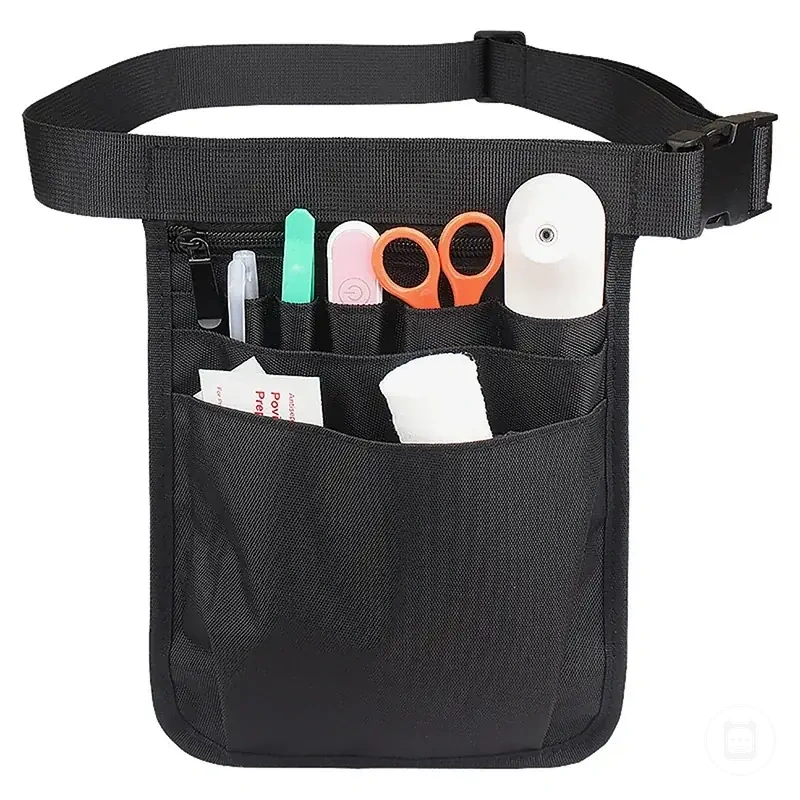
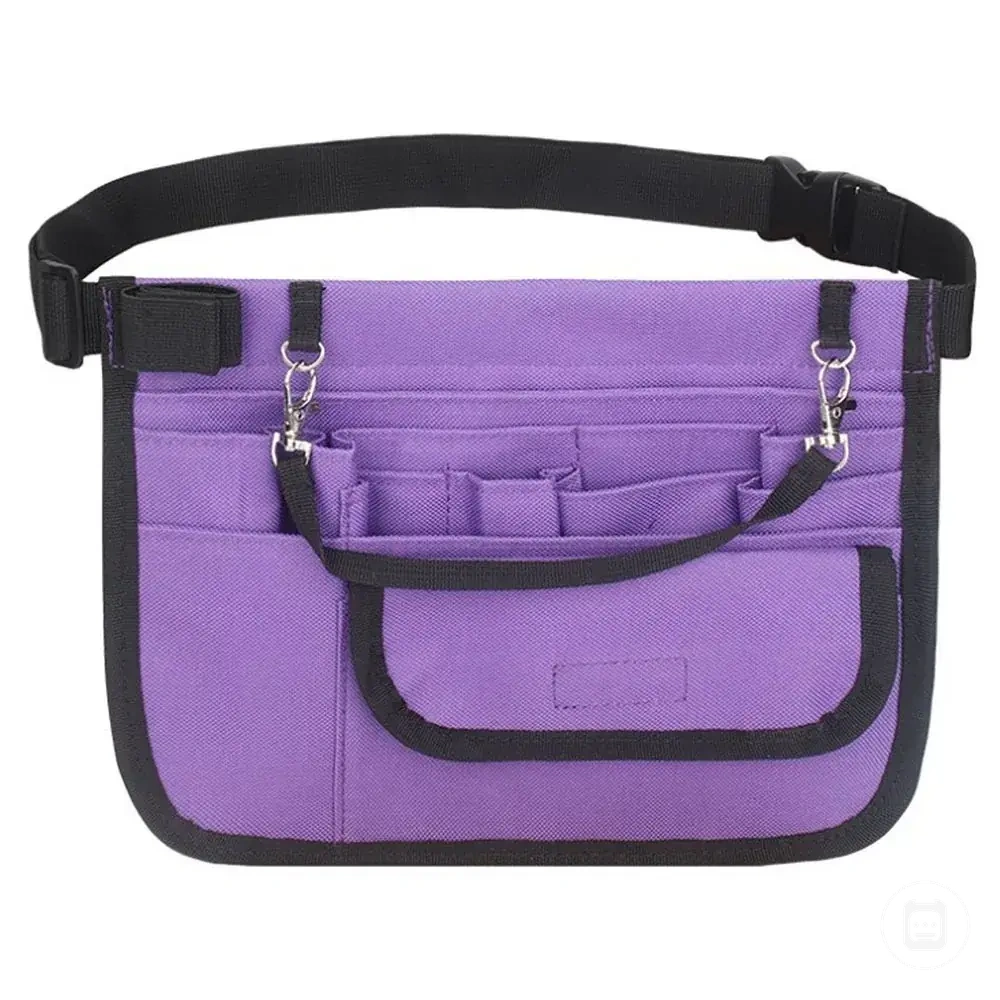
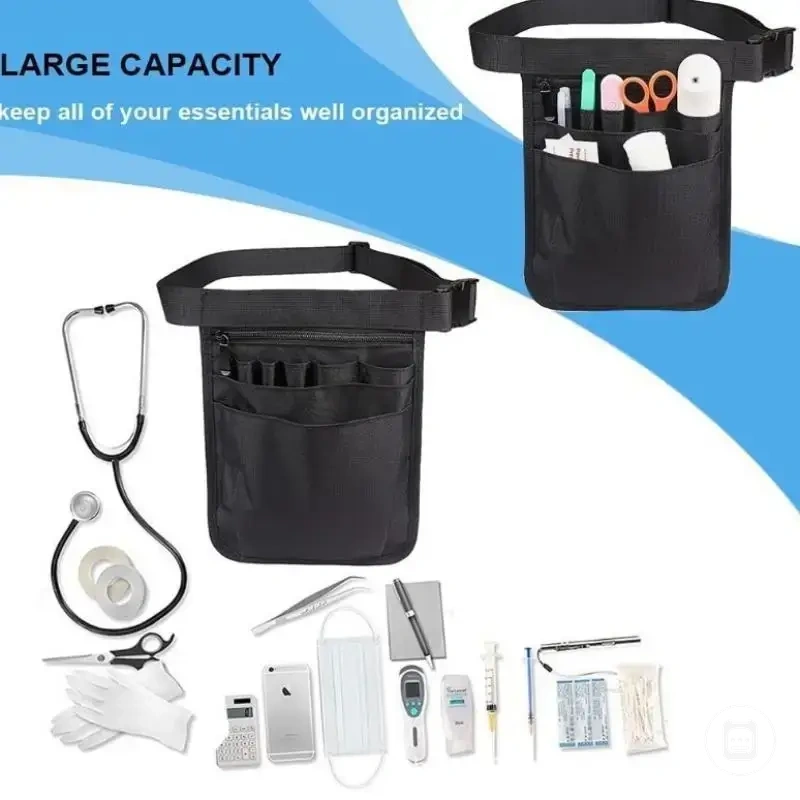
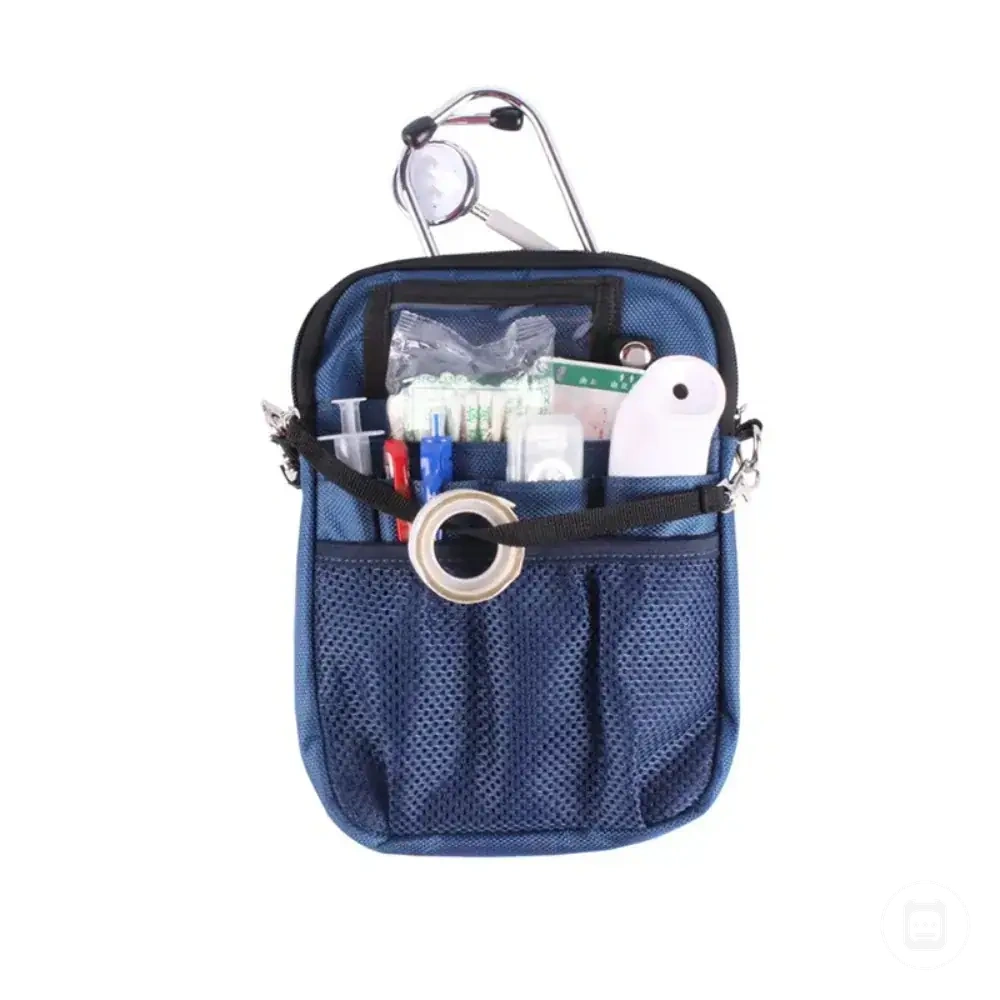
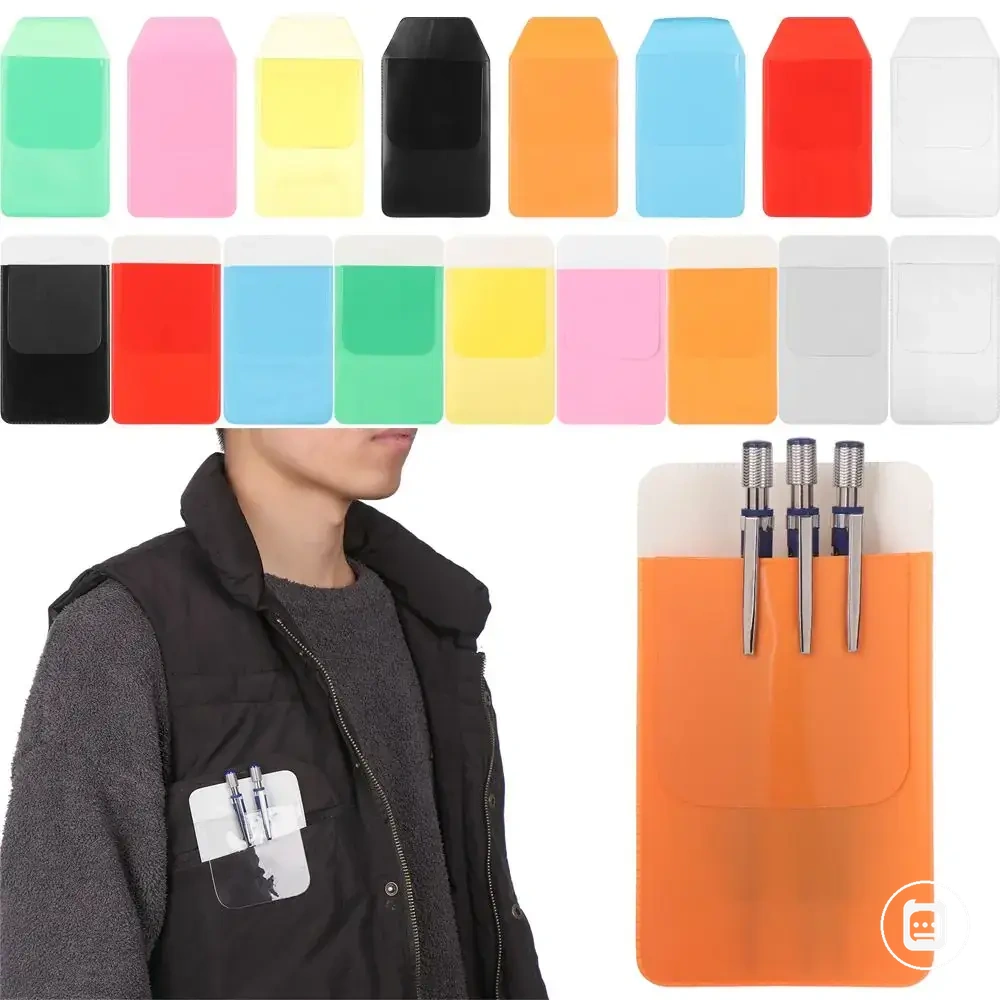
The products below are useful examples for comparing available options. Before buying, check that the compatibility criteria, key features, and product details match your needs.
Fast-Access Items Versus Backup Items
Fast-access items should be separated from backup items based on access frequency so the bag supports immediate use with less clutter. Items used repeatedly during a shift may benefit from front placement, while less-used supplies often fit better in backup storage. Access frequency should determine placement priority.
An item does not need to remain in the same category because shift routine, role, and workload can change. Immediate-use items may move from backup storage to a front pocket when retrieval becomes more frequent, while rarely used items and personal extras may move to deeper storage when access demand decreases. A practical decision signal is repeated retrieval during the same shift.
The comparison below shows how placement priority can support retrieval speed and clutter control.
| Fast-access placement | Backup placement |
|---|---|
| Fast-access items with higher access frequency placed in an easy-to-reach compartment for quicker retrieval | Backup items with lower frequency value stored deeper to support clutter control |
| Immediate-use items positioned in a front pocket when regular access is expected | Reserve items kept in backup storage until needed |
| Item groups tied to the current shift routine prioritized for front placement | Rarely used items stored away from primary access zones |
| Frequently reached accessories separated from other contents to reduce retrieval delays | Personal extras stored in secondary compartments when immediate access is not required |
Clean, Sharp, Personal, and Spill-Prone Item Separation
Items with different risk attributes should be separated so they do not create avoidable usability, damage, privacy, or spill concerns inside the bag. Mixing clean items, sharp items, personal items, and spill-prone items can make retrieval less convenient and increase the chance of cross-contact. A practical organization method uses separation and containment based on item type and risk.
The compartment checklist below separates item types by risk attribute, containment condition, and expected usability effect.
- Clean items: Store in a protected compartment when separation from personal items supports better hygiene and easier retrieval.
- Sharp items: Keep pointed tools in secure containment so exposed edges are less likely to contact other bag contents during movement.
- Personal items: Place personal items in a separate compartment to reduce cross-contact and support privacy and organization.
- Spill-prone items: Store liquid items in sealed pockets when possible so leaks are less likely to affect nearby contents.
- Snacks and electronics: Keep snacks and electronics separated from spill-prone items because moisture exposure may affect usability and storage condition.
For example, small pouches or sealed pockets can help separate clean items from liquid items when both need to be carried inside the same bag. This containment approach may reduce cross-contact and help keep accessory groups easier to identify and manage during a shift.
Common Nurse Bag Organization Mistakes
When access problems, clutter, or missing items become a recurring symptom, the likely cause is often an organization mistake rather than a lack of storage space. Poor placement, overpacking, weak separation, or a mismatched organizer can reduce access, cleanliness, comfort, or preparedness during a shift. The most useful diagnostic frame is mistake → symptom → likely cause → practical correction.
The table below helps identify common organization mistakes and connect each symptom to a likely cause and practical correction.
| Mistake | Symptom | Likely cause | Practical correction |
|---|---|---|---|
| Overpacking | Clutter problem and slower retrieval | Carry volume exceeds available compartment space | Reduce carry volume and keep only routinely needed items in primary storage areas |
| Buried tools | Access delay when frequently used items are needed | High-frequency items stored beneath less-used contents | Move frequently used tools to easier-access compartments |
| Weak separation | Items become harder to locate or manage | Different item categories share the same storage area | Separate item groups using dedicated compartments, pouches, or pockets |
| Mismatched organizer | Bag fit issue or wasted storage space | Pocket layout does not match the actual bag or carry routine | Use an organizer format that better aligns with bag size and storage needs |
| Mixed priority placement | Frequently used accessories are difficult to reach | Access frequency is not reflected in compartment placement | Assign higher-priority locations to items used more often during a shift |
Overpacking is often one of the highest-impact organization mistakes because it can create clutter and make retrieval less predictable. If a tote feels crowded or compartments become difficult to use, reducing carry volume may improve access without changing the bag itself.
Buried tools and a mismatched organizer can create different symptoms but often lead to the same access problem. When frequently used items are difficult to reach, reorganizing pocket layout or reassessing organizer fit may provide a practical correction that better matches the shift routine.
Prevention usually comes from reviewing placement decisions as carry needs change rather than treating one setup as permanent. A bag that separates item categories, matches access frequency, and maintains reasonable carry volume may remain easier to manage across different routines and work conditions.
The products below are useful examples for comparing available options. Before buying, check that the compatibility criteria, key features, and product details match your needs.