Nursing Student Accessories Checklist for School and Clinicals
Nursing student accessories are support items that help students stay prepared for nursing school, clinicals, and daily learning activities. Unlike general work-shift gear, nursing student accessories focus on compatibility with training environments, organization needs, identification requirements, and clinical readiness.
Nursing school and clinical placement settings can involve different expectations for identification, portability, hygiene, and tool use. A badge holder, penlight, organizer, planner, or notebook may be useful in different ways depending on the learning environment. Students who need broader context about accessory categories can also explore the nursing accessories hub before comparing individual item groups.
This checklist uses a compatibility-based approach rather than assuming the same requirements apply to every student. Program guidance, placement conditions, and instructor expectations may influence which essentials are appropriate, while other accessories may remain optional until clinical use becomes relevant.
Nursing student accessories need to support identification, study preparation, organization, portability, and clinical readiness. The goal is to identify accessory groups that can help students stay prepared for school and clinical responsibilities.
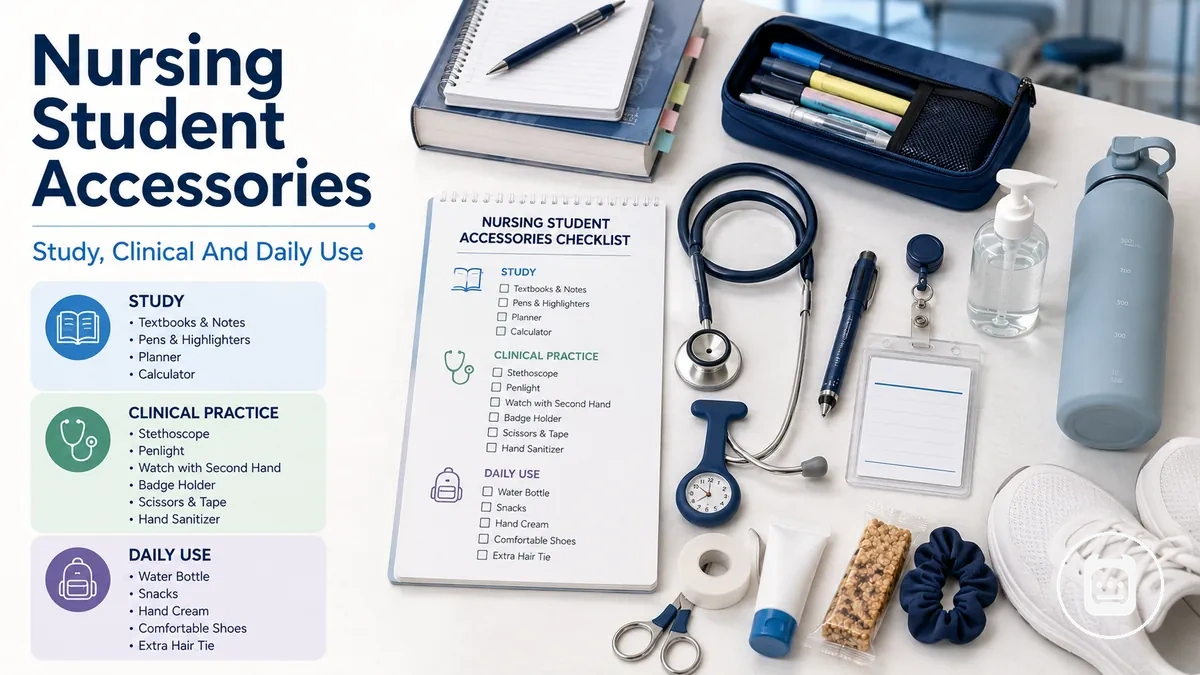
Nursing student accessories checklist for school and clinicals: The checklist below helps verify whether common accessory groups align with student-use conditions, compatibility needs, and practical readiness goals.
- Badge holder and identification accessories — May be useful when visibility requirements or placement rules apply; supports identification and daily access.
- Penlight and pocket assessment tools — Can become relevant when allowed for supervised learning activities, including situations where a pupil gauge may be used; supports clinical readiness and convenient carrying.
- Planner, notebook, or study-support items — Often help organize coursework, schedules, skills practice, and preparation tasks; supports study management throughout nursing school.
- Organizer pouch or compartment system — May improve portability and quick access when students carry multiple school supplies or clinical accessories.
- Backpack or carry organizer — Can help separate learning materials, identification items, and daily essentials while moving between classes, labs, and clinical locations.
- Pocket reference or note-support accessories — May support fast access to learning information when permitted by program expectations and placement conditions.
- Cleanable storage accessories — Can support hygiene-focused organization when accessories move between classroom and clinical environments.
What Nursing Student Accessories Need to Support
Nursing student accessories are support items that help students prepare for nursing school activities across study, lab, clinical placement, identification, and organization needs. Nursing student accessories support readiness, access to learning materials, and day-to-day student responsibilities. Their purpose is centered on student use rather than general nursing workplace preferences.
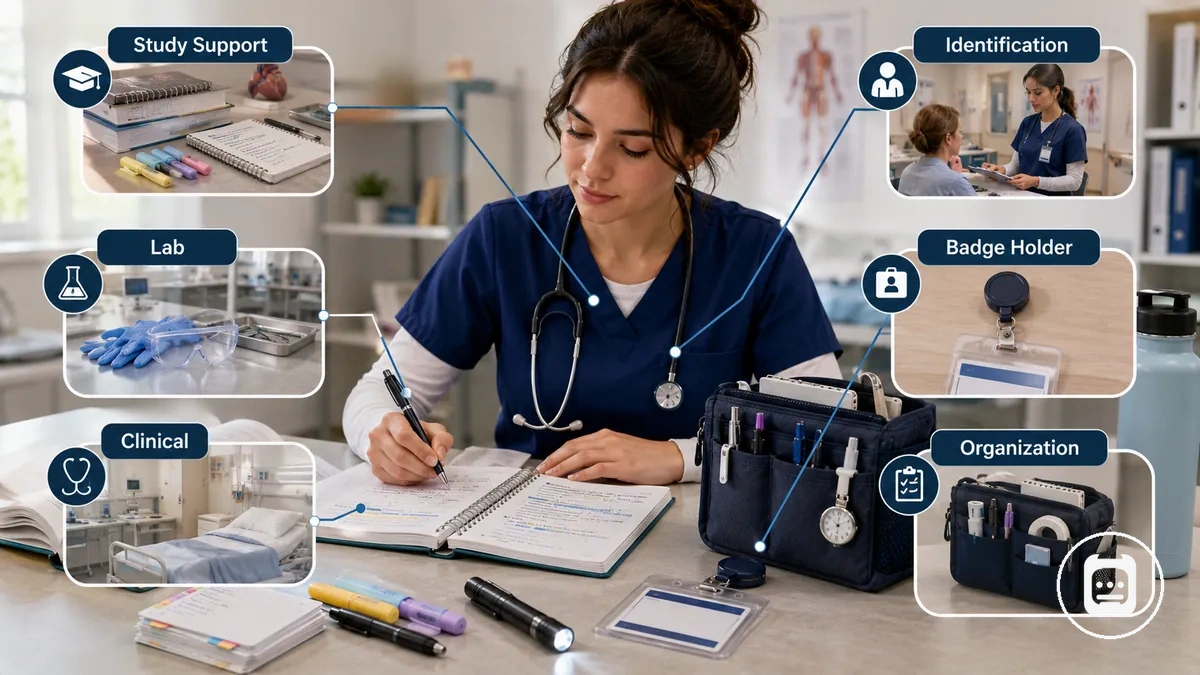
Nursing student accessories may serve different functions depending on whether the setting is a classroom, lab, or clinical placement. Identification accessories such as a badge holder can support visibility when identification is expected. A penlight may support learning activities when its use is permitted, while an organizer can support daily access, portability, and organization of nursing school supplies or clinical items. These accessory types are intended to support preparation, access, and practical student use conditions.
Requirements can vary by nursing program and clinical placement, so the same accessory type may not be needed in every learning environment. Students comparing nursing accessory types can focus on how each option supports identification, study support, organization, and clinical responsibilities within their specific requirements.
Nursing School and Clinical Compatibility Requirements
Nursing School and Clinical Compatibility Requirements depend on program rules, clinical placement conditions, hygiene expectations, and ease of use. Compatibility is influenced by both the accessory and the environment where it will be used. An accessory that fits one learning setting may not have the same suitability in another.
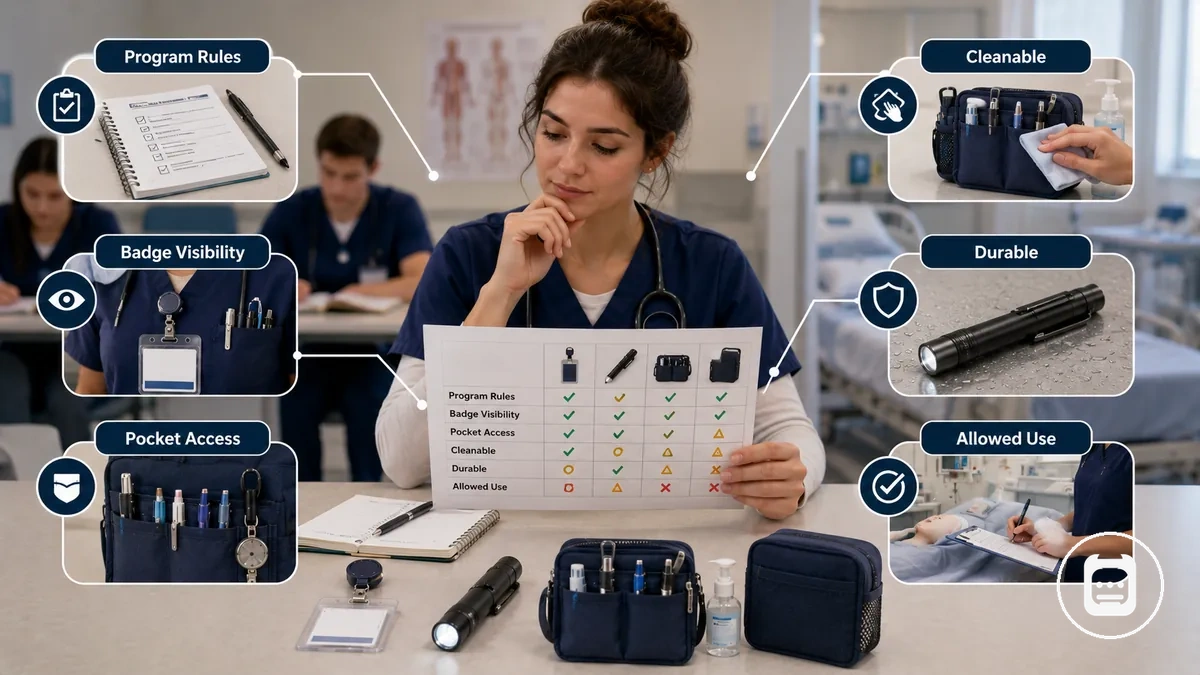
The table below organizes common compatibility factors using an entity-attribute-value approach. It connects accessory characteristics with conditions and possible decisions so students can evaluate suitability without assuming the same requirements apply across all programs or placements.
| Entity/part | Attribute/criterion | Value/condition | Effect/risk/decision |
|---|---|---|---|
| Badge holder | Badge visibility | Identification remains visible when attached appropriately | May support recognition and placement fit |
| Organizer | Pocket access | Items remain accessible without creating excess bulk | Can improve portability and daily use |
| Accessory surface | Hygiene | Cleanable materials may be preferred when routine cleaning is expected | May support suitability in a clinical placement |
| Penlight | Allowed use | Use depends on instructor rule, program rules, or clinical setting | May be useful when permitted and restricted when conditions differ |
| Carry accessory | Durable | Supports repeated transport between school and clinical placement | Can reduce wear-related replacement needs |
| Accessory component | Replaceability | Parts can be changed when worn or damaged | May extend practical use |
| Attachment item | Noise | Produces limited distraction during normal movement | May create fewer usability concerns |
| Storage accessory | Size | Matches available carrying space and use conditions | Supports suitability and convenience |
A penlight may be useful for learning activities yet still be restricted in a specific clinical setting when instructor guidance or placement conditions limit its use. When evaluating suitability, compare visibility, hygiene, pocket access, durability, replaceability, and allowed use, then review broader buying criteria for nursing accessories to support a criteria-based decision.
Program rules and placement requirements
Program rules and placement requirements determine whether an accessory is acceptable for student use. A program rule, placement requirement, instructor guidance, or facility rule may influence which items can be carried or used in a specific setting. Students should verify requirements before relying on an accessory for class, skills lab, or clinical placement.
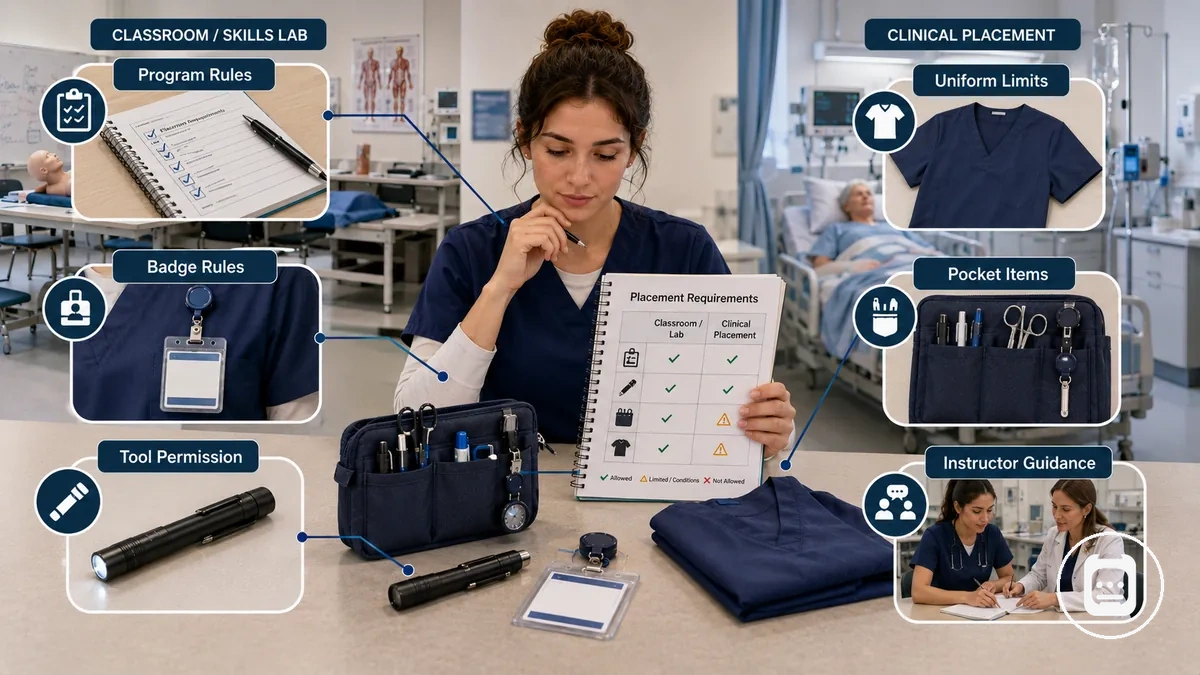
Program rules and placement requirements can be reviewed through a concise policy-check process:
- Badge rules: Verify whether badge visibility must be maintained and whether a specific attachment method is expected.
- Uniform limits: Check whether accessory size, placement, or appearance should follow school policy or facility rules.
- Tool permissions: Confirm whether a tool may be used during a clinical placement under instructor guidance.
- Pocket restrictions: Review whether pocket items are limited by workflow, visibility, or placement conditions.
- Infection-control expectations: Determine whether a cleanable accessory is preferred and whether pocket-item cleanability is part of the requirement.
A useful item may have different allowed conditions depending on the setting. For example, a penlight may be used during a skills lab activity but may be restricted during a clinical placement if instructor guidance or facility rules apply different conditions. The safest decision boundary is to verify the relevant rule source before assuming an accessory meets placement requirements.
Clinical-use suitability and patient-facing practicality
Clinical-use suitability and patient-facing practicality depend on whether an accessory supports efficient use without creating distraction, hygiene concerns, or access delays during clinical placement. Compatibility is influenced by how an accessory performs in a patient-facing clinical setting rather than how it performs in class. An accessory should support pocket access, cleanability, and placement fit while remaining practical during clinical tasks.
Clinical-use suitability and patient-facing practicality can be evaluated through the following compatibility criteria:
| Entity/part | Attribute/criterion | Value/condition | Effect/risk/decision |
|---|---|---|---|
| Badge holder | Secure attachment | Remains attached during routine movement | May support badge visibility and reduce drop risk |
| Accessory tool | Pocket access | Can be reached quickly when needed | May reduce delays during clinical tasks |
| Accessory surface | Cleanable | Supports routine cleaning expectations | May support hygiene in a clinical setting |
| Pocket item | Glove-friendly handling | Can be handled with minimal adjustment | May support practical patient-facing use |
| Attachment item | Low distraction | Creates minimal movement-related noise | May reduce unnecessary distraction |
| Carry accessory | Durable | Maintains usability through repeated use | May support ongoing clinical placement suitability |
A compact accessory with quick pocket access may be more suitable during clinical tasks, while a bulky or decorative accessory may be better suited to classroom use if it interferes with movement, attachment security, or patient-facing practicality. Compatibility depends on cleanability, secure attachment, minimal interference, and suitability for the clinical placement environment.
Core Nursing Student Accessories Checklist
A core nursing student accessories checklist helps organize identification, assessment, study support, and organization needs into practical accessory groups. Required, commonly useful, and optional items can vary by program expectations, clinical placement conditions, and individual learning needs. The checklist is organized around student-use function rather than product popularity.
This checklist groups accessory categories by the role they support in a student kit. Each accessory group is evaluated through use condition, a must-have attribute, and the outcome it may support. Requirement status should be confirmed locally because an item that is commonly useful in one setting may be optional in another.
The checklist below helps verify which accessory groups may belong in a nursing student kit based on function, compatibility, and expected use conditions.
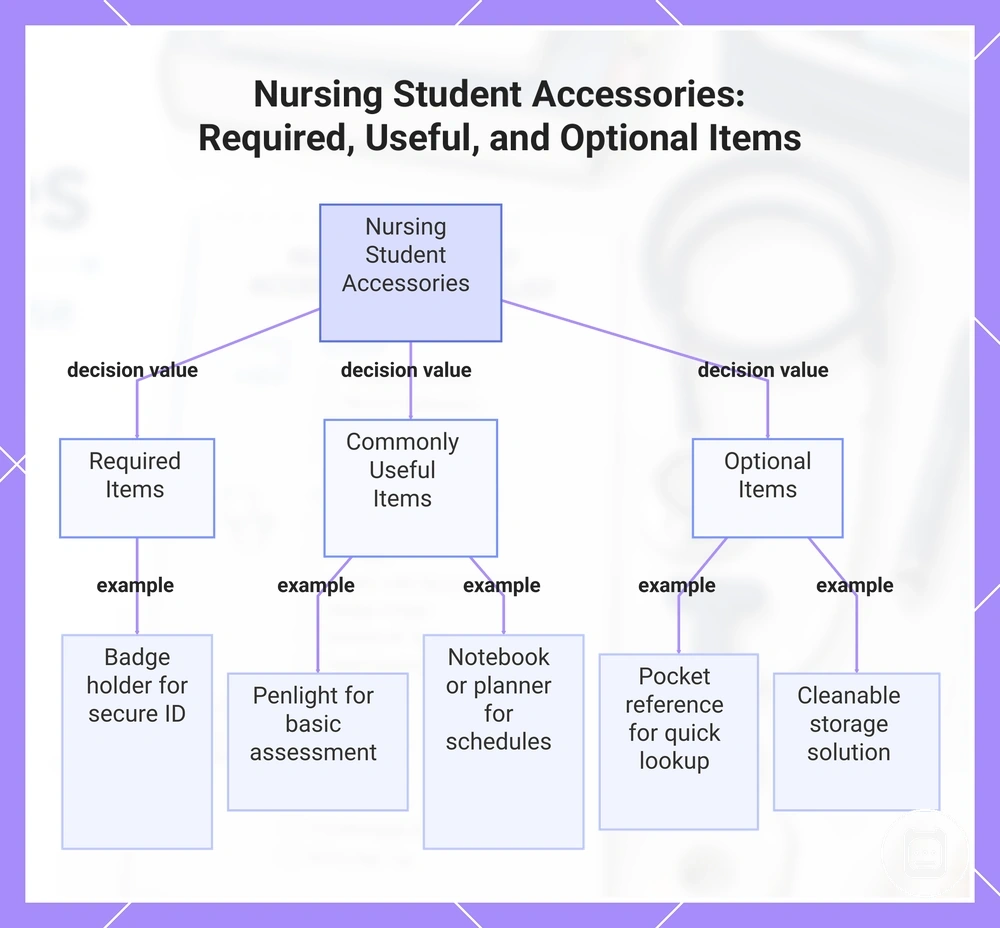
- Identification accessories — Item group: badge holder or identification support; use condition: identification must remain visible; must-have attribute: secure attachment; student outcome: may support access and recognition when identification is expected. Decision value: may be required.
- Assessment accessories — Item group: penlight or pocket assessment tool; use condition: allowed use during training or clinical activities; must-have attribute: accessible storage; student outcome: may support basic assessment-related tasks. Decision value: commonly useful.
- Study support accessories — Item group: notebook, planner, or schedule aid; use condition: coursework and skills preparation require organization; must-have attribute: easy reference; student outcome: helps track study supply needs and schedules. Decision value: commonly useful.
- Organizer accessories — Item group: organizer pouch or compartment system; use condition: multiple supplies need structured storage; must-have attribute: organized access; student outcome: helps reduce time spent locating items. Decision value: commonly useful.
- Carry accessories — Item group: backpack or transport organizer; use condition: materials move between classes, labs, and clinical placement locations; must-have attribute: practical storage; student outcome: supports transport and separation of supplies. Decision value: commonly useful.
- Pocket reference accessories — Item group: pocket reference or note-support item; use condition: permitted within the learning environment; must-have attribute: quick access; student outcome: may support information lookup when appropriate. Decision value: optional.
- Storage accessories — Item group: cleanable storage solution; use condition: clinical tool or accessory storage requires organization; must-have attribute: cleanable surface; student outcome: may support orderly storage and maintenance. Decision value: optional.
Students can use this checklist as a starting point for accessory planning. For broader checklist coverage across learning and clinical contexts, review the essential nursing accessories checklist.
This chart organizes the nursing student accessory checklist by requirement status, showing representative items for required, commonly useful, and optional groups.
Identification and badge accessories
Identification and badge accessories are an accessory group used to support visibility, access, and compliance during school and clinical use. Their function is to keep identification available while supporting portability and practical student use. Attachment method, cleanability, and durability can influence how the accessory group performs in different conditions.
The accessory group below organizes identification item types by function and attribute. Identification accessories should be evaluated according to visibility, attachment stability, cleanability, durability, and any program or facility limits that may affect clinical use.
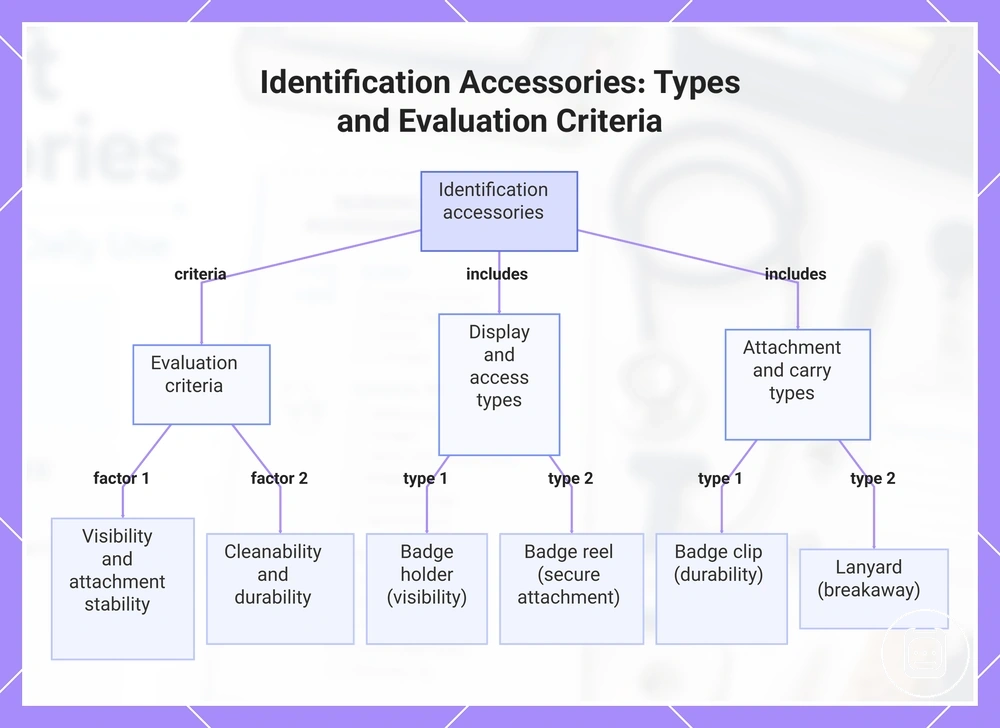
- Badge holder — Function: displays identification; attribute: badge visibility; condition: may support student use when identification needs to remain visible.
- Badge reel — Function: improves access to identification; attribute: secure attachment; condition: may support repeated badge use when frequent access is needed.
- Badge clip — Function: attaches identification to clothing; attribute: durability; condition: suitability may depend on attachment stability and clothing type.
- Lanyard — Function: carries identification; attribute: breakaway feature; condition: acceptance may vary according to program or facility requirements.
- Identification accessory surface — Function: supports routine handling; attribute: cleanability; condition: may be preferred when regular cleaning is part of clinical use expectations.
Secure attachment is important because a loose badge accessory may shift, detach, or become difficult to retrieve during skills practice or patient-facing movement. Badge visibility depends on both attachment style and positioning, while breakaway and permission-related features should be considered according to local requirements. This local attribute review helps determine whether a badge holder, badge reel, clip, or lanyard supports practical clinical use conditions.
This chart shows the main types of identification accessories and the key evaluation criteria for clinical and school use.
Assessment and pocket clinical tools
Assessment and pocket clinical tools are an accessory group used to support basic checks, documentation support, and supervised clinical readiness during student use. Their function is to keep commonly carried tools accessible while supporting portability, cleanability, durability, and practical clinical use. Storage method and allowed-use conditions can influence how the accessory group fits different learning environments.
The accessory group below organizes pocket clinical tools by function, attribute, and use condition. Assessment and pocket clinical tools should be evaluated according to portability, cleanability, safe storage, and supervised-use context, with clinical use remaining within training and placement expectations.
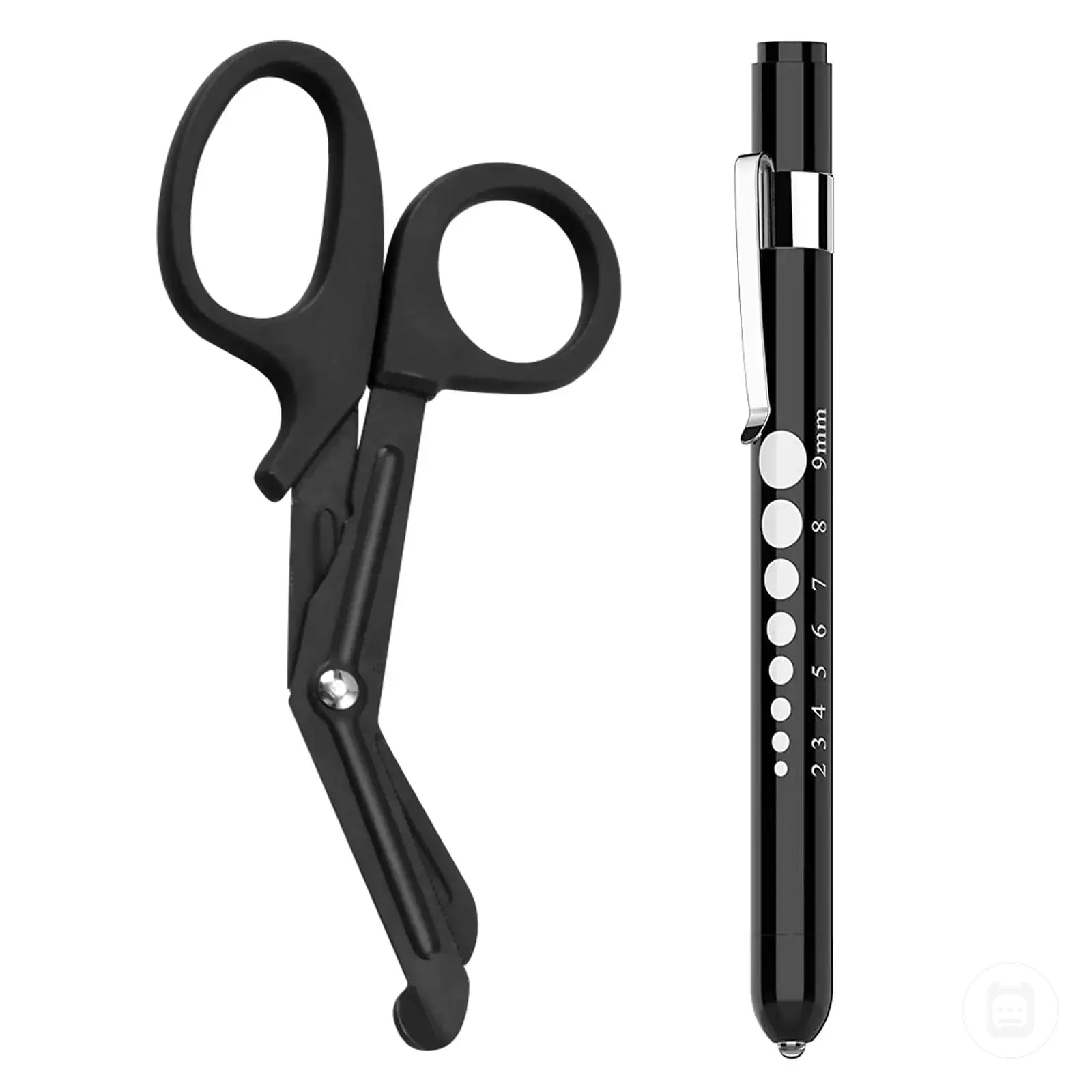
- Penlight — Function: supports basic observation activities; attribute: pocket portability; condition: use may depend on instructor guidance and clinical placement expectations.
- Pocket tool with pupil gauge — Function: supports supervised learning activities; attribute: quick pocket access; condition: use should remain within student training scope and allowed-use conditions.
- Small scissors — Function: supports limited accessory-related tasks when permitted; attribute: safe storage; condition: carrying permission may depend on facility or instructor requirements.
- Timing support item — Function: supports time-related observation or documentation activities; attribute: portability; condition: use may vary according to learning environment expectations.
- Note tool — Function: supports documentation and information retention; attribute: durability and accessibility; condition: storage should allow quick retrieval without creating unnecessary clutter.
Assessment tools, penlights, timing support items, and other pocket tools are most practical when they remain easy to carry, clean, and store securely. A pocket tool that is difficult to retrieve or store may reduce practical use during busy learning activities. Instructors and facility rules should guide which tools are carried and how they are used during clinical placement activities, providing a clear boundary for student use.
Study, note-taking, and schedule accessories
Study, note-taking, and schedule accessories are an accessory group used to keep coursework, lab preparation, and clinical timing organized during student use. Their function is to support information access, planning, and preparation while maintaining portability for nursing school and clinical use. Cleanability, durability, and storage method can influence how the accessory group supports practical use across different learning environments.
The accessory group below organizes study-support items by function, attribute, and use condition. Study, note-taking, and schedule accessories should be evaluated according to portability, quick retrieval, durability, privacy awareness, and separation between study notes and clinical documentation.
- Planner — Function: organizes schedules and preparation tasks; attribute: portability; condition: may support coordination of coursework, lab sessions, and clinical timing.
- Notebook — Function: supports note-taking and information capture; attribute: durability; condition: may help keep study information organized and accessible.
- Clipboard — Function: supports writing and document handling; attribute: quick retrieval; condition: may improve access to frequently used materials during learning activities.
- Reference card — Function: supports rapid information access; attribute: compact storage; condition: may be carried when permitted and relevant to student use.
- Schedule tool — Function: supports timing and planning; attribute: accessibility; condition: may help reduce preparation gaps when multiple activities require coordination.
An organizer with compartments that support quick retrieval may help separate study notes from clinical documentation and reduce misplaced supplies. For example, storing a planner, notebook, and reference card in dedicated locations may reduce the chance of arriving at a lab session without needed materials. Privacy awareness, organized storage, and clear separation of information sources help keep this accessory group aligned with practical preparation and clinical use conditions.
Bag, organizer, and carry accessories
Bag, organizer, and carry accessories are an accessory group used to keep nursing school items accessible without unnecessary overpacking. Their function is to support movement between class, lab, and clinical use while maintaining portability and organized storage. Cleanability, durability, and compartment layout can influence how the accessory group supports student use in different settings.
The accessory group below organizes carry accessories by function, attribute, and access condition. Bags, pouches, and organizers solve different retrieval and storage needs, so selection depends on what items are carried and how often access is required.
- School bag — Function: carries larger study and lab materials; attribute: capacity and durability; condition: may be useful when coursework and supplies move between multiple locations.
- Clinical organizer — Function: supports quick retrieval of commonly used items; attribute: compartment structure; condition: may help keep essential accessories accessible during clinical use.
- Pouch — Function: groups related item types together; attribute: portability; condition: may reduce loose-item storage and improve organization.
- Carry accessory — Function: separates personal and clinical items; attribute: cleanability; condition: may support more organized storage when different item categories need separation.
- Organizer — Function: improves access through compartment-based storage; attribute: quick retrieval; condition: may help reduce time spent locating supplies.
A large school bag may be more suitable when carrying notebooks, planners, and class materials across a full day of activities, while a small clinical organizer may be easier to manage when only essential accessories require quick access. Weight, compartment count, and cleanability should be evaluated according to practical use conditions rather than capacity alone. Separating personal items from clinical-use accessories can help maintain organization during movement between classroom, lab, and clinical environments, providing a practical local carry strategy without encouraging overpacking.
First-Year and Clinical-Stage Accessory Priorities
First-Year and Clinical-Stage Accessory Priorities depend on compatibility with program rules, learning activities, and clinical placement requirements. Early nursing school needs and clinical-stage needs are not identical because classroom use, skills lab preparation, and patient-facing environments can require different accessory types. The table below organizes stage-based priorities so students can focus on suitability and timing rather than assuming every accessory is needed immediately.
Accessory priorities often change when clinical placement begins because hygiene expectations, badge visibility requirements, pocket access needs, and allowed-use conditions may become more relevant. Program rules can influence whether an identification item, organizer, or assessment tool is appropriate for student use. Clinical setting expectations may also affect cleanable surfaces, durable construction, and placement fit. Confirming requirements before expanding an accessory kit can help avoid unnecessary purchases when final instructions are still pending.
| Entity/part | Attribute/criterion | Value/condition | Effect/risk/decision |
|---|---|---|---|
| First-year needs | Classroom use | Focus on study, note-taking, and schedule support | May prioritize organization before clinical-specific items |
| Skills lab accessories | Preparation | Requirements depend on course activities and program rules | May justify adding selected training-related accessories |
| Identification item | Badge visibility | Visibility and attachment expectations vary by setting | May become more important during clinical placement |
| Assessment tool | Allowed use | Penlight use may depend on instructor rule and placement conditions | May be delayed until requirements are confirmed |
| Organizer | Pocket access | Useful when carrying frequently accessed items | May improve accessibility during clinical-stage activities |
| Clinical-stage needs | Hygiene and cleanability | Cleanable and durable accessories may be preferred | May support suitability in a clinical setting |
Students building a starter set before receiving final clinical instructions may focus on classroom and organization accessories first, then confirm clinical placement requirements before adding items that depend on instructor guidance or allowed-use conditions. This approach keeps stage-based priorities aligned with compatibility, program rules, and actual placement needs rather than a fixed purchase order.
Accessories for early nursing school
Choose accessories for early nursing school based on study support, organization, and basic preparation needs rather than unconfirmed clinical requirements. Priority items are usually those that help manage coursework, schedules, and daily student use. Clinical stage requirements may differ, so early purchase decisions should remain flexible until additional instructions are available.
The checklist below helps decide which early nursing school accessory groups may be reasonable to select first and which items may be delayed until requirements are confirmed.
- Study item — Timing: early school stage; condition: coursework and note organization are already part of student use; purchase implication: may be a practical priority for preparation and organization.
- Organization item — Timing: early school stage; condition: schedules and materials need structure; purchase implication: can support daily organization before clinical stage requirements are known.
- Basic preparation item — Timing: early school stage; condition: simple reusable supplies support classroom activities; purchase implication: may be selected when no special requirement confirmation is needed.
- Badge preparation item — Timing: depends on program instruction; condition: badge requirements may vary; purchase implication: confirm the requirement before selecting a specific option.
- Optional item — Timing: often later; condition: clinical practice requirements, allowed tool conditions, or clean storage expectations may depend on program confirmation; purchase implication: delay until confirmation reduces the risk of an unnecessary purchase decision.
Early nursing school accessory choices should remain adaptable because program requirements, lab expectations, and clinical stage instructions may change the priority of later items. A starter item that supports study support and organization can often be selected sooner, while an optional item may be added later when requirements are confirmed. This approach helps align requirement timing and purchase decisions without assuming every accessory is needed immediately.
Accessories to add before clinical practice
Choose accessories to add before clinical practice according to clinical stage requirements, skills lab expectations, and patient-facing use conditions. Priority items are usually those that support identification, organized access, clean storage, and allowed clinical activities. Requirement timing can vary, so it is important to confirm placement guidance before making a purchase decision for clinical-specific accessories.
The checklist below helps decide which clinical functions may justify adding an accessory group and which optional items may be delayed until requirements are confirmed.
- Badge visibility support — Timing: before clinical stage activities; condition: identification visibility and attachment requirements may apply; purchase implication: choose an option after confirming local requirements.
- Observation support — Timing: when an allowed tool becomes relevant to training activities; condition: penlight suitability may depend on instructor guidance or placement expectations; purchase implication: confirm the requirement before selecting the item.
- Pocket access support — Timing: when patient-facing tasks increase the need for organized retrieval; condition: access requirements may vary by activity; purchase implication: select an accessory group that supports practical access without assuming universal requirements.
- Clean storage support — Timing: when clinical practice or skills lab participation begins; condition: clean storage expectations may depend on the clinical setting; purchase implication: choose a cleanable storage option when guidance supports that need.
- Carry and timing support — Timing: closer to placement activities; condition: facility-approved carry methods or timing support expectations may vary; purchase implication: delay selection when placement-specific guidance is not yet available.
Clinical practice requirements often become clearer as placement details are confirmed. A starter item that supports badge visibility or pocket access may be added sooner when requirements are known, while an optional item linked to a specific setting may be added later. For example, a student may delay selecting a carry method until placement-specific guidance confirms which options are suitable for that environment.
How to Choose Nursing Student Accessories
How to choose nursing student accessories depends on criteria such as program compatibility, clinical-use conditions, portability, hygiene, and long-term value. The most suitable accessory depends on how well its attributes match student-use requirements rather than convenience alone. The table below organizes key criteria that can support a practical purchase decision.
| Entity/part | Attribute/criterion | Value/condition | Effect/risk/decision |
|---|---|---|---|
| Accessory | Fit | Matches intended use conditions and program expectations | Supports a better decision; poor fit may reduce usefulness |
| Carry item | Portability | Easy to transport between class, lab, and clinical activities | Supports daily access; limited portability may reduce convenience |
| Accessory material | Cleanability and hygiene | Material can be cleaned when routine maintenance is expected | May support hygiene; difficult-to-clean materials may create limitations |
| Attachment item | Pocket access | Allows quick retrieval and secure attachment | May improve access speed; poor attachment may reduce usability |
| Accessory component | Durability | Suitable for repeated student use | May improve long-term value; lower durability may increase replacement needs |
| Accessory part | Replaceability | Can be replaced when worn or damaged | May extend useful life and improve value over time |
Each criterion connects an accessory attribute to a decision outcome. Cleanability links material choice to hygiene expectations, while pocket access links attachment style to daily access speed. Durability and replaceability can influence long-term value because replacement needs often depend on use conditions and handling patterns.
A low-cost convenience item may appear useful in the short term, while a school-compatible accessory with stronger durability, cleanability, or replaceability may provide greater value during repeated use. Required, useful, and optional accessories can be evaluated through the same criteria framework instead of relying on popularity, ranking-style claims, or short-term convenience alone.
Portability, fit, and daily access
Portability, fit, and daily access depend on whether an accessory can be carried comfortably, retrieved quickly, and used consistently during student routines. An accessory that fits classroom movement, lab sessions, commuting, and clinical rounds may provide more practical value than an accessory that is difficult to carry or access. The criteria below help evaluate whether an accessory supports everyday use before relying on it regularly.
- Pocket size: The accessory should fit available pocket space without creating unnecessary bulk; limited fit may reduce daily access.
- Bag space: The accessory should fit within normal carry space while leaving room for study and clinical materials; oversized items may create carrying friction.
- Secure attachment: The attachment method should remain stable during movement between classes, labs, and placements; weak attachment may increase the risk of misplacement.
- One-hand access: The accessory should allow practical retrieval when quick access is needed; ease of use may vary by routine and placement conditions.
- Daily carry comfort: Weight, shape, and placement should support repeated carrying; comfort depends on individual use patterns and carried items.
Portability affects how easily an accessory moves between learning environments, while fit affects whether the accessory integrates into existing storage and carry habits. Daily access influences retrieval speed during busy routines, and secure attachment may reduce interruptions caused by shifting or misplaced items. A practical check is to carry the accessory through a typical day of commuting, classroom movement, and study activities to determine whether access, fit, and carry comfort remain acceptable under routine conditions.
Durability, hygiene, and replaceability
Durability, hygiene, and replaceability depend on whether an accessory can tolerate routine use, remain reasonably cleanable, and be maintained or replaced when wear becomes noticeable. Reusable accessories may provide better value when material condition, cleaning tolerance, and replacement options remain practical for student use. The table below organizes the main criteria that affect wear, hygiene, and replacement decisions.
| Entity/part | Attribute/criterion | Value/condition | Effect/risk/decision |
|---|---|---|---|
| Accessory material | Durability | Maintains function during repeated handling | May improve value; visible damage can justify replacement |
| Accessory surface | Cleaning tolerance | Can be cleaned without obvious material degradation under normal use | May support hygiene; limited cleaning tolerance may affect continued use |
| Clip or attachment | Clip strength | Remains secure during routine movement | Weak attachment may increase replacement needs |
| Battery or replaceable part | Replaceability | Part can be changed when worn or depleted | May extend usability and improve value |
| Accessory exterior | Stain resistance | Resists visible marks during normal handling | May support a cleaner appearance between maintenance cycles |
| Accessory condition | Visible wear | Wear can be identified during routine inspection | May serve as a decision signal for replacement |
Material choice affects both durability and hygiene because cleaning frequency, handling patterns, and use conditions vary. Cleaning tolerance can influence whether an accessory remains practical for continued use, while clip strength and part replacement options affect replacement decisions and long-term value. Visible wear, damaged attachment points, or declining function may justify replacement when routine use creates limitations.
A low-cost accessory may still provide acceptable value when replaceability is simple and wear can be identified easily. In that situation, replacement convenience may matter more than extended use because the accessory can be exchanged when visible wear becomes the primary decision signal.
Starter Kit Priorities for Nursing Students
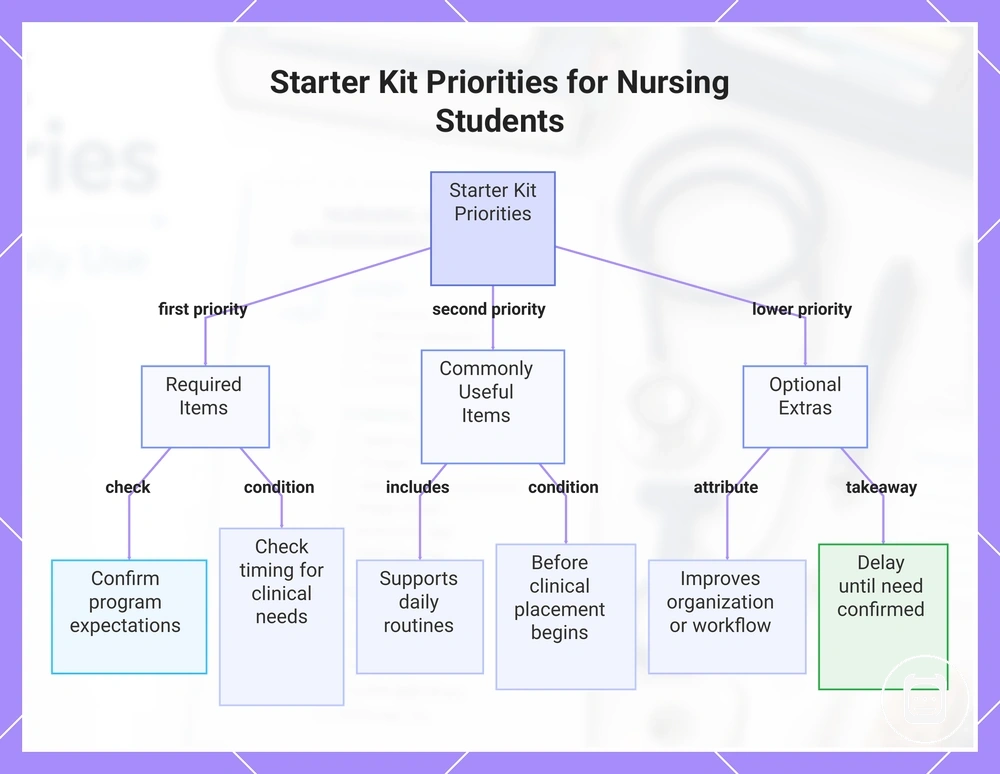
Starter kit priorities for nursing students should begin with school-compatible essentials and add clinical-ready items only when required. A starter kit works best when priority follows actual student needs rather than item quantity. This approach helps keep early purchases focused and practical.
A required item should receive first priority when it is linked to program instructions, identification needs, or participation requirements. A commonly useful item can follow when it supports note-taking, scheduling, organization, or routine nursing school activities. Required item selection depends on confirmation and timing, while commonly useful items often support daily learning before clinical placement begins. This distinction helps keep essentials separate from later additions.
An optional extra may improve organization, storage, or personal workflow, but optional items usually have a lower priority than essentials. A delay signal appears when an accessory depends on placement instructions, clinical-use conditions, or instructor guidance that is not yet available. Badge accessories, penlights, and organizer additions may be easier to evaluate after requirements are confirmed. Delaying uncertain purchases can improve value by reducing unnecessary additions to the starter set.
Confirmation checks should happen before selecting items connected to clinical activities. Students may need to confirm program expectations, placement requirements, and allowed-use conditions before deciding whether a required item is needed immediately. This decision-support step helps align the starter kit with actual use conditions.
A nursing school kit often provides more value when priority follows requirement status, confirmation timing, and practical student use. A required item should be prioritized first, a commonly useful item can be included when it supports everyday routines, and an optional extra may wait until a clear need appears. This qualified purchase-support approach encourages buying restraint while keeping the starter kit focused on essentials.
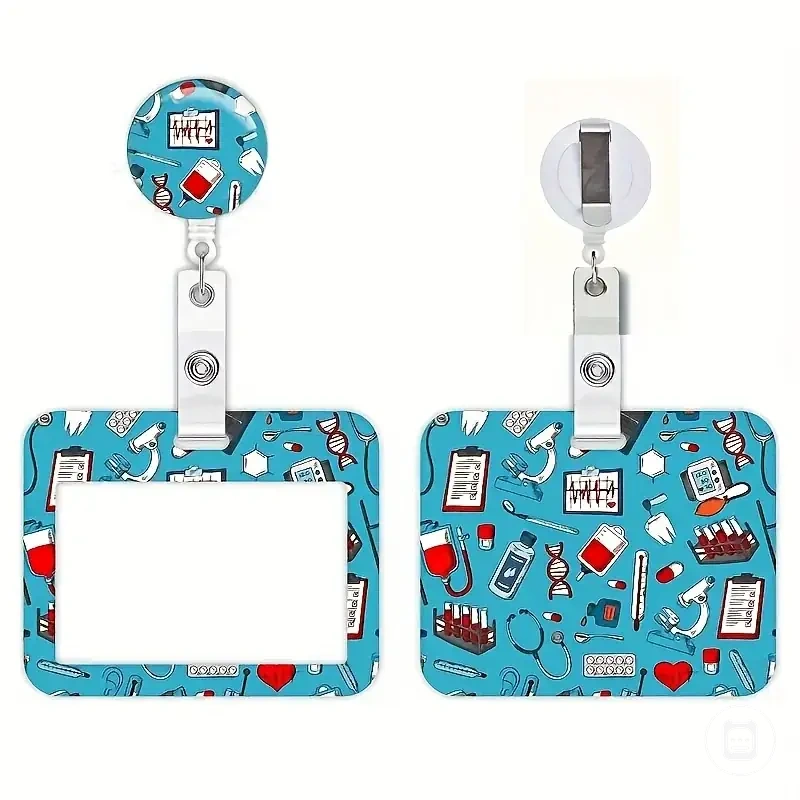
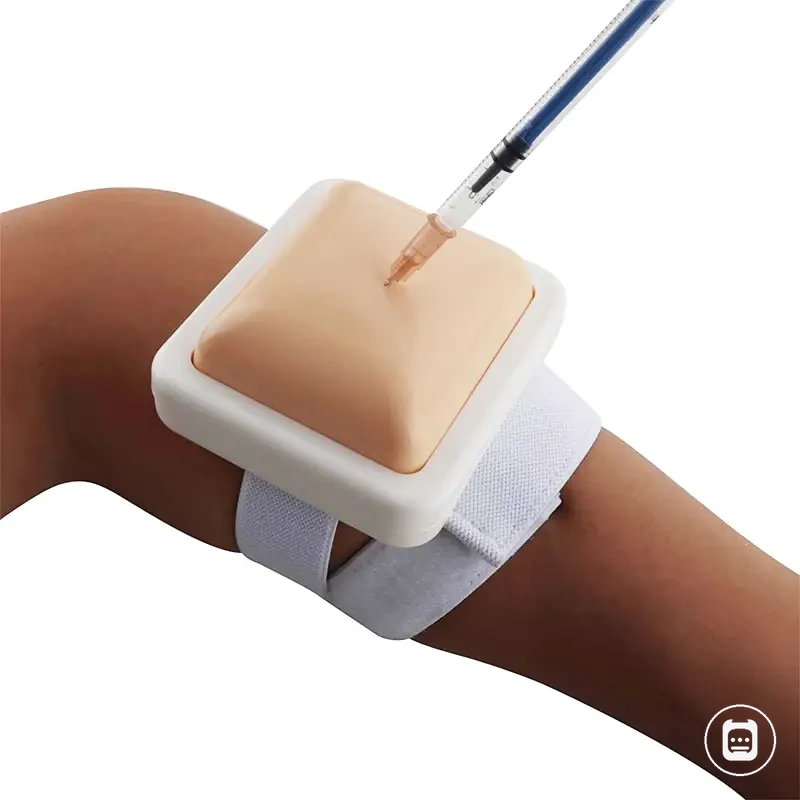
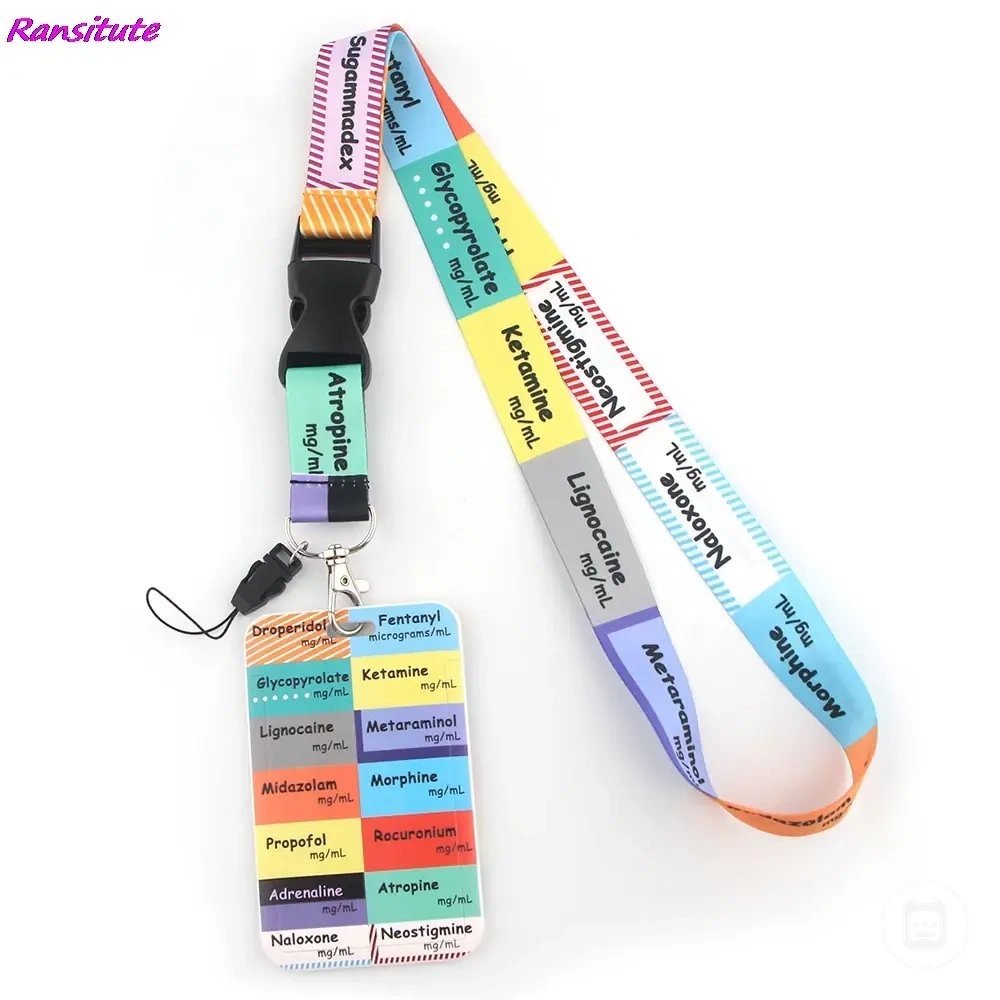
Here are product examples that may make comparison easier. Before buying, always review the compatibility criteria, essential features, and product details.

This chart shows how to prioritize items for a nursing student starter kit based on requirement status, confirmation timing, and practical use.
What belongs in a student nurse essentials kit
A student nurse essentials kit can include identification, assessment, study support, and organization accessories when they match school and clinical requirements. Required, commonly useful, and optional items vary by program expectations and placement conditions. The student kit should be adjusted to actual requirements rather than treated as a fixed bundle.
The checklist groups accessories by function so each item group can be evaluated through requirement status, compatibility condition, and practical use outcome. This checklist helps confirm what may belong in a student kit while preserving flexibility for different learning and clinical environments.
Final kit contents should be adjusted to program instructions and clinical placement rules because required and optional status may change between settings.
The checklist below verifies which accessory groups may belong in a student nurse essentials kit when they match local requirements.
- Identification group — Status: may be required; compatibility condition: identification visibility requirements apply; practical use outcome: supports recognition and access during student activities.
- Assessment group — Status: commonly useful or required depending on instruction; compatibility condition: assessment tool use is allowed; practical use outcome: supports supervised assessment-related activities.
- Study support group — Status: commonly useful; compatibility condition: coursework, note-taking, and schedule management are part of student use; practical use outcome: supports planning and information organization.
- Organizer group — Status: commonly useful; compatibility condition: supplies require structured storage; practical use outcome: supports retrieval and organization of study and clinical items.
- Badge accessory group — Status: commonly useful; compatibility condition: secure attachment is needed for daily use; practical use outcome: supports convenient identification access.
- Penlight or pocket tool group — Status: optional or commonly useful; compatibility condition: clinical tool use and storage align with program expectations; practical use outcome: supports organized access to allowed-use clinical tools.
- Backpack or carry group — Status: commonly useful; compatibility condition: materials move between class, lab, and placement settings; practical use outcome: supports transport and separation of supplies.
- Optional organization extras — Status: optional; compatibility condition: additional workflow or storage support is needed; practical use outcome: may improve convenience without being universally required.
What can stay optional until required
Choose optional accessories based on requirement timing rather than adding them to a starter item list immediately. Priority should remain with confirmed requirements, while optional items can be added later when program expectations or clinical stage needs become clearer. This approach can help avoid early overbuying without excluding useful accessories.
Optional items often depend on placement relevance, program confirmation, and practical value. A useful accessory may still be worth selecting later, but confirmation helps align the purchase decision with actual requirements. For example, waiting to confirm badge policies may prevent choosing a decorative badge item that conflicts with school rules. The checklist below highlights optionality signals that can justify delaying a purchase until requirements are confirmed.
The checklist helps decide whether an optional item should be selected now or delayed until requirements are known.
- Duplicate tool — Timing: before a clear requirement exists; condition: an existing tool already supports the same use; purchase implication: delay until an additional need is confirmed.
- Decorative badge item — Timing: before identification rules are verified; condition: school or placement policies may limit accessory styles; purchase implication: confirm requirements before selecting.
- Extra organizer — Timing: early school stage; condition: current study support and organization already meet daily needs; purchase implication: add later if a specific workflow need appears.
- Specialized carry item — Timing: before placement details are available; condition: carry preferences and storage expectations may vary by setting; purchase implication: delay until clinical stage requirements become clearer.
- Later clinical need — Timing: before clinical practice begins; condition: allowed tool use or clean storage expectations are not yet confirmed; purchase implication: avoid early selection until program guidance justifies the item.
Common Mistakes When Buying Nursing Student Accessories
When buying nursing student accessories becomes difficult, the mistake is often purchasing items before requirements are clear. This can create a mismatch between student needs and actual use conditions. Verifying requirements first may improve compatibility, usefulness, and value.
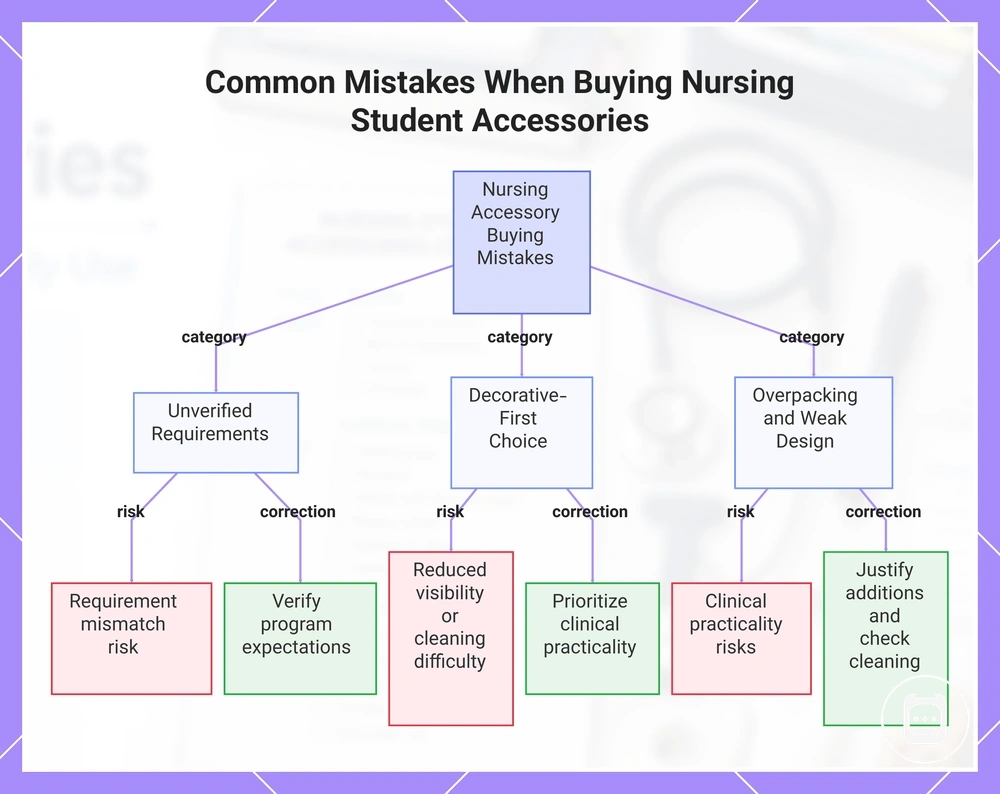
The most common buying errors usually involve requirement mismatch rather than the accessory itself. General nurse gear may not match a student requirement when school expectations, clinical permissions, or placement conditions differ. Decorative-first choices can reduce visibility or complicate cleanability, while overpacking may make organization and access less efficient. Poor cleanability, weak clips, and unverified clinical permissions can also reduce clinical practicality when requirements have not been confirmed.
The mistake-and-correction checklist below diagnoses common buying errors and offers safer corrections. A requirement mismatch may be corrected by verifying program expectations before selecting accessories. A decorative item may be more suitable after visibility, cleaning, and policy considerations are confirmed. Overbuying can often be avoided by adding items only when a specific use condition justifies them, while cleanability, attachment strength, and permission status should be verified before relying on an accessory for student use.
- Mistake: Choosing general nurse gear without checking student requirements; Risk: requirement mismatch; Safer correction: verify program expectations before selecting accessories.
- Mistake: Prioritizing a decorative item over function; Risk: reduced visibility or more difficult cleaning; Safer correction: choose clinical practicality first and add decorative features only when permitted.
- Mistake: Overpacking with duplicate accessories; Risk: reduced organization and slower access; Safer correction: add items only when a specific use condition justifies them.
- Mistake: Selecting accessories with poor cleanability or weak clips; Risk: reduced usefulness during routine student use; Safer correction: confirm that attachment and cleaning needs align with expected use conditions.
- Mistake: Buying clinical-use accessories before permissions are verified; Risk: the accessory may not match local requirements; Safer correction: verify allowed use before selecting the item.
A practical verification step is to separate required, useful, and optional accessories before making a purchase decision. Requirements should be verified through program instructions and placement expectations when available. Confirming school rules before selecting a decorative accessory may help avoid a compatibility issue. This approach can reduce overbuying while supporting clinical practicality and requirement alignment.
Here are product examples that may make comparison easier. Before buying, always review the compatibility criteria, essential features, and product details.
This chart groups common buying mistakes into three categories, showing the risk of each and a safer correction.
Buying general nurse accessories before checking student requirements
Buying general nurse accessories before checking student requirements is a mistake when student rules are not clear. General nurse gear can create a mismatch if school policy, placement limits, or tool permissions differ from student-use conditions. The correction is to verify requirements before upgrading from basic school-compatible accessories.
A general nurse accessory may be suitable only when it aligns with student status, training needs, and clinical practicality. School policy may restrict decorative items, visibility expectations, cleanability requirements, or tool permission, while placement limits can affect what students are allowed to use. Licensed-nurse work needs and student training needs are not always the same, which can make overbuying a buying error when requirements have not been confirmed. Students can avoid this mismatch by verifying requirements first and selecting additional accessories only when a clear need is justified.
The mistake-and-correction list below highlights common causes of mismatch between general nurse gear and student requirements.
- Mistake: Selecting a general nurse accessory before checking school policy; Risk: requirement mismatch; Safer correction: verify program expectations before choosing the accessory.
- Mistake: Choosing accessories before tool permission is confirmed; Risk: the item may not fit student-use conditions; Safer correction: verify allowed use before adding the accessory.
- Mistake: Prioritizing decorative features before function; Risk: visibility or cleanability expectations may not be met; Safer correction: confirm policy and clinical practicality before selecting decorative options.
- Mistake: Overbuying accessories designed for broader work needs; Risk: reduced organization and unnecessary items; Safer correction: add accessories only when requirements or placement conditions justify them.
Choosing decorative items over clinical practicality
When a decorative item is selected before clinical practicality is considered, the mistake may create a mismatch between appearance and student-use needs. Decorative choices can become a problem when they reduce visibility, cleanability, or clinical usability. The safer correction is to verify requirements and confirm that function remains suitable before prioritizing appearance.
A decorative accessory may still be appropriate when it supports both personal style and patient-facing suitability. Badge accessories, organizers, clips, and small tools can remain useful if visibility, attachment security, and cleanability are maintained. Required or useful features should generally take priority, while optional decorative elements may be added after requirements are verified. Students can avoid this buying error by confirming facility expectations and clinical practicality before choosing appearance-focused upgrades.
The mistake-and-correction checks below identify decorative choices that can conflict with function.
- Mistake: Choosing a badge accessory with dangling parts; Risk: visibility or usability may be reduced during student activities; Safer correction: select a design that maintains clear identification and practical use.
- Mistake: Selecting hard-to-clean decorative surfaces; Risk: cleanability expectations may become more difficult to meet; Safer correction: verify that the material supports routine cleaning needs.
- Mistake: Using a decorative clip with weak attachment; Risk: the accessory may become less secure during movement; Safer correction: choose an attachment method that supports reliable daily use.
- Mistake: Prioritizing appearance over readability on an organizer or small tool; Risk: information may be harder to access quickly; Safer correction: confirm that decorative features do not reduce practical usability.
Nursing Student Accessories FAQ
What nursing student accessories are usually required?
Required nursing student accessories depend on program rules and placement expectations. A required item may vary by school, clinical setting, or instructor guidance. Verify local requirements before treating any accessory as required.
Should optional accessories be purchased before clinicals?
Optional accessories can often be purchased later when clinicals and placement expectations become clearer. An optional item may become more useful after actual student-use needs are confirmed. A starter kit is usually easier to build around required items first.
Can a penlight be used during clinicals?
A penlight may be used during clinicals when instructor guidance or placement rules allow its use. Penlight suitability depends on allowed-use conditions and training requirements. Verify permission before including a penlight in student nurse supplies.
Does a badge holder need special features?
A badge holder should support visibility and practical daily use when identification is required. Additional features may be optional if they do not reduce readability or clinical suitability. Badge holder preferences can vary by placement conditions.
When should a nursing student organizer be added?
An organizer can be added when nursing student accessories become harder to manage with basic storage alone. Timing depends on coursework, clinical preparation, and daily carry needs. An organizer may become more useful as access and organization requirements increase.
How should a starter kit be planned?
A starter kit should focus on required items before optional additions. Nursing school essentials are usually easier to evaluate when program rules, clinical permissions, and placement expectations are known. This approach can help keep a starter kit practical and compatible with student-use conditions.
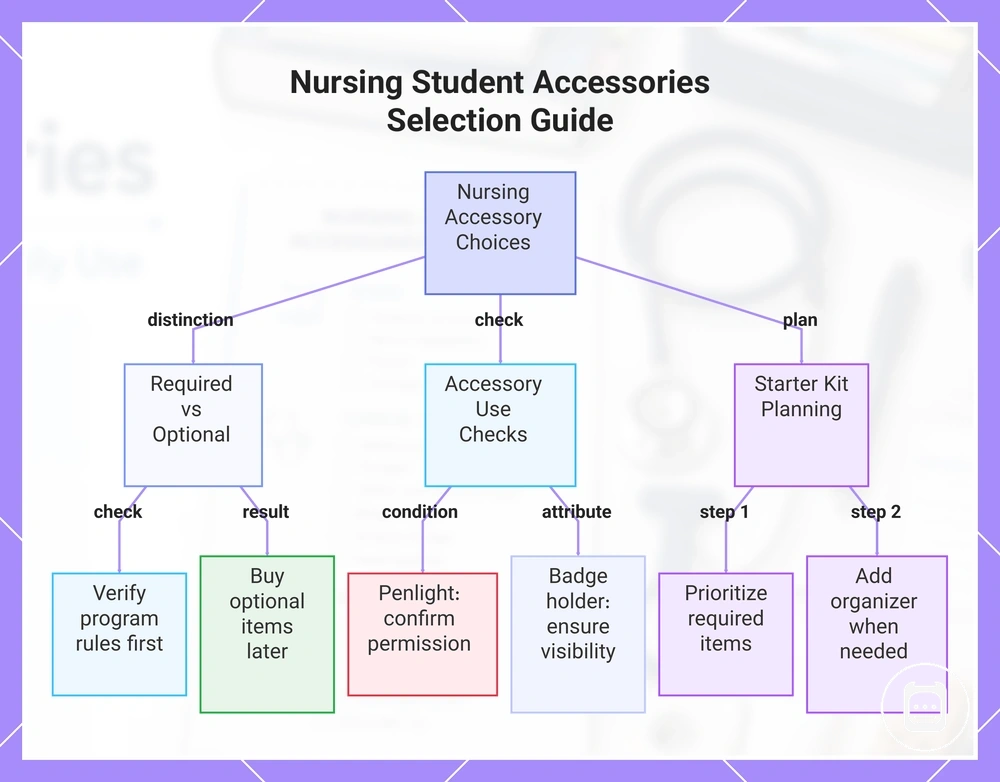
This chart shows how to decide on nursing student accessories, covering required vs optional items, key use rules for specific accessories, and how to plan a starter kit.