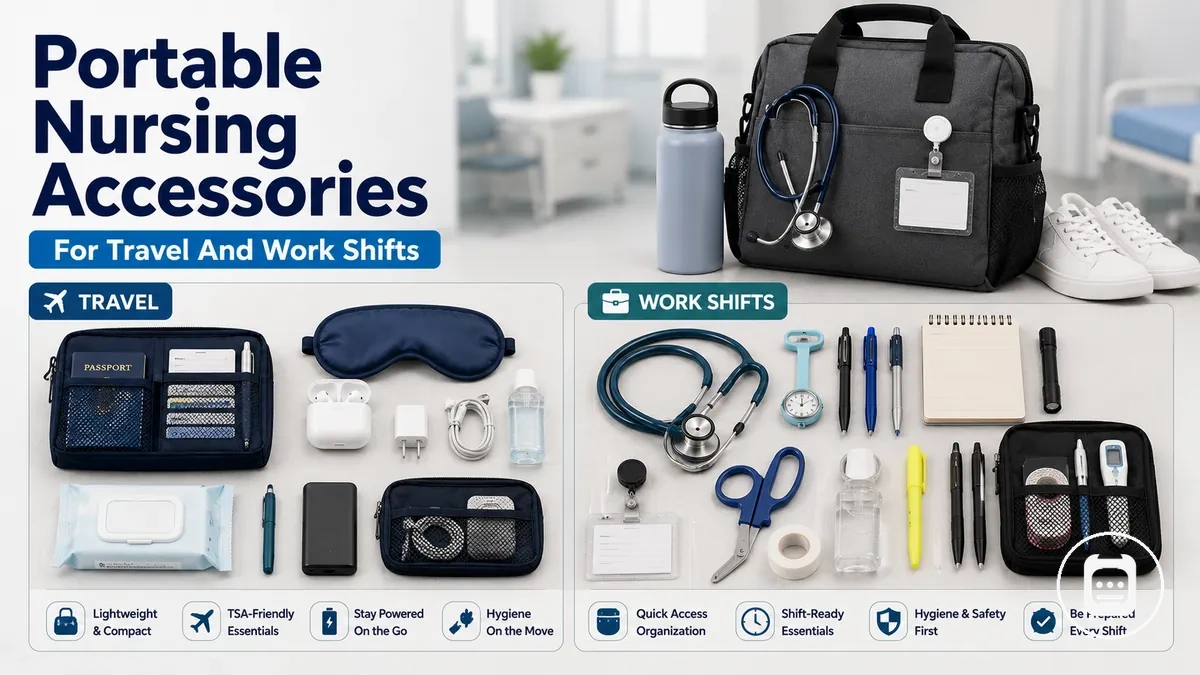
Portable nursing accessories for mobile shift use
Portable nursing accessories are nursing accessories selected and arranged to make essential work items easier to carry, access, and use while moving between locations. Rather than focusing on a single product type, this page looks at how portability supports practical access to tools and supplies during daily nursing routines. The main use contexts include travel, commuting, and mobile shift movement.
Access problems often happen when frequently used items are difficult to reach, stored in multiple places, or carried in a way that slows retrieval. A nurse may need to balance access speed, carry method, item weight, cleanability, and storage space while moving through work shifts. Using a nurse pouch, compact organizer, or nurse travel bag can help organize work-accessible items in many situations, but the most suitable setup depends on work conditions and movement patterns. For that reason, portability is a selection condition rather than a product category alone.
A nurse may move between a nurse bag, pocket, portable nurse pouch, and work area multiple times during a shift. During commuting or travel, lightweight tools may need to stay reachable without creating unnecessary bulk, while a utility organizer can help keep frequently used items accessible. Because different roles, facilities, and shift routines can influence what stays immediately available, the next step is understanding what portability means for portable nursing accessories.
What portability means for nursing accessories
Portable nursing accessories are nursing accessories selected or arranged for easier carrying, faster access, and practical movement during shifts, commuting, or travel. The focus is not on a specific product type but on how nursing accessories support daily use while remaining compact and shift-ready. Portability connects nursing accessories to carry, access, and movement.
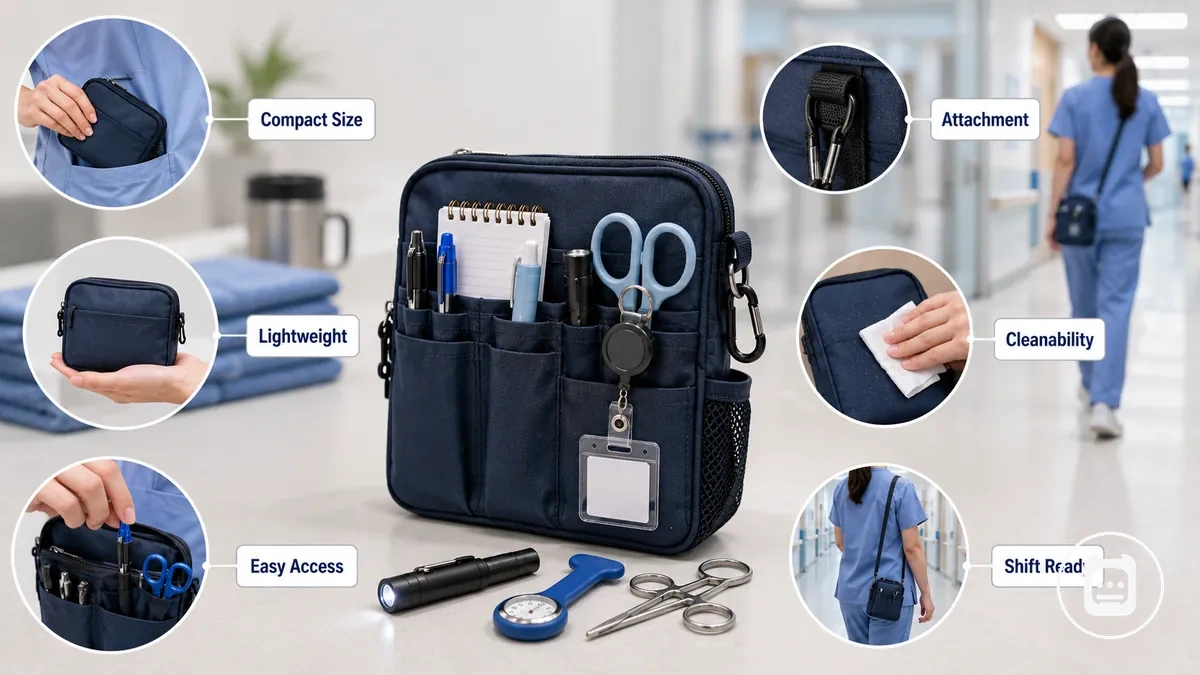
Portability depends on practical work conditions rather than appearance alone. Size and weight can affect movement between work areas, while a carry method, attachment option, pocket, or pouch may influence access during work shifts. Cleanability can matter during daily handling, and compact, lightweight designs may be easier to manage during commuting or travel. Portable work-shift accessories focus on work use and access needs rather than broad travel packing, as also reflected throughout the nursing accessories hub.
When evaluating portable nursing accessories, portability is usually easier to understand by looking at the conditions that affect daily use and shift readiness.
- Compact size that supports movement without unnecessary bulk
- Lightweight design that may be easier to carry during work shifts
- Accessible placement through a pocket, pouch, or attachment method
- Cleanability suitable for regular handling and changing work conditions
- Carry method that supports practical access during commuting and travel
- Work-accessible accessories arranged for shift readiness rather than general luggage storage
Portable nursing accessories versus full travel packing lists
Portable nursing accessories differ from full travel packing lists because they focus on work-accessible items used during a shift, commute, or movement between work areas. Full travel packing lists address broader trip preparation, while portable nursing accessories focus on shift-access items needed during daily work activities. The page focus remains on work-accessible nursing items.
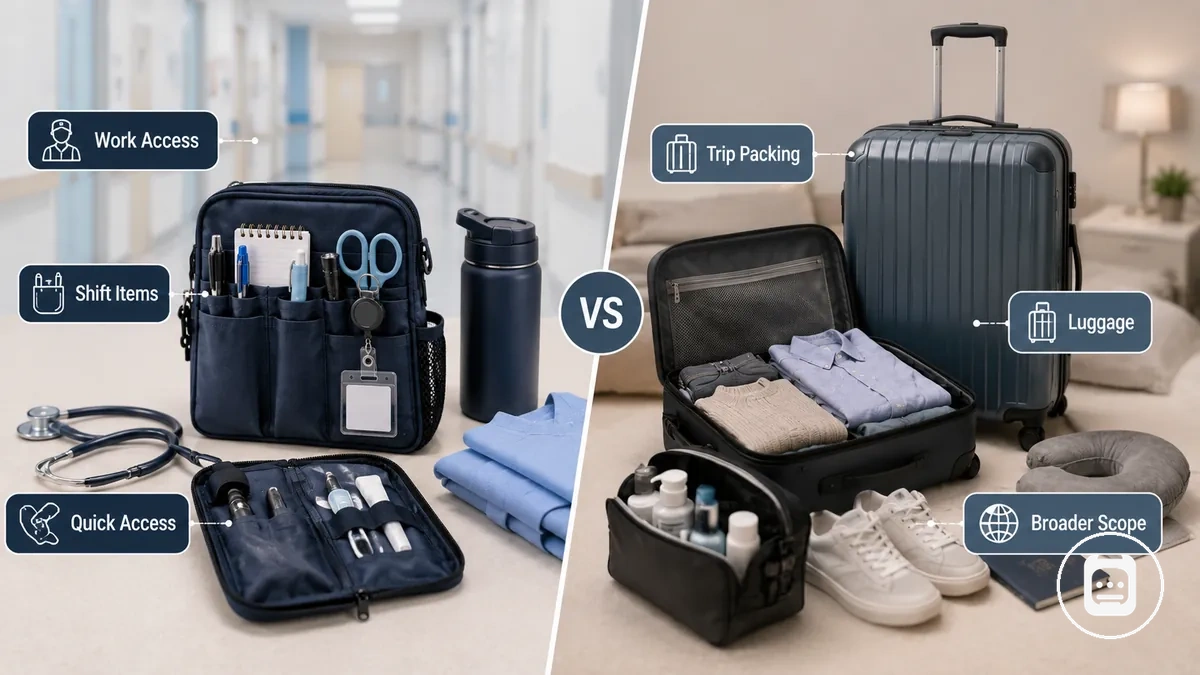
A common misconception is that travel nurse accessories always refer to a complete packing list. In practice, travel nurse accessories may describe a portable setup carried in a nurse travel bag or work kit for frequent use during a shift or commute. Full travel packing lists often extend beyond immediate work relevance and include items outside this page scope. The comparison below highlights the difference between shift-access items and broader travel preparation.
| Portable Nursing Accessories | Full Travel Packing Lists |
|---|---|
| Focused on work-accessible and shift-access items | Focused on whole-trip preparation |
| Often carried in a nurse travel bag, pouch, pocket, or work kit | Often stored in larger luggage or travel storage |
| Intended for frequent access during work activities | May include items used less frequently during a trip |
| Carry location supports easier retrieval while working | Carry location may prioritize transport over immediate access |
| Work relevance is the primary consideration | Includes broader travel essentials outside the page focus |
Accessory groups that support travel, commuting, and shifts
During travel, commuting, and work shifts, different accessory groups support movement and access in different ways. Compact organizers, pouches, lightweight tools, and personal care items may be carried differently depending on how often they are needed. Grouping items by function helps connect carry behavior to practical outcomes.
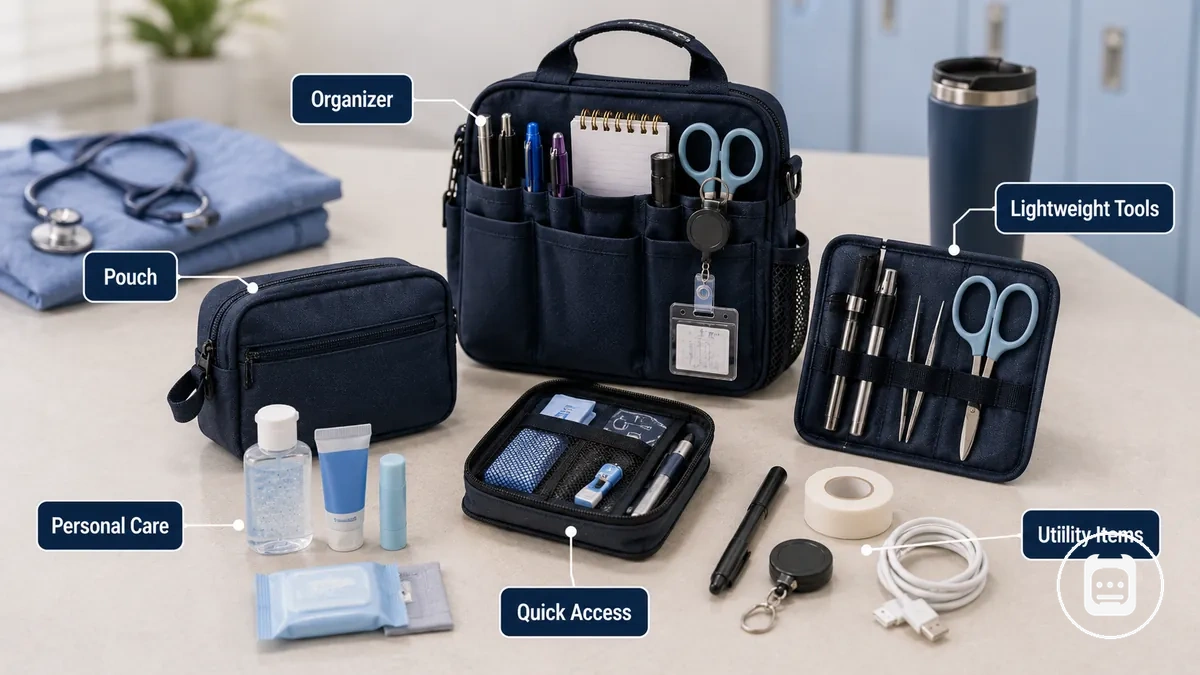
When portable accessories are stored without clear grouping, access can become less convenient and carrying space may be used less efficiently during shifts. Organizing accessory groups by function can help separate frequently used items from occasional-use utility items. This approach supports quicker identification of needed items and a more structured portable setup. The table below summarizes common accessory groups and their roles.
| Accessory Group | Function | Size | Carry Location | Access Frequency | Practical Outcome |
|---|---|---|---|---|---|
| Compact organizers | Keep related items together | Compact | Bag compartment or work kit | Moderate | More organized storage |
| Pouches | Provide quick access to small items | Compact | Pocket, bag, or attachment point | Frequent | Easier retrieval during shifts |
| Lightweight tools | Support routine work tasks | Small | Pocket, badge area, or pouch | Frequent | Work-accessible utility |
| Personal care items | Support comfort during shifts | Small | Pouch or small storage area | As needed | Shift-ready convenience |
| Utility items | Provide supplementary support | Small to compact | Organizer or nurse bag | Occasional | Flexible access when needed |
Compact organizers, pouches, and fanny packs
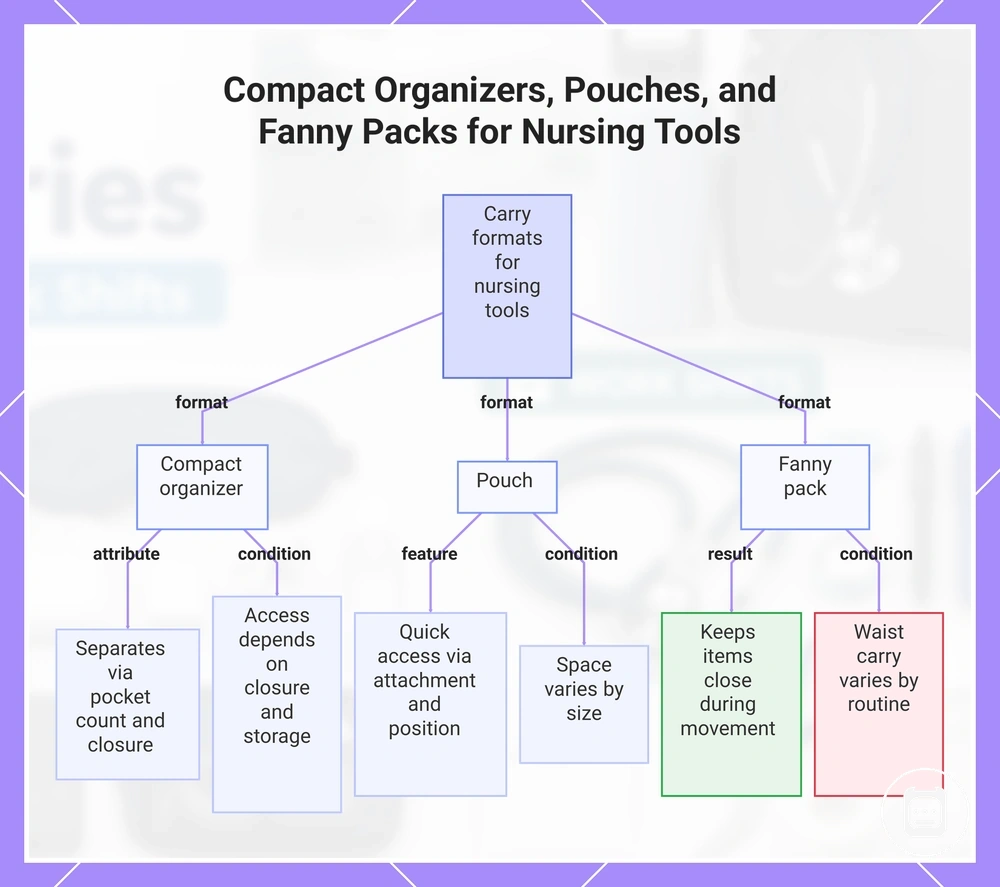
Compact organizers, pouches, and fanny packs help keep small nursing tools organized and reachable during movement. A compact organizer can separate items through pocket count and closure design, while a pouch or fanny pack may support quick access through a practical attachment method and carry position. These carry formats help keep frequently used tools within reach.
During a shift that involves repeated movement between work areas, carry format can affect access convenience and storage efficiency. For example, a portable nurse pouch may be more useful than a larger bag when only a few frequently used items need to remain immediately accessible. Pocket count, attachment options, closure style, and wipeability can influence suitability for uniform carry, waist carry, or bag carry.
- A compact organizer can group small items through multiple pockets, but access may depend on closure design and storage location.
- A pouch can attach to a uniform or stay inside a bag for quick access, though available space varies by size.
- A fanny pack or waist pack keeps items close during movement, but waist carry preferences may vary by work routine.
- Wipeability can be a practical condition when accessories are handled frequently during daily use.
- For broader storage planning, compare these carry formats with nurse bag essentials when additional capacity is needed.
This chart shows the three main compact carry formats for nursing tools, their key features, and conditions that affect suitability.
Lightweight clinical tools for quick access
Lightweight clinical tools support quick access when they are used frequently, easy to carry, and fit comfortably in available pocket space. Their value as shift-support items often comes from reducing time spent searching for commonly used work tools and keeping frequently accessed items within reach. The most suitable tools can vary according to role requirements and workplace policy.
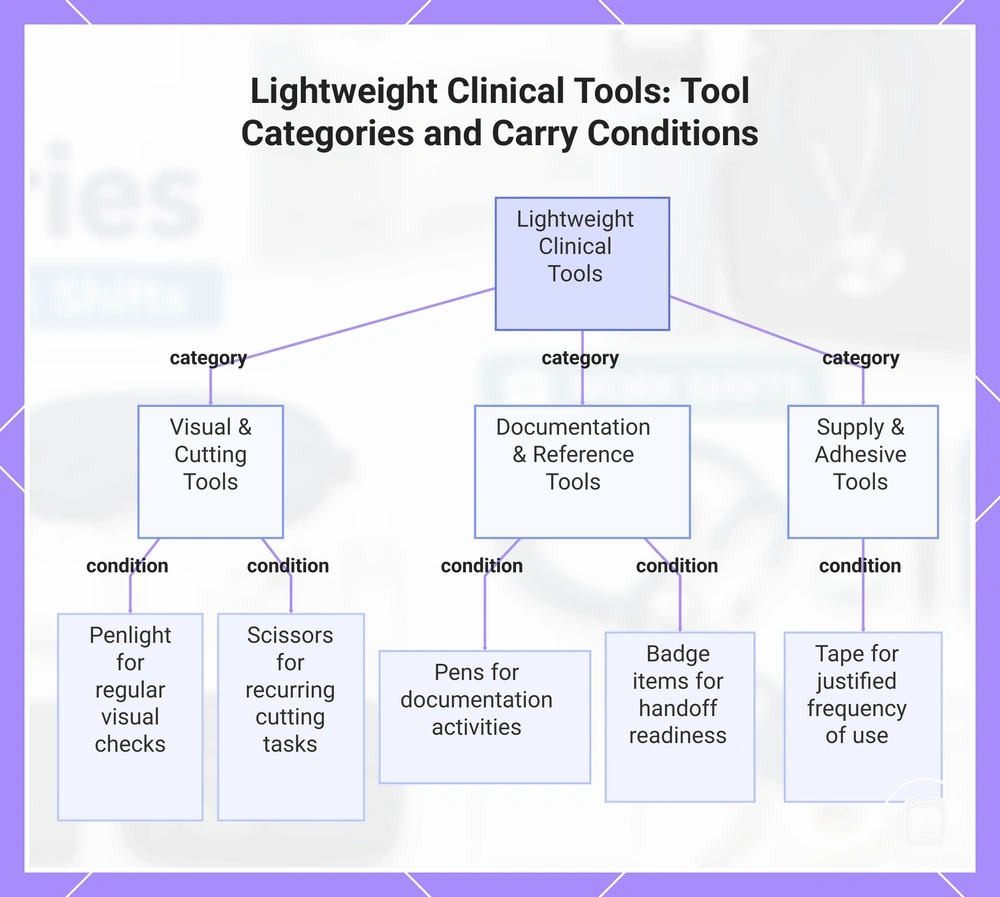
- Penlight: May support quick access when visual checks are performed regularly, but may not need to be carried if use is infrequent.
- Scissors: Can be useful for recurring work tasks that require quick retrieval, though carry decisions depend on role requirements and pocket fit.
- Pens: Often benefit from easy access during documentation activities, but the number carried may vary by workflow.
- Badge items: Reference cards or badge-attached tools may support quick retrieval and smoother handoff readiness when information is needed frequently.
- Tape or small supplies: May be carried when frequency of use justifies quick access, though suitability depends on available space and workplace policy.
This chart shows the main categories of lightweight clinical tools and the conditions under which each supports quick access.
Personal care items that stay shift-ready
During commuting, travel, or long shifts, personal care items can help support a shift-ready setup when they are easy to carry, fit within small storage, and are available when needed. Their usefulness often depends on hygiene relevance, frequency of need, and storage method rather than carrying large personal supplies. The focus remains on small carryable items that support portable readiness.
When personal items take up unnecessary space or are difficult to locate, portability can become less practical. Limiting personal care items to those with a clear purpose can help maintain a more organized shift-ready setup.
- Sanitizer: May be useful when hygiene relevance and quick access are priorities, provided it suits the intended carry condition.
- Hand cream: Can serve as a small backup item during long shifts when occasional use justifies the storage space.
- Lip balm: May support shift-ready comfort when stored in a location that allows easy access as needed.
- Snack: Can function as a compact backup item during commuting or long shifts when frequency of need makes carrying it practical.
- Personal care items: Are often most useful when their frequency of need justifies small storage space and easy retrieval.
How portable accessories improve access during movement
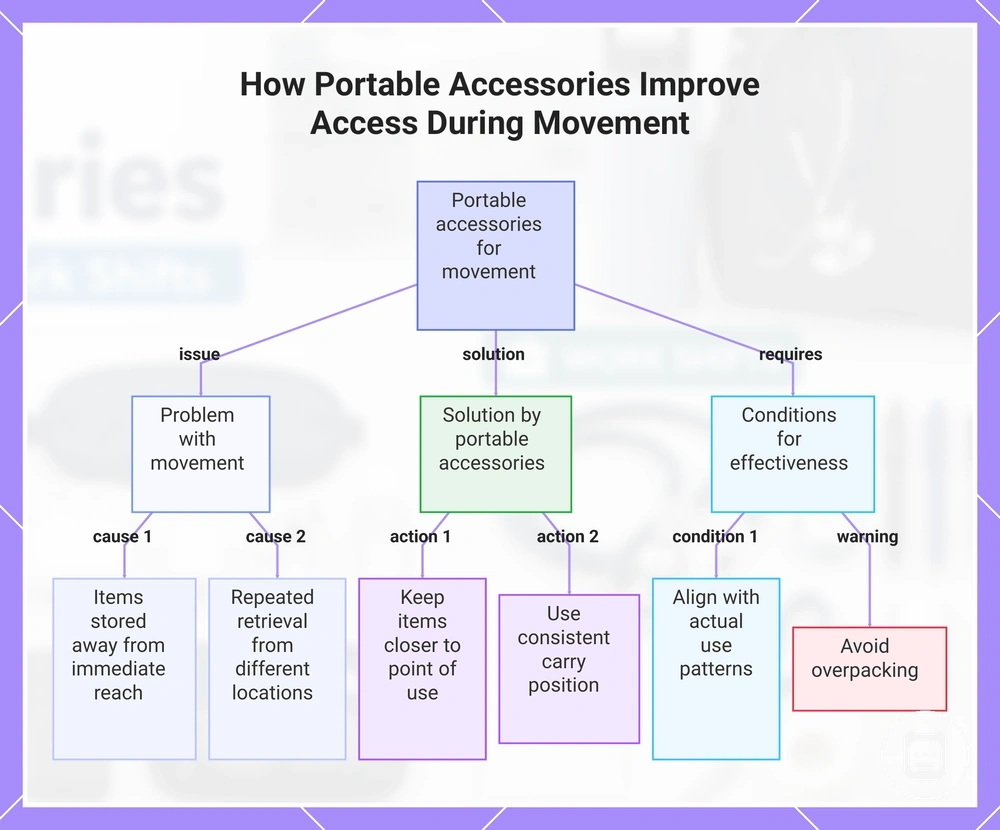
When frequently used items are stored away from immediate reach, access during movement can become less convenient and require repeated retrieval from different locations. Portable accessories help address this issue by keeping commonly used items closer to the point of use while moving between work contexts. In this situation, movement becomes the key variable that influences readiness.
During commuting or movement between units, a nurse may shift between a storage area, patient-facing work, and shift breaks throughout the day. Portable accessories can support mobile access by keeping frequently used items in a consistent carry position rather than in multiple storage locations. Access frequency often influences what remains readily available, while hand availability can affect how easily an item can be retrieved. As movement increases, carry position and retrieval friction become more noticeable factors.
Portable accessories can improve access during movement when retrieval time, access frequency, and carry position are aligned with actual use patterns. Readiness often depends on balancing mobile access with practical item selection rather than simply carrying more equipment. Carrying more items is not always better because overpacking may increase movement friction and reduce suitability.
- Commuting → accessible carry position → occasional access need → easier retrieval without returning to a storage area.
- Movement between units → consistent portable setup → repeated access frequency → more predictable access behavior during shift movement.
- Patient-facing work → limited hand availability → quick retrieval need → reduced searching when items remain within reach.
- Shift breaks → temporary storage area use → return-to-work access need → smoother transition back to frequently used items.
This access-focused approach also relates to accessories for work shifts, where carry decisions are influenced by movement patterns and item accessibility.
This chart explains how portable accessories help nurses and mobile workers access frequently used items during movement, addressing retrieval problems and key alignment conditions.
Choosing portable nursing accessories by carry method
The right carry method depends on shift movement, uniform constraints, and access needs rather than a single preferred setup. Selection is usually influenced by how often items are used, where they are carried, and how easily they can be reached during the day. Each carry method involves trade-offs between capacity, access speed, comfort, workplace fit, and cleanability.
When access becomes difficult or storage needs increase, changing the carry method can help balance portability and organization. A pocket, pouch, waist carry option, or bag supports a different combination of quick retrieval and storage capacity. Smaller setups may be sufficient when access frequency is high and item volume is limited, while a larger organizer may become more practical when more items need to remain available. The table below compares these carry methods using common selection criteria.
| Carry Method | Capacity | Access Speed | Comfort | Workplace Fit | Cleanability | Selection Signal |
|---|---|---|---|---|---|---|
| Low capacity | Usually supports quick retrieval | Depends on uniform constraints | Often suitable when minimal items are carried | Depends on pocket use and material | May suit frequent-access items with limited storage needs | |
| Pouch | Moderate capacity | Often supports accessible storage | Varies by attachment method | Depends on shift use and workplace fit | May be easier to clean when used frequently | May suit users who need more organization than a pocket provides |
| Waist | Moderate capacity | Can support accessible retrieval | Depends on comfort and range of motion | Varies by workplace fit | Depends on material and use conditions | May suit movement-focused access needs when waist carry is appropriate |
| Bag | Higher capacity | Access speed may be lower than on-body carry | Often useful during commuting | Suitable when more storage is needed | Depends on storage method and material | May suit a nurse travel bag or larger organizer when item volume increases |
This criteria-based approach can also help readers choose practical nursing accessories according to movement patterns, storage needs, and access requirements.
Pocket, pouch, waist, and bag compatibility
Pocket, pouch, waist, and bag compatibility depends on whether a carry location allows access without restricting movement or making items difficult to reach. A compatible setup usually reflects how portable accessories fit within daily shift movement, storage needs, and access patterns. Local factors such as uniform fit, attachment security, range of motion, and access point often determine whether a carry location remains practical or becomes inconvenient.
| Carry Location | Compatibility Factors | Local Contrast |
|---|---|---|
| Depends on uniform fit, available space, and access point | Pocket carry may support quick retrieval but usually offers lower capacity | |
| Pouch | Depends on attachment security, cleanability, and shift use | A pouch may provide more organization than pocket carry when attachment security supports movement |
| Waist | Depends on range of motion, comfort, and shift condition | Waist carry may keep items accessible, but suitability varies with movement patterns and workplace fit |
| Bag | Depends on storage needs, access point, and commuting use | Bag carry may support more storage, though retrieval can require an additional access step |
Capacity, weight, and compartment trade-offs
When a portable setup carries too many items, access and comfort can become less manageable, while carrying too few items may create access gaps during a shift. The practical trade-offs involve balancing enough capacity with manageable loaded weight and useful compartments for organization. Capacity, weight, and compartment separation work together, making retrieval friction and balance important evaluation points.
- Capacity and loaded weight: Greater storage capacity may support more items, but additional loaded weight can affect balance and carrying comfort during movement.
- Compartments and retrieval friction: Compartment separation can improve access by keeping items organized, while limited compartments may increase retrieval friction when items are grouped together.
- Overpacked pouch: An overpacked pouch may create movement friction and make frequently used items harder to access, creating a condition that may require adjustment.
- Underprepared pocket: An underprepared pocket may lead to a missing item or backup need, creating an access gap when an item is not immediately available.
- Balance and item load: A portable setup is often easier to use when storage capacity, carry weight, and organization space remain balanced for the intended shift role and routine.
Material, cleanability, and daily durability
Material choice affects cleanability, daily handling, and daily durability because portable accessories are exposed to repeated shift use. A material that is easier to maintain may remain more practical for frequent handling, while long-term durability can depend on how the material, closures, and construction respond to repeated use. Wipeability, closure durability, stitching, water resistance, and odor retention are the main checks when evaluating portable accessories.
When maintenance needs become difficult to manage, material differences can help guide selection. Fabric, silicone, plastic, and coated material options may differ in wipeability, water resistance, and odor retention, so suitability often depends on daily handling patterns, cleaning routines, and carrying conditions.
- Wipeability: An easy-clean surface may support simpler maintenance when accessories are handled frequently.
- Closure durability: Closure durability can affect repeated use, and wear may vary according to handling conditions and frequency of use.
- Stitching: Stitching can influence daily durability when pouches or organizers are opened, carried, and handled regularly.
- Water resistance and odor retention: Water resistance may affect cleaning convenience, while odor retention can influence ongoing maintenance needs.
- Material condition: Fabric, silicone, plastic, and coated material options may differ in cleanability and daily durability depending on use conditions.
Building a portable setup for different shift patterns
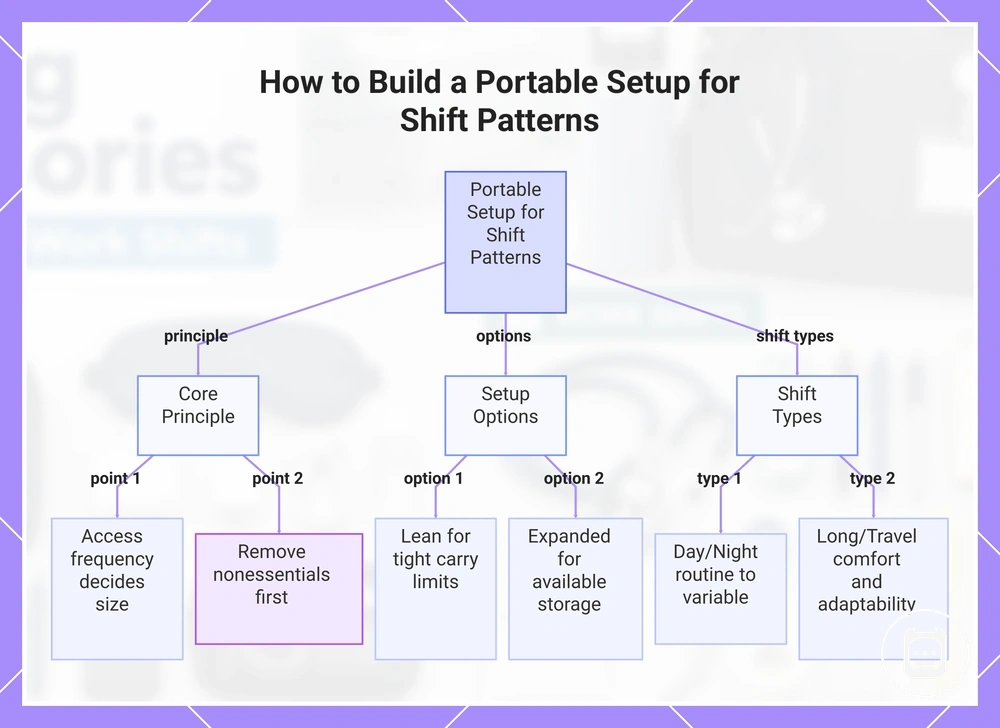
During day shifts, night shifts, long shifts, commuting, and travel-nurse movement, a portable setup is most effective when it reflects how often items need to be accessed. Different shift patterns create different readiness requirements, movement conditions, and storage constraints. Setup size should follow access frequency.
- Keep frequently used items immediately reachable when access frequency is high.
- Use available storage opportunity before expanding on-body carry.
- Match a lean setup or expanded setup to actual movement and retrieval needs.
- Prioritize work-accessible items before adding comfort-focused or backup items.
- Remove nonessential items when they add carry burden without improving readiness.
When storage opportunity is limited during commuting, carrying too many accessories can reduce portability and make retrieval less convenient. A lean setup may be easier to manage when carry limits are tight. If storage access remains available throughout a shift, an expanded setup may be appropriate for items that are not needed frequently. The choice depends on access needs rather than item quantity, creating a lean-versus-expanded setup distinction.
Personal comfort need and backup item planning should follow essential access needs. A backup item may be useful when access gaps are possible, while comfort-focused items can become more relevant during long shifts. Remove nonessential items before adding more accessories.
During day shifts, a portable setup may emphasize routine access and predictable movement. During night shifts, access needs can depend on changing workflows and retrieval frequency. Long shifts may increase the relevance of personal comfort need and a backup item. Travel-nurse movement may require a nurse travel setup that adapts to changing storage opportunity and work-accessible item needs, depending on conditions.
A practical setup balances access frequency, storage opportunity, personal comfort need, and backup item planning without becoming a complete inventory of carried items. The most suitable portable setup depends on shift patterns, workplace routines, and movement demands. Remove nonessential items before adding more accessories.
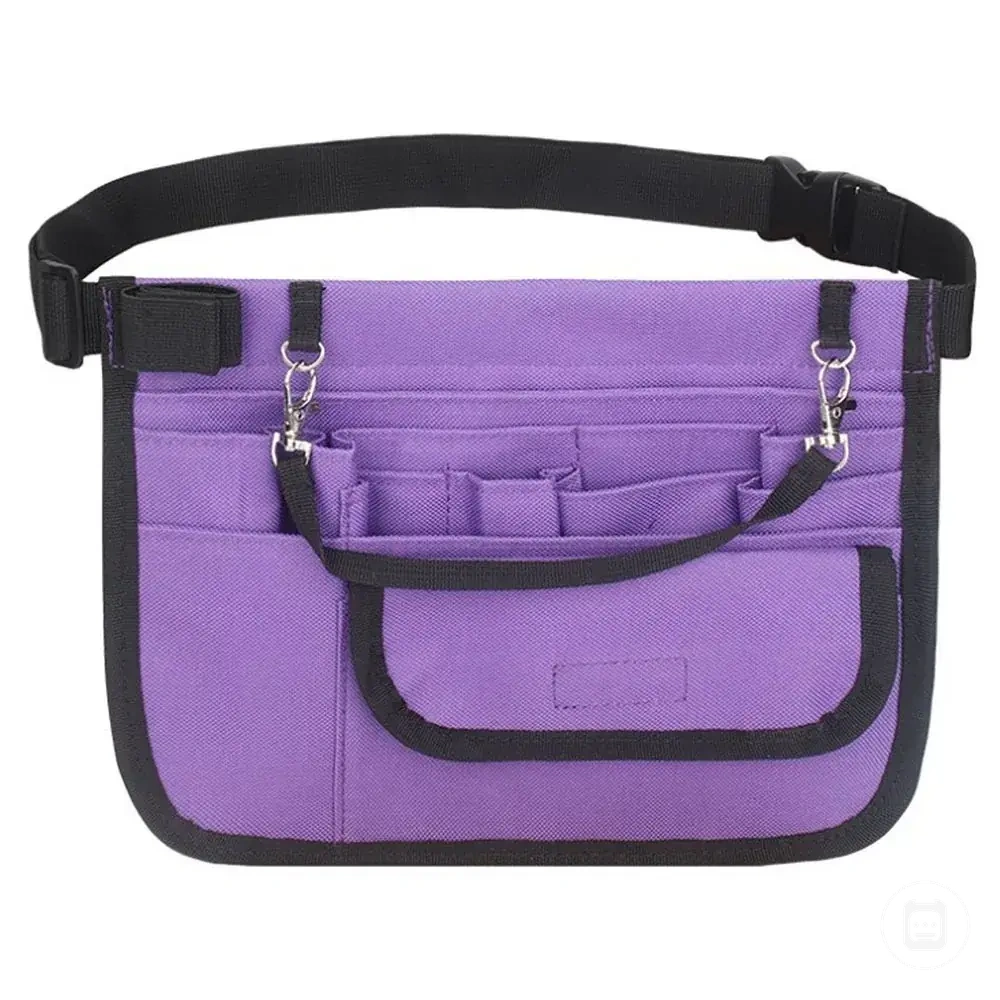
The products below are useful examples for comparing available options. Before buying, check that the compatibility criteria, key features, and product details match your needs.
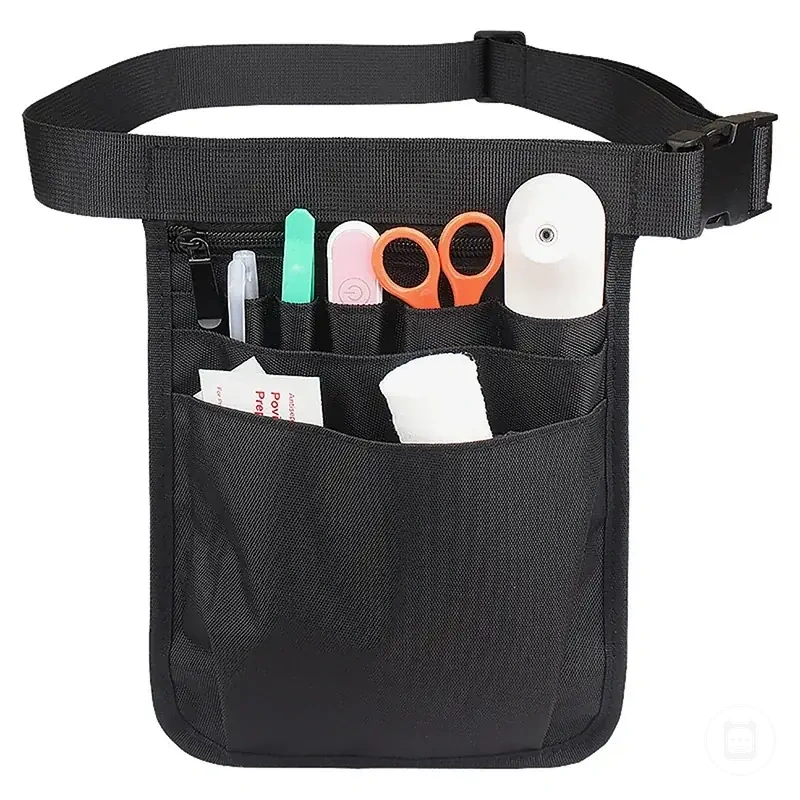
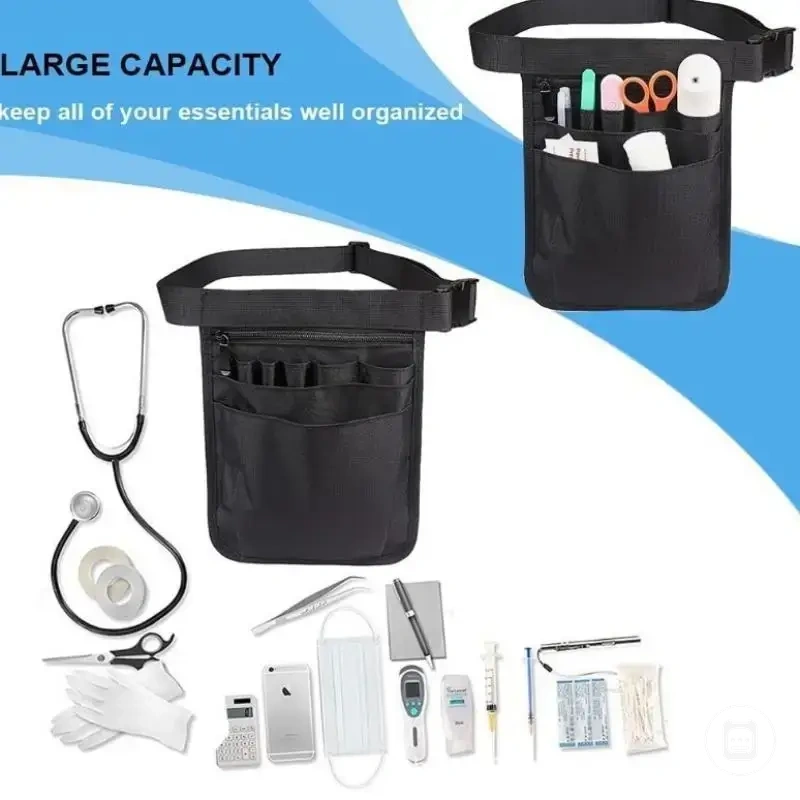
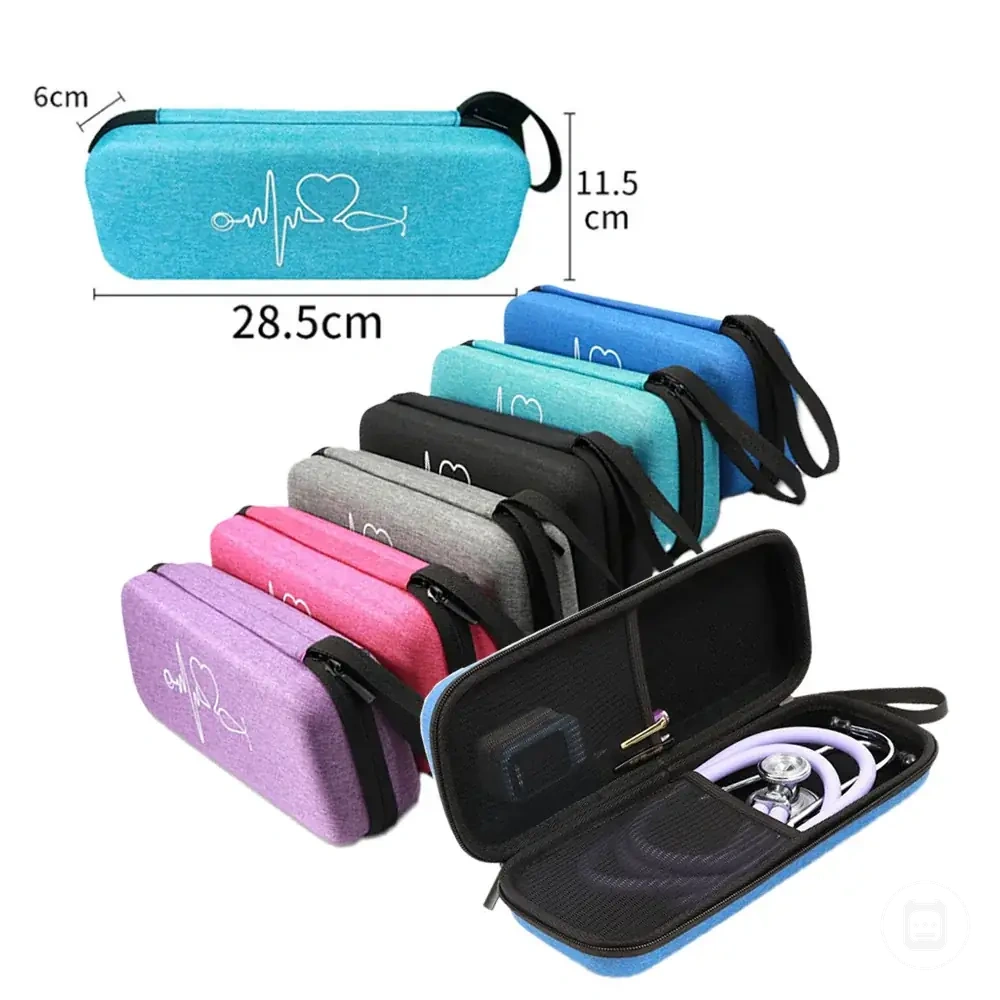
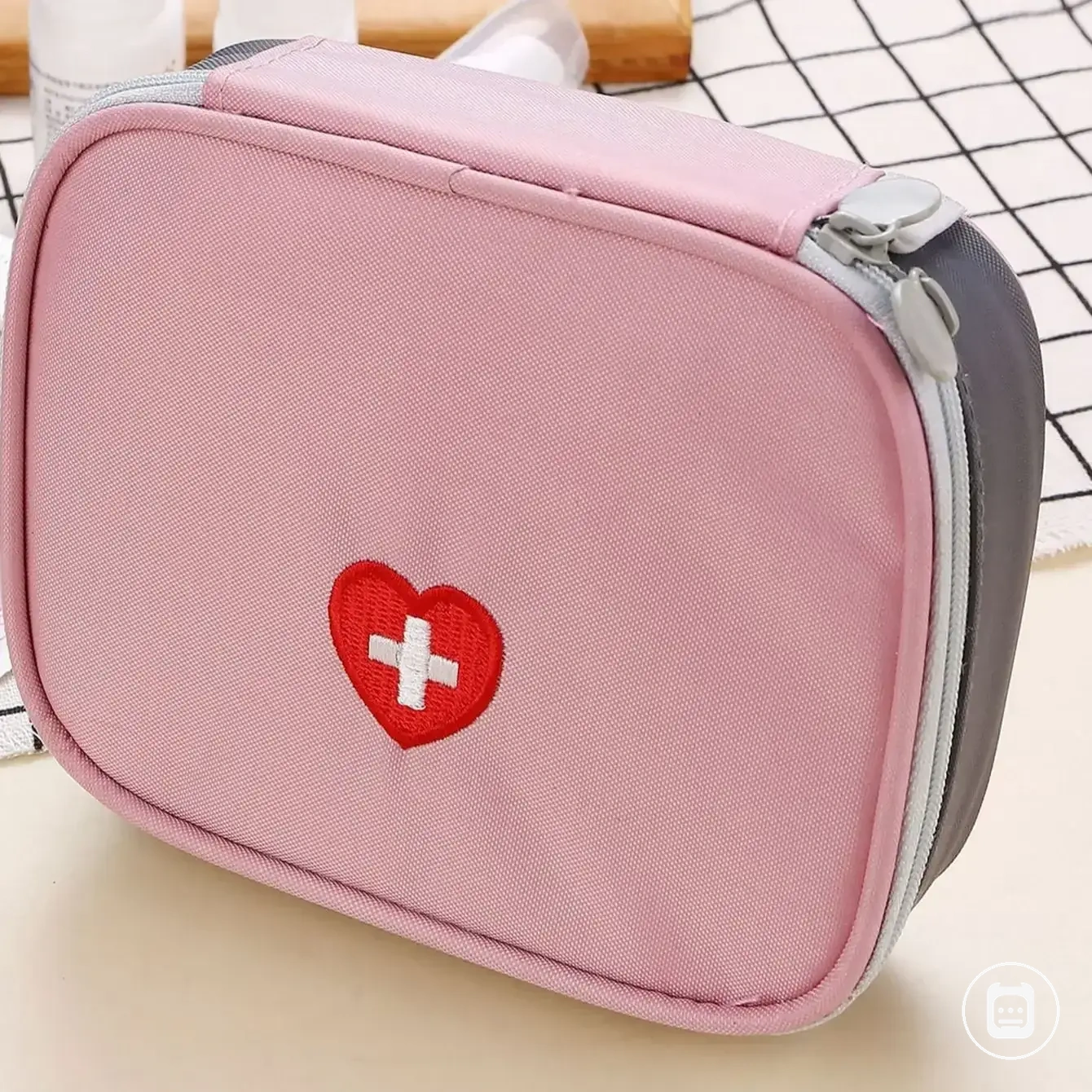
This chart shows the key principles, setup options, and shift-specific adjustments for creating a portable nursing setup based on access needs.
Practical limits of travel-friendly nursing accessories
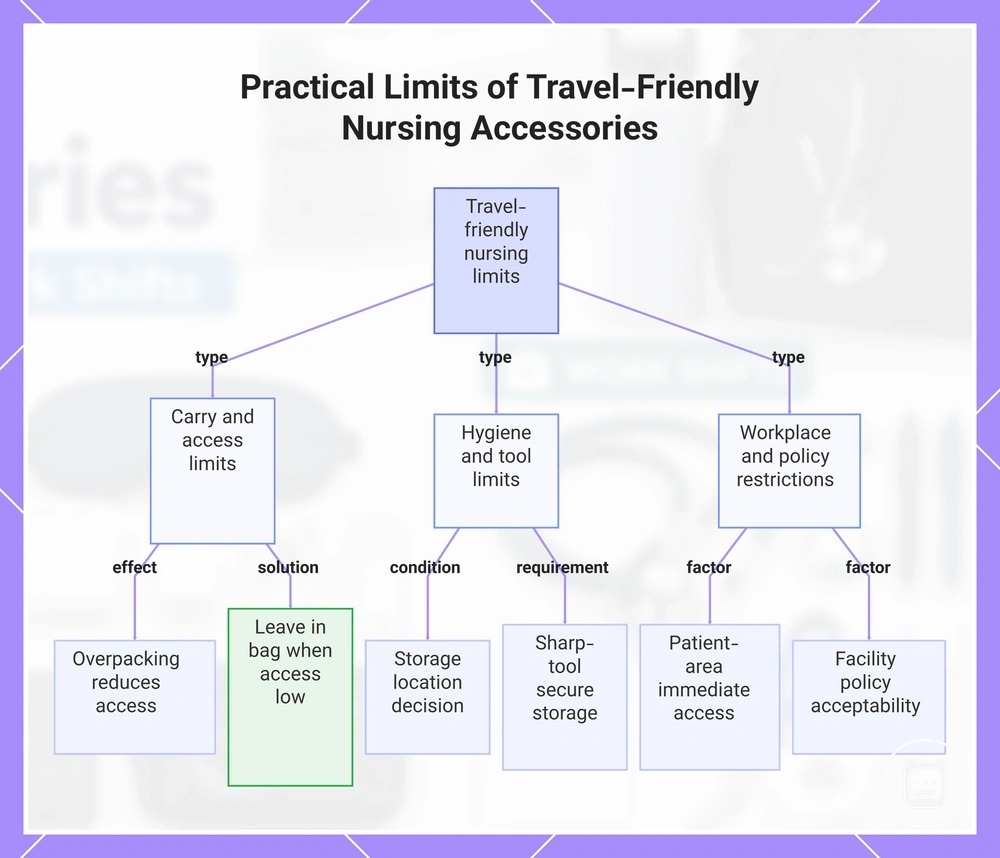
Travel-friendly nursing accessories still require workplace boundaries and hygiene expectations to remain suitable for daily use. A portable setup may improve access and convenience, but practical limits help prevent unsuitable use conditions during routine work. The main limit categories are overpacking, infection-control expectations, sharp-tool handling, patient-area restrictions, and facility policy.
Caution helps keep portable setup limits aligned with responsible carry decisions. The checklist below highlights common conditions that may influence whether an accessory remains appropriate for a specific workplace environment.
- Overpacking may increase movement friction and make frequently used items harder to access.
- Infection-control expectations can influence whether an item should remain in a patient area or be stored elsewhere.
- Sharp-tool handling may require secure storage when tools are not actively in use.
- Patient-area restrictions can affect which accessories are suitable to keep immediately accessible.
- Facility policy may influence whether a carry method, storage approach, or accessory remains acceptable.
When overpacking reduces access efficiency, removing unnecessary items can support a more practical portable setup. Sharp-tool handling may require storage that reduces exposure during movement, while patient-area restrictions can affect where accessories are carried. These conditions often depend on facility policy and workplace boundaries.
During a shift, an accessory may be better left in a bag when access frequency is low or when carrying it creates unnecessary movement friction. An item may need to be cleaned when maintenance needs become apparent, replaced when wear affects suitability, or checked against workplace rules when conditions are uncertain. Responsible selection depends on balancing portability with workplace boundaries and practical limits.
This chart shows the main categories of practical limits for travel-friendly nursing accessories, including carry and access, hygiene and tool safety, and workplace policy restrictions, along with their key effects and actions.