Nursing accessories for nurses: meaning and included workplace items
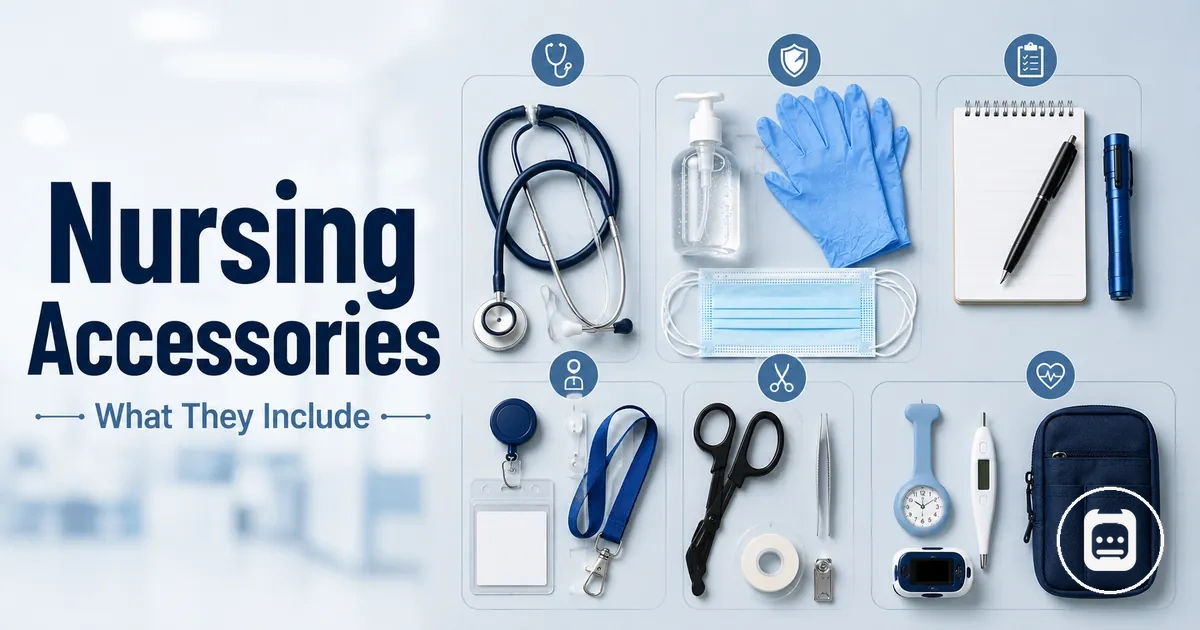
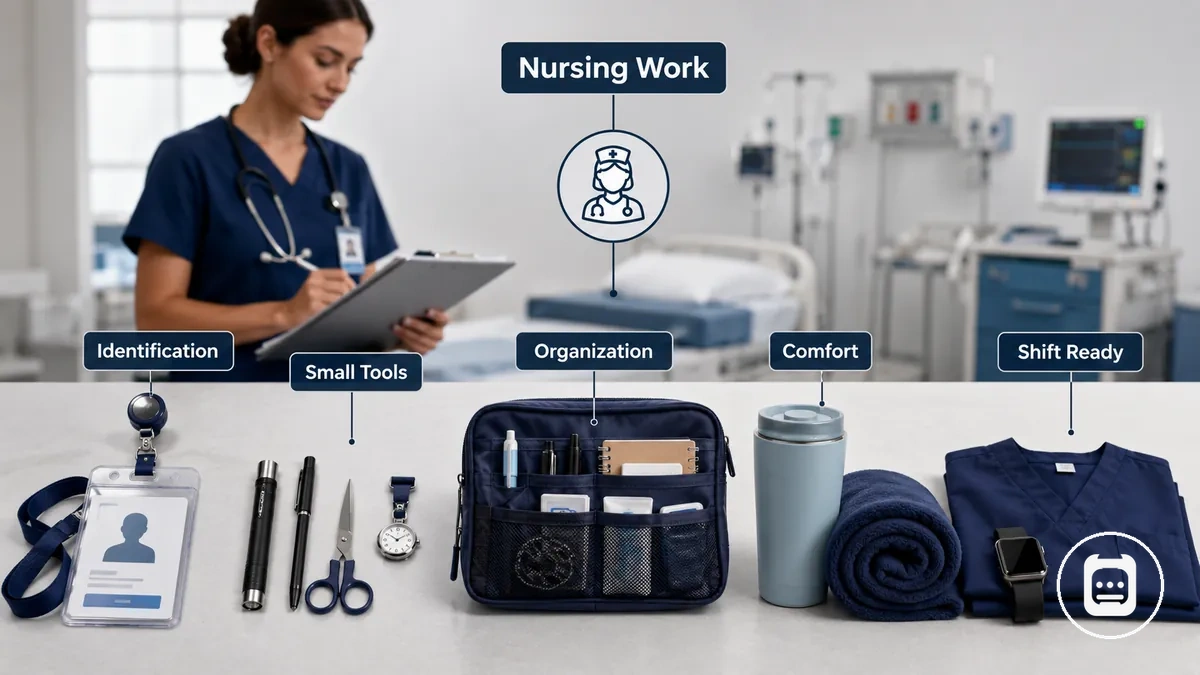
Nursing accessories are workplace-support items that help nurses manage identification, access small tools, stay organized, and work more comfortably during daily responsibilities. They support nursing work without defining a single way that every nurse works or prepares for a shift. In this context, nursing accessories are supportive workplace items rather than a fixed kit.
The included items can cover a broad range of functions depending on a nurse role, clinical setting, and daily work needs. Nursing accessories may include identification-related items, small tools used for routine support tasks, organization aids, and comfort-focused support items. Different workplaces may emphasize different nursing work items based on workflow and facility expectations. Together, these included items are best understood through their role in identification, tools, organization, comfort, and practical limits.
The meaning of nursing accessories can vary by department, workplace rules, and local policy. Nurses in different clinical settings may carry different support items, and certain accessories may be limited by workplace control or role requirements. Because of these differences, accessories are not always the same as supplies or equipment, even when they are used in the same work environment. Understanding these boundaries helps create a clearer picture of what nursing accessories include and how they are used.
The sections that follow explain the meaning of nursing accessories in more detail, outline common included item groups, and clarify where accessories fit within the broader workplace context.
What nursing accessories mean in nursing work
Nursing accessories are supportive items nurses use around clinical tasks, identification, organization, comfort, and shift readiness. These items support nursing work by helping nurses manage everyday responsibilities and personal work organization. Nursing accessories are separate from treatment supplies and are not defined by direct patient treatment functions.
The meaning of nursing accessories depends on how they support a nurse role within a specific workplace. Different clinical settings may use different work accessories based on workflow, organization needs, and workplace rules. Nursing accessories can help nurses keep small work items accessible, support identification requirements, or improve comfort during a shift. For example, an identification holder may support both workplace identification and daily shift readiness.
The exact meaning of nursing accessories may vary by department, facility expectations, and shift context. This variation helps maintain a practical boundary between accessories, supplies, and equipment while keeping the focus on nursing work. For a broader view of related categories and topics, visit the nursing accessories hub.
What nursing accessories usually include
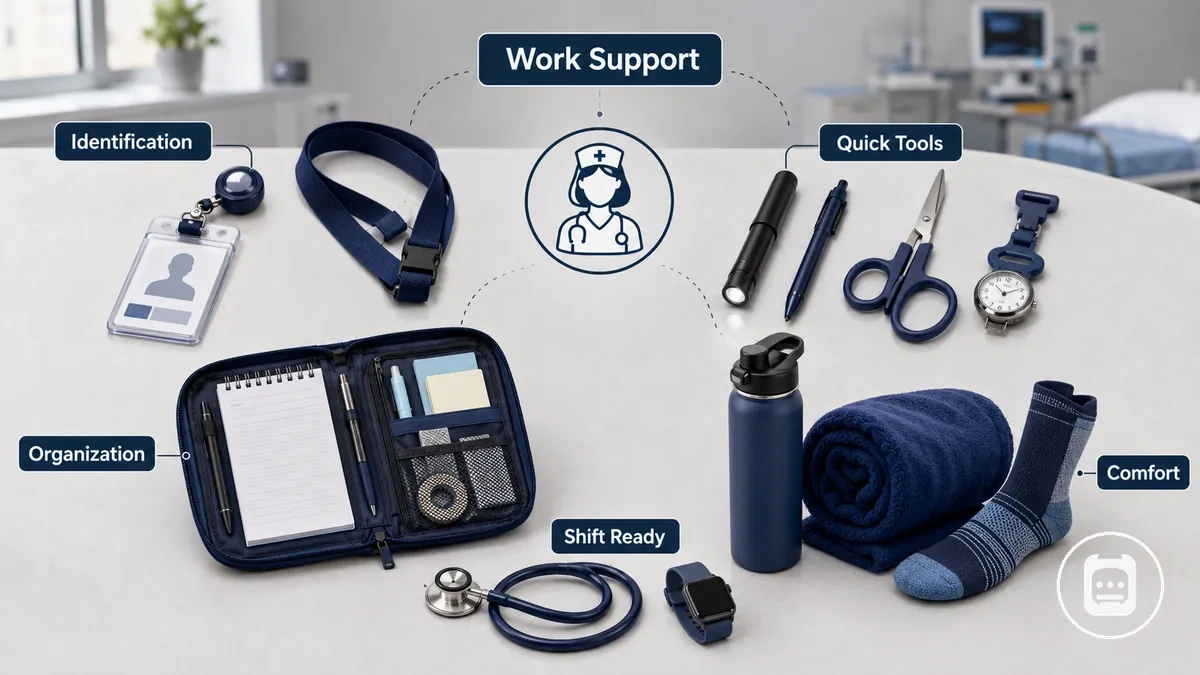
Nursing accessories usually include identification items, quick-access tools, organizing items, and comfort-support items that help nurses manage daily work activities. These included items are typically grouped by workplace purpose rather than treated as a universal collection. The items are better understood by function than by a universal list.
The grouping below organizes common accessory groups by function, use condition, and practical value within nursing work. It shows how different accessory groups support identification, access, organization, and shift readiness without implying that every nurse uses the same items.
| Accessory Group | Function | Use Condition | Practical Value |
|---|---|---|---|
| Identification items | Support visibility and identification | When workplace identification is required | Helps confirm role and access |
| Quick-access tools | Support routine clinical tasks | When small nurse tools need to remain accessible | Helps improve task readiness |
| Organizing items | Store and arrange work-support items | When carrying notes, tools, or small essentials during a shift | Helps improve organization and access |
| Comfort-support items | Support comfort during work activities | When shift demands vary by role or setting | Helps improve comfort throughout a shift |
These categories provide a broad view of included items, while more detailed distinctions can be explored through nursing accessory types.
Identification and wearable accessories
Identification and wearable accessories support identification, visibility, and basic shift convenience within the included-items group. These wearable accessories help keep identification or access-related items available during nursing work. Their usefulness or restriction may vary by clinical setting and workplace rules, but their examples are primarily tied to identification or access.
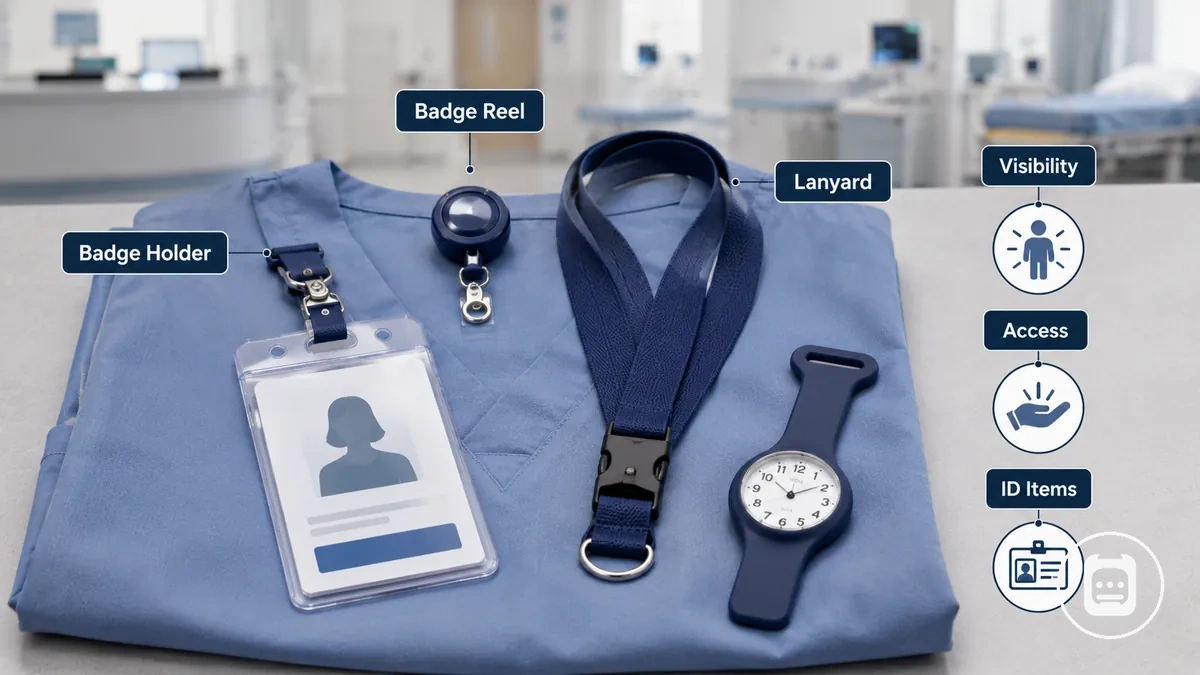
- Badge holder: Supports identification visibility when an ID needs to remain visible during a shift.
- Badge reel: Helps provide convenient access to an identification card while keeping it attached during a shift.
- Lanyard: Holds identification items in an accessible location when permitted by a clinical setting.
- Watch-like items: May support basic time awareness for shift-related activities when allowed by workplace rules.
- ID accessories: Help keep identification items visible and accessible within a nurse role.
Clinical task-support tools
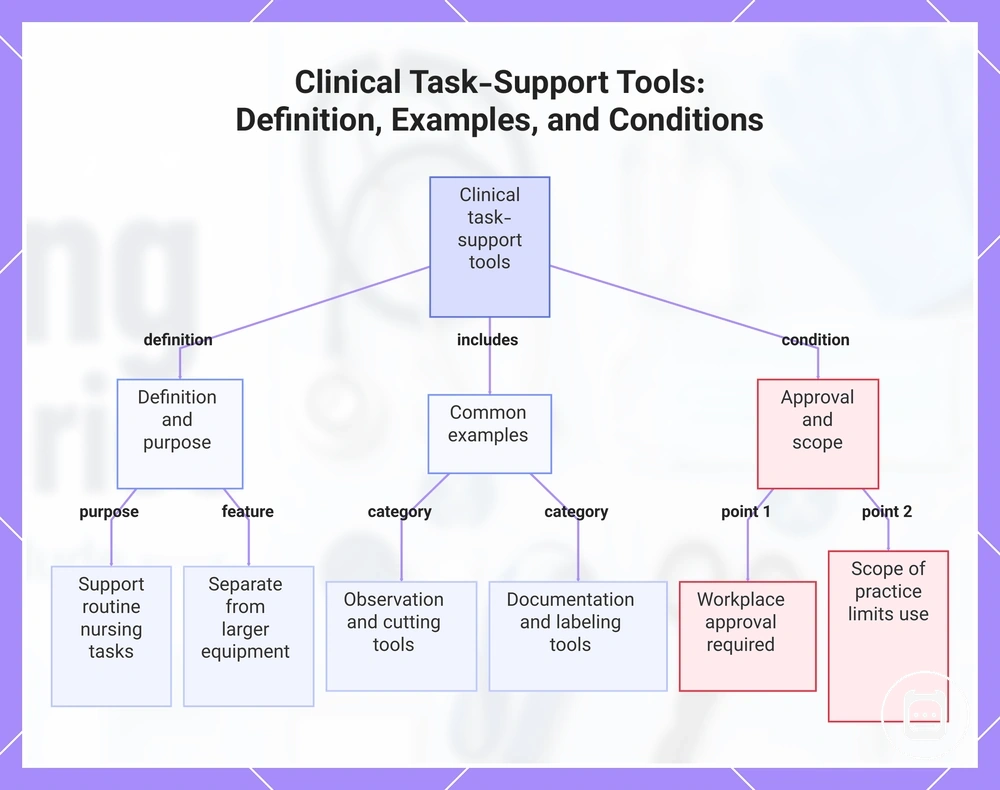
Clinical task-support tools are small accessories that assist routine nursing tasks by supporting observation, note-taking, organization, and quick access to everyday work needs. These task-support tools help with daily workflow while remaining separate from larger clinical equipment. Workplace approval and scope of practice may affect which tools a nurse may carry.
- Penlight: Supports task observation in a clinical condition where a small light source may be useful.
- Scissors: Function as a quick-access tool that can assist routine nursing tasks within an approved scope.
- Pens: Help record notes and support shift documentation activities.
- Markers: Support labeling or note-related work tasks within workplace expectations.
- Notepad: Helps keep brief notes and task reminders accessible during a shift.
This chart defines clinical task-support tools, lists common examples, and explains the workplace conditions that affect their use.
Organization and shift-comfort items
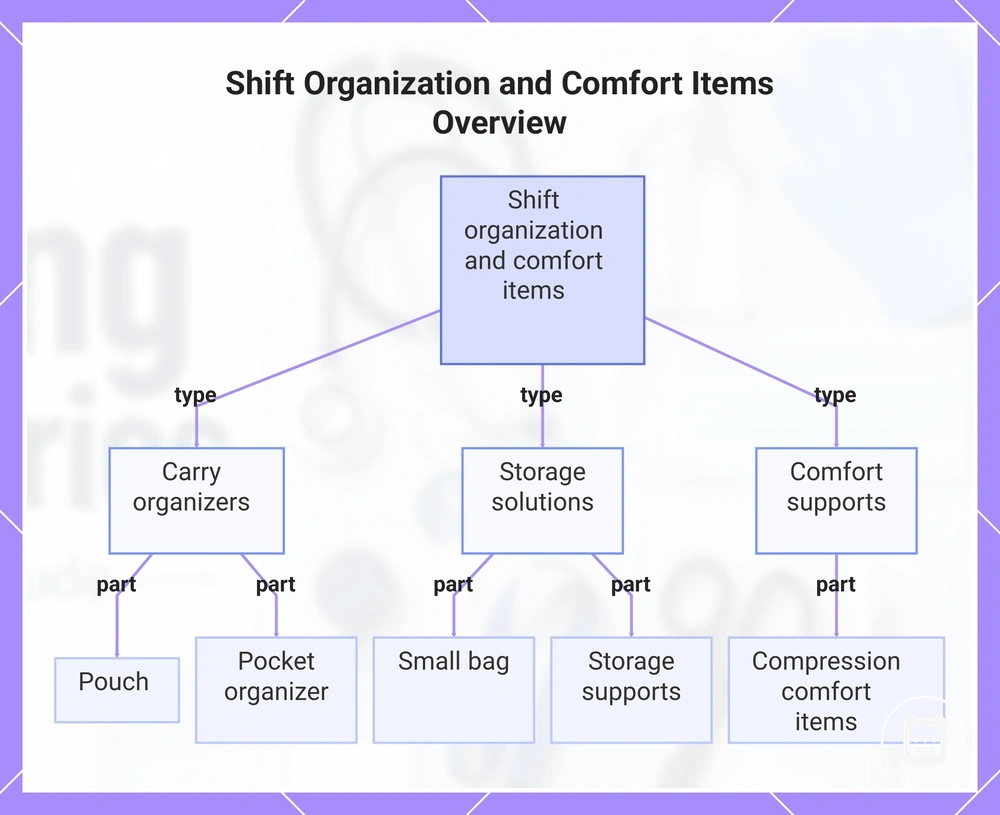
During a shift, organization and shift-comfort items help reduce small friction related to access, portability, and carrying everyday work essentials. These supportive accessories help keep frequently used items organized and easier to reach while supporting comfort across different shift durations. Organization and comfort needs may vary by shift type, uniform pockets, and facility rules.
- Pouch: Supports organization and portability when small work items need to remain together and easy to access.
- Pocket organizer: Supports quick access when uniform pockets are used to carry multiple tools, notes, or small accessories.
- Small bag: Supports storage and portability when available uniform pockets may not accommodate all needed items.
- Compression-related comfort items: Support shift comfort during longer shift durations when permitted by facility rules.
- Storage supports: Support organization when work items need to remain accessible throughout a shift.
This chart categorizes shift organization and comfort items into three main types and lists their specific examples.
Nursing accessories, nursing supplies, and medical equipment
Nursing accessories, nursing supplies, and medical equipment are different categories of workplace items because they serve different purposes. Nursing accessories typically provide a support function related to organization, identification, access, or comfort, while nursing supplies are usually consumable care materials and medical equipment generally refers to a clinical device or larger workplace asset. This distinction helps separate nursing accessories, nursing supplies, and medical equipment.
Category boundaries can vary by facility rules, role responsibilities, workplace control, and item use. The table below compares category, purpose, typical ownership, disposability, and workplace control to clarify how these workplace items are commonly distinguished.
| Category | Purpose | Typical Ownership | Disposability | Workplace Control |
|---|---|---|---|---|
| Nursing accessories | Support function such as organization, identification, access, or comfort | Often personally carried or workplace provided | Usually reusable | May depend on workplace rules and role requirements |
| Nursing supplies | Consumable care material used during routine care activities | Often facility provided | Often consumable or replaced after use | Usually managed through workplace processes |
| Medical equipment | Clinical device or larger workplace asset used for clinical functions | Typically facility managed | Usually intended for repeated use | Often subject to workplace control, training, or access conditions |
These category boundaries may vary by facility rules, role expectations, and the way an item is used.
Accessories vs supplies
Accessories and supplies differ mainly in reuse and purpose: accessories are typically reusable items used for task support and personal carry, while supplies are usually consumable items used as care material through workplace provision. Accessories often remain available across multiple shifts, whereas supplies are commonly replaced after use. The main difference is the contrast between ongoing task support and consumability.
| Accessories | Supplies |
|---|---|
| Usually reusable | Usually consumable |
| Often associated with personal carry | Often associated with workplace provision |
| Support task support, organization, or access | Support care activities through consumable materials |
An edge case can occur when an item is personally carried in one setting but treated as a facility-provided item in another. In those situations, the category boundary may depend on workplace provision, item use, and local practices.
Accessories vs equipment
Accessories and equipment differ because equipment usually carries a greater clinical function and more usage control than everyday accessories. Accessories are often used for everyday support, personal carry, or organization, while equipment is more commonly facility-controlled and may involve workplace rules, ownership controls, or training requirements. As a category, equipment is usually more facility-controlled than accessories.
Some small tools can create a boundary case because they may appear similar to everyday accessories. However, when workplace rules, approval requirements, or training apply, those small tools may be treated closer to equipment due to their clinical function and usage control.
Basic nursing accessories nurses commonly carry at work
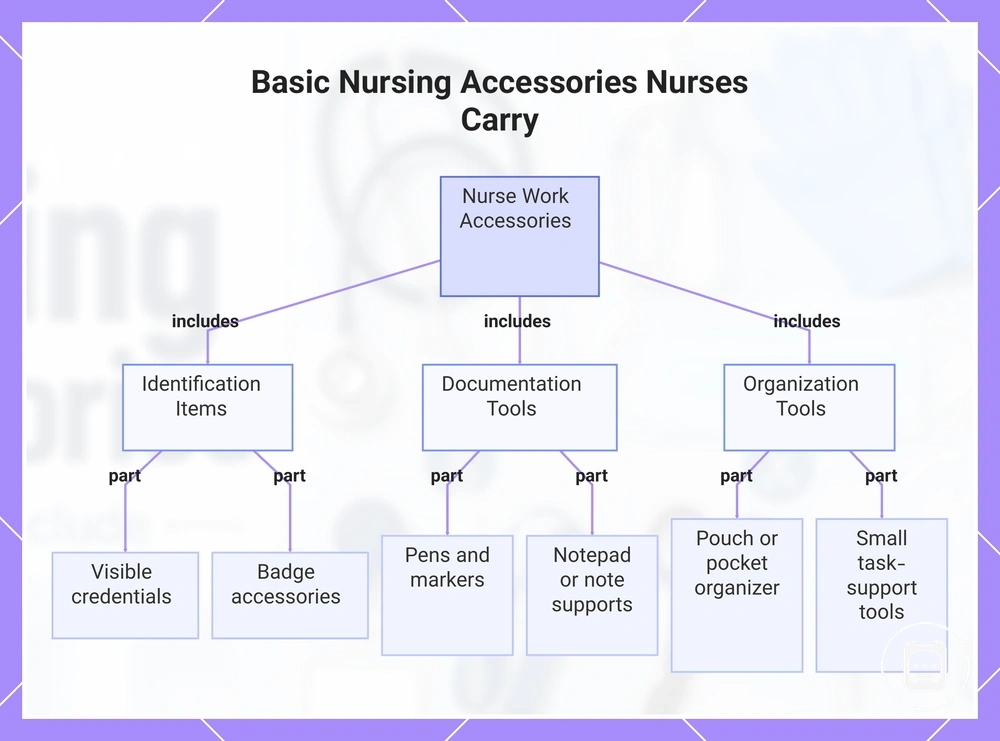
Basic nursing accessories nurses commonly carry at work are usually small, practical items used for identification, quick notes, task support, and personal organization during daily responsibilities. The exact carried items can vary by nurse role, shift condition, workplace policy, and clinical setting. The checklist below is illustrative rather than a universal requirement.
This mini-checklist organizes commonly carried items by how they are used during work. Each item group may be more or less relevant depending on shift condition, workplace policy, and daily responsibilities.
- Identification items: Support identification and access when visible workplace credentials are required during work.
- Pens and markers: Support quick notes and routine documentation when written information needs to remain accessible during a shift task.
- Small task-support tools: Support everyday work activities when workplace policy allows approved carried items.
- Notepad or note supports: Help keep quick notes available when responsibilities or shift conditions change throughout the day.
- Pouch or pocket organizer: Support personal organization when multiple carried items need to remain accessible during work.
- Badge accessories: Help keep identification items visible and easier to access during routine work activities.
Items that nurses commonly carry may differ between ward, clinic, student, and specialty settings because responsibilities, workplace policy, and shift condition can vary. For a broader checklist-focused discussion, see essential nursing accessories.
This chart shows the categories of basic nursing accessories commonly carried at work, grouped by purpose: identification, documentation, and organization. The exact items may vary by role, shift, policy, and setting.
How nursing accessories support a shift
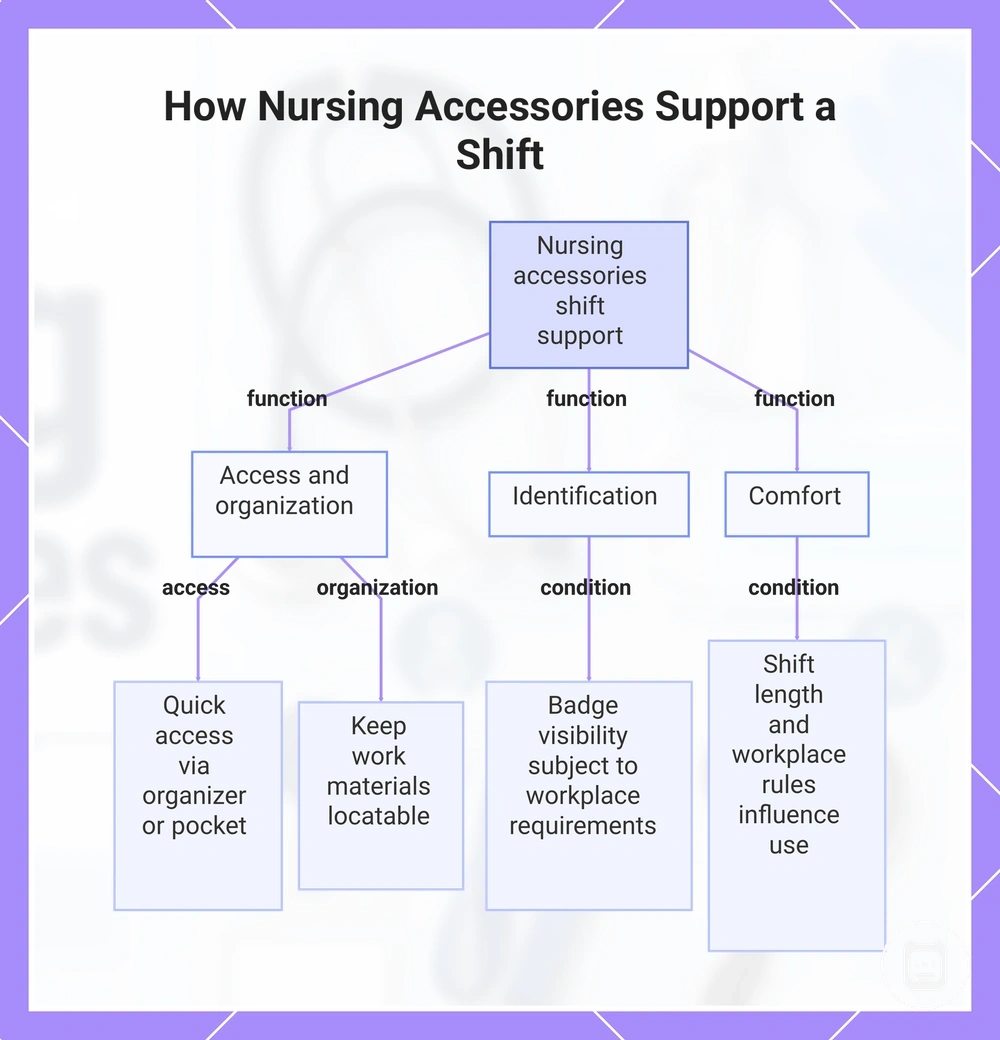
During a busy workday, nursing accessories support a shift by helping nurses manage small access, identification, organization, and comfort challenges that can arise throughout routine responsibilities. The usefulness of nursing accessories may vary by nurse role, shift length, work condition, and facility expectations. Together, they provide practical shift support through access, identification, organization, and comfort functions.
When frequently used items need to remain accessible, an organizer or pocket-based accessory can support quicker access and easier retrieval. When identification must remain visible in the workplace, badge-related accessories can support visibility while remaining subject to workplace requirements. Comfort-related accessories may become more relevant as shift length increases, while hygiene constraints and facility rules can influence which items are appropriate in a given setting. These functions help nursing accessories provide workday support while remaining distinct from clinical equipment.
The following examples show how nursing accessories support a shift through access, identification, organization, and comfort.
- When a nurse role involves moving between different work areas, identification accessories can help keep credentials visible and accessible.
- When quick access to notes or small carried items is needed, organization accessories can help keep work materials easier to locate.
- When shift length increases, comfort-focused accessories may help address personal comfort needs within workplace expectations.
- When hygiene constraints or facility rules apply, accessory use may depend on local restrictions, approved practices, or work conditions.
This chart shows the three main functions of nursing accessories in shift support—access and organization, identification, and comfort—and the conditions that influence their use.
Common limits on nursing accessories in clinical settings
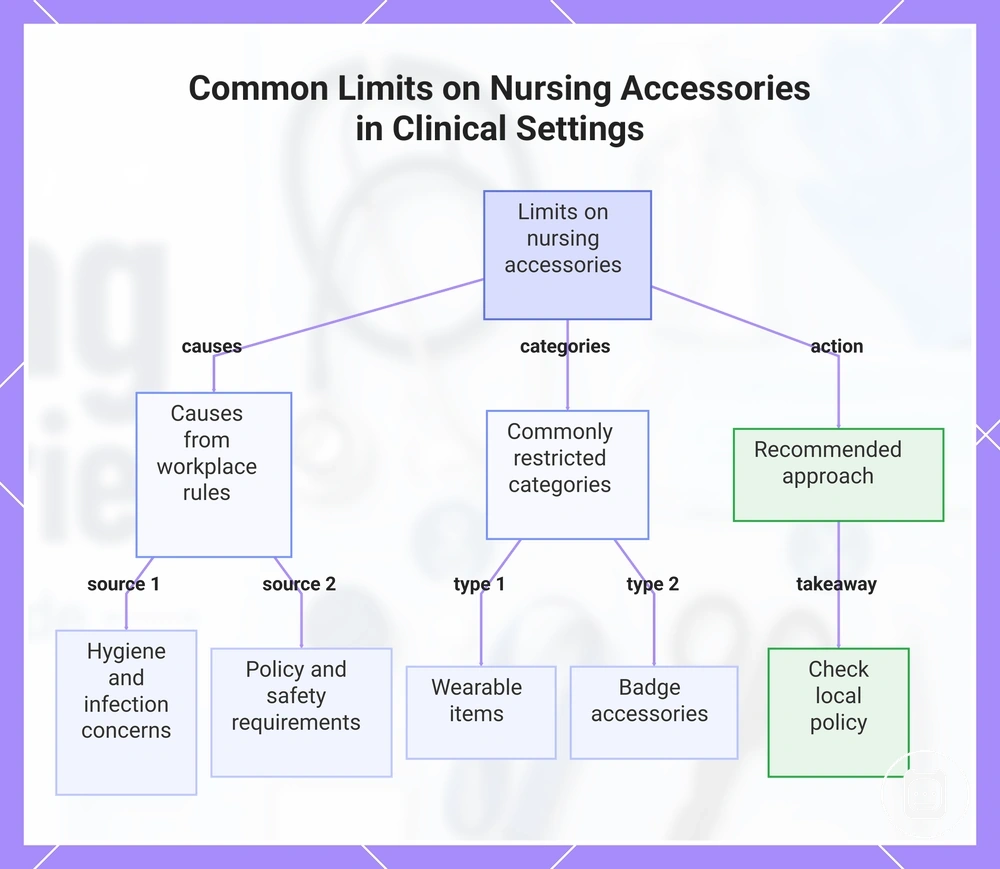
Limits on nursing accessories in clinical settings can result from hygiene rules, safety expectations, uniform policies, role requirements, and facility-specific restrictions. An accessory that is acceptable in one workplace may be restricted in another because work conditions, responsibilities, and facility rules differ. These limits vary by facility and role.
Wearable items may face restrictions when hygiene rules or infection-control concerns affect their use, making it important to check local policy before assuming they are permitted. Badge accessories can be influenced by uniform policies or role requirements that determine visibility, placement, or use within a facility. Small tools may be subject to safety expectations, approval requirements, or scope-related restrictions depending on the clinical setting. In each case, the safest interpretation is to follow workplace limits and check local policy rather than assuming a universal rule.
The checklist below highlights common categories of restrictions, but it does not replace local policy.
- Wearable items: Hygiene rules or infection-control concerns may lead to restrictions; check local policy.
- Badge accessories: Uniform policies or role requirements may affect use; follow facility rules.
- Small tools: Safety expectations, approval requirements, or scope considerations may apply; confirm workplace expectations.
- Organization accessories: Item size, placement, or accessibility may be limited by workplace rules; check local policy.
- Comfort-related accessories: Use may depend on facility-specific restrictions or work conditions; review local guidance.
For workplace-specific edge cases that remain unclear, see common nursing accessories questions.
This chart shows the main sources of restrictions on nursing accessories, the most commonly affected categories, and the recommended action of checking local policy.