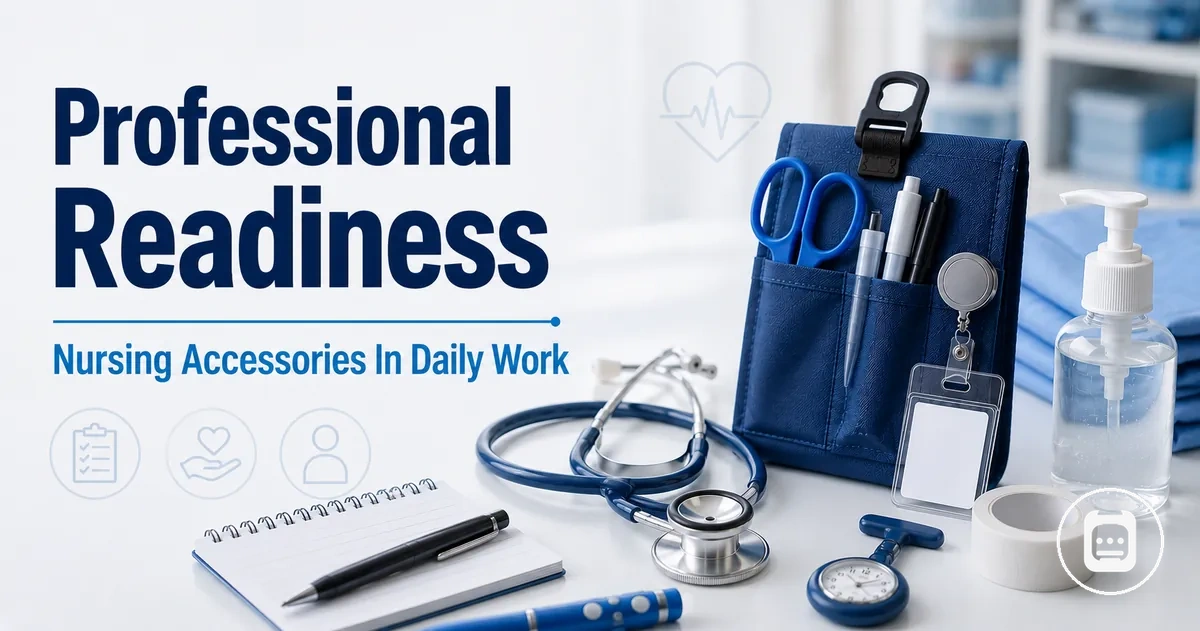
Professional nursing accessories for readiness in clinical practice
Professional nursing accessories are support items used to maintain organized access to tools and materials that can contribute to readiness during clinical practice. Their role is to keep commonly used resources visible, accessible, and suitable for daily work conditions rather than to define professional ability. In this context, professional readiness is the controlling context.
Professional nursing accessories connect readiness with access, organization, identification, documentation, and assessment support. Organized access can reduce unnecessary searching for frequently used items, while identification and documentation support may improve day-to-day workflow when workplace expectations require them. Assessment support items can contribute to task readiness when they are appropriate for the role and setting. Their usefulness depends on workplace protocol, role expectations, and safe use conditions.
Before a shift begins, a nurse may arrange identification items, documentation tools, and other support items so they remain easy to reach throughout the day. This preparation focuses on accessibility and suitability rather than carrying the greatest number of items. The emphasis moves from readiness itself to the functions that professional nursing accessories can provide during clinical work.
Professional nursing accessories do not replace clinical judgment, training, supervision, licensing, or institutional procedures. They contribute to preparedness by supporting organization, access, and routine task support, but competence and authorization come from professional qualifications and workplace requirements. For broader context around related support items and usage topics, visit the nursing accessories hub.
What professional readiness means for nursing accessories
Professional readiness is the practical state of having suitable, accessible, and appropriate support items available for clinical duties. Professional readiness for nursing accessories focuses on whether nursing accessories are available and suitable for use within a specific work environment. It is separate from owning a large number of items.
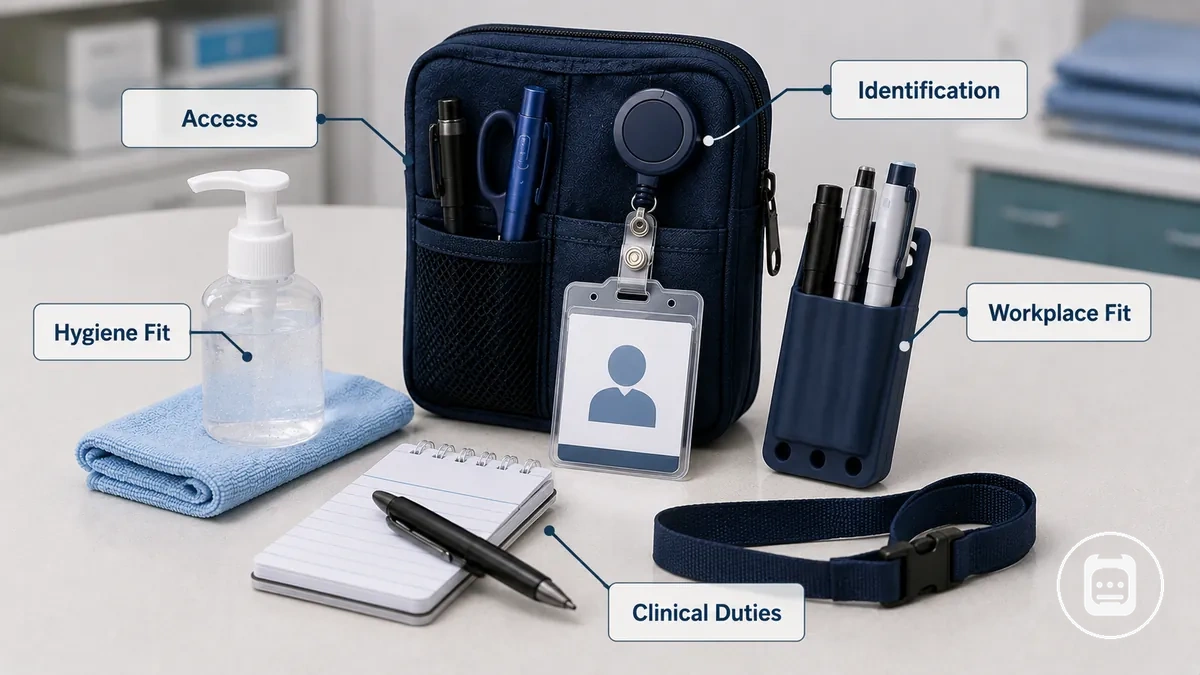
What professional readiness means for nursing accessories can be understood through conditions such as access, identification, hygiene suitability, and workplace fit. The image illustrates how nursing accessories may be grouped and labeled according to these conditions rather than by product type. Suitable support items contribute to prepared practice when they remain accessible and align with workplace expectations and role needs.
A common myth is that being well equipped automatically means being ready for clinical work. In practice, professional readiness depends on whether nursing accessories are appropriate for clinical duties and fit the setting in which they are used. Nursing accessories can support clinical readiness, but they do not replace competence, authorization, or clinical decision-making ability.
Clinical work functions supported by professional nursing accessories
Clinical work functions supported by professional nursing accessories typically involve task support rather than direct clinical action. Professional nursing accessories can contribute to assessment support, identification, communication, and documentation when they provide quick access, visibility, portability, or reliability within a workplace setting. These relationships are most visible in recurring clinical work functions.
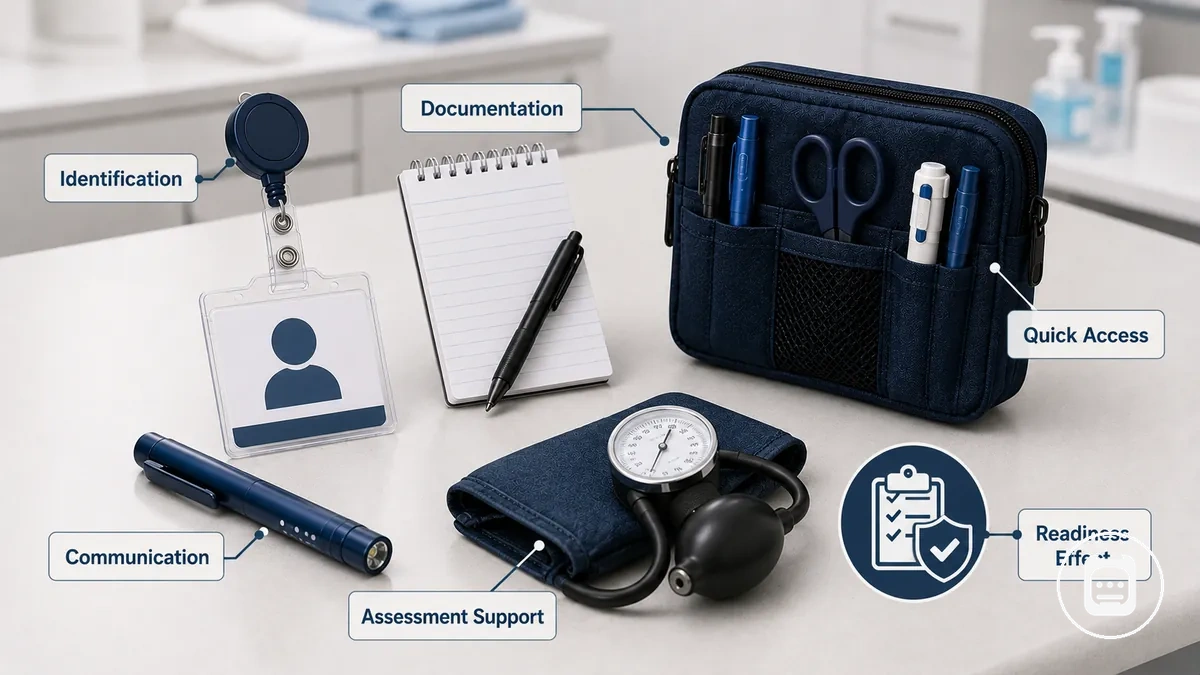
The function-to-readiness relationship becomes clearer when work functions are viewed alongside the conditions that influence their use. The table below organizes recurring clinical work functions by accessory support, workplace condition, and readiness effect.
| Clinical work function | Accessory support | Condition of use | Readiness effect |
|---|---|---|---|
| Identification | Visibility and accessibility | When workplace identification methods are used | Clearer role recognition during routine tasks |
| Documentation | Portability and quick access | When documentation activities occur throughout the shift | More consistent access to recording tools |
| Assessment support | Reliable access to support items | When role responsibilities include observational tasks | Better task readiness for routine assessments |
| Communication | Visibility and accessibility | When communication tools are part of workplace processes | Reduced time spent locating support items |
Common function patterns connect accessory support with accessibility and readiness effect rather than with clinical outcomes. Identification functions depend on visibility, while documentation functions often depend on portability and quick access. Assessment support may benefit from reliable access to appropriate support items when workplace expectations call for them. Professional nursing accessories support clinical work functions, but they are not treatment tools and do not provide a diagnostic guarantee.
For example, a nurse preparing for a routine shift may organize identification and documentation support items so they remain accessible during recurring tasks. In that context, the readiness effect comes from improved access to needed support items rather than from the accessories performing the clinical task. Workplace expectations and role variation can influence which functions receive the greatest task support.
Because clinical work functions can vary across departments and responsibilities, the usefulness of specific accessory functions may differ by workplace condition. For a broader look at role-based preparation and carrying practices, see work-shift accessories.
Assessment and quick-response support
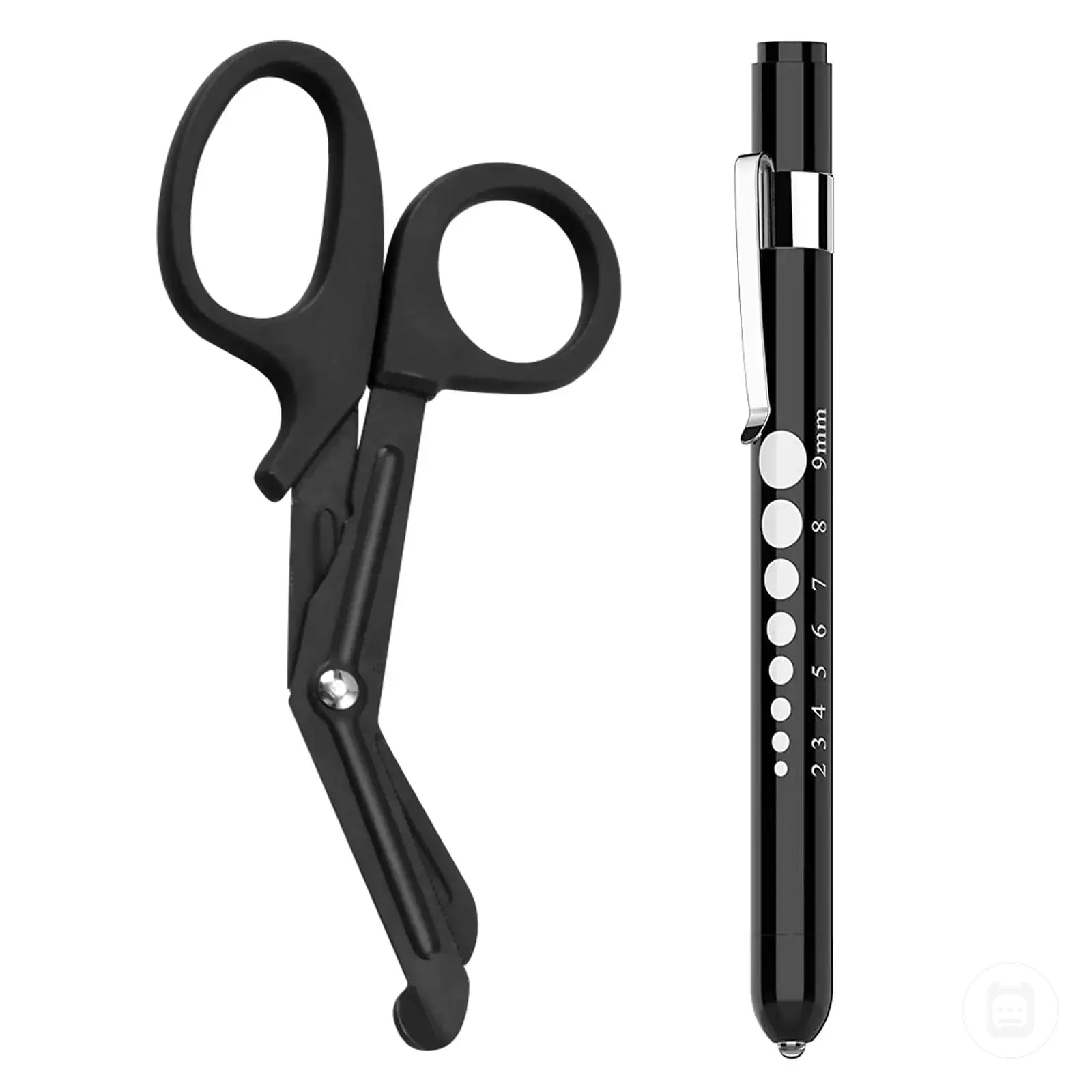
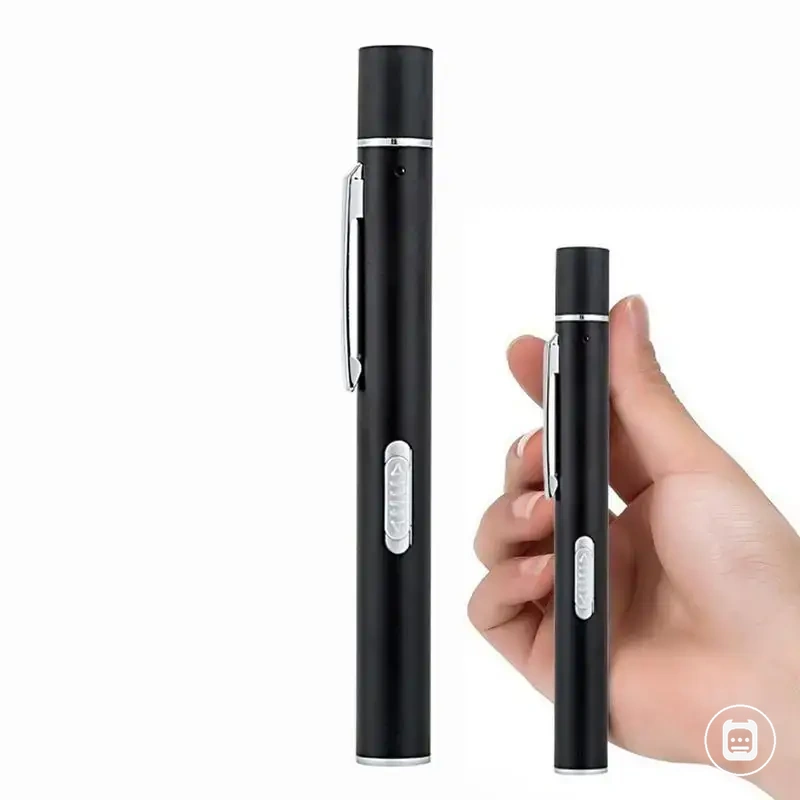
Assessment and quick-response support can come from selected accessories that improve assessment preparation and access to commonly used support items. A penlight, reachable writing item, or similar assessment-support item may help maintain visibility and reachability during routine clinical tasks. Their value is limited to preparation and access rather than assessment performance itself.
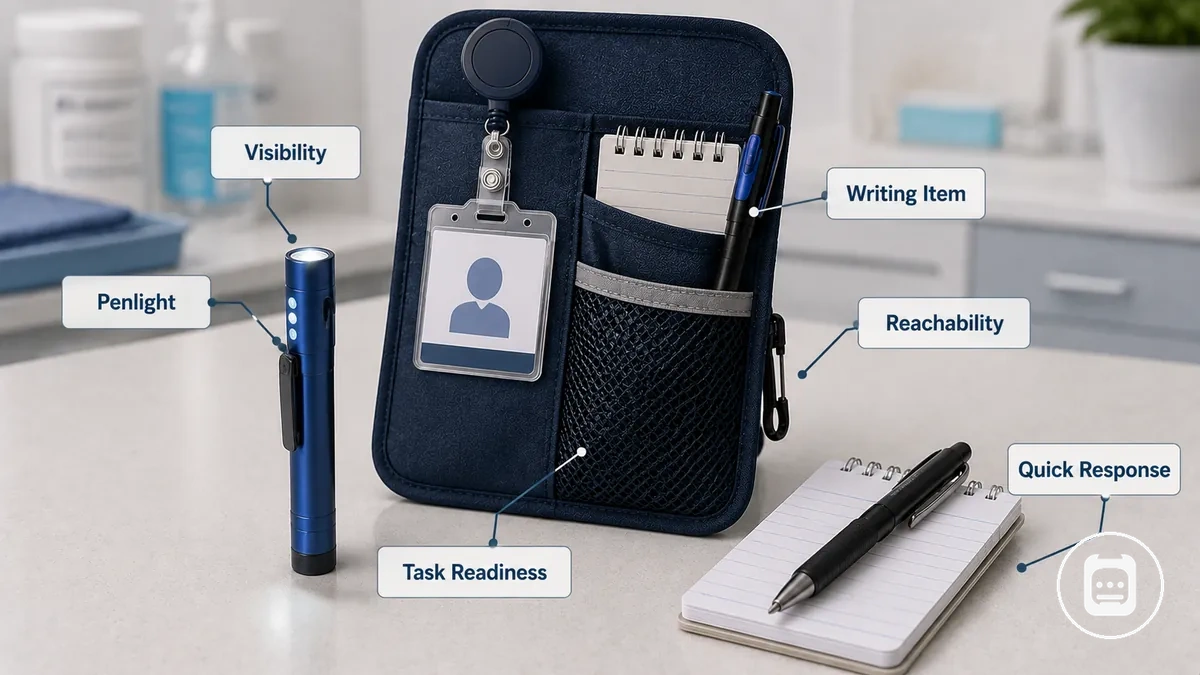
Assessment and quick-response support is often easiest to understand in a routine work scenario. A penlight stored in an accessible pocket or a reachable writing item kept in an organizer may support task readiness when a role includes observational or documentation-related activities. Any benefit depends on workplace protocol, role limits, and whether rapid access to the item is relevant to the task.
Usefulness may vary across departments and responsibilities. Local protocol and workplace variation can influence whether a penlight, reachable writing item, or another support item contributes meaningfully to assessment preparation and routine task support.
Identification and communication support
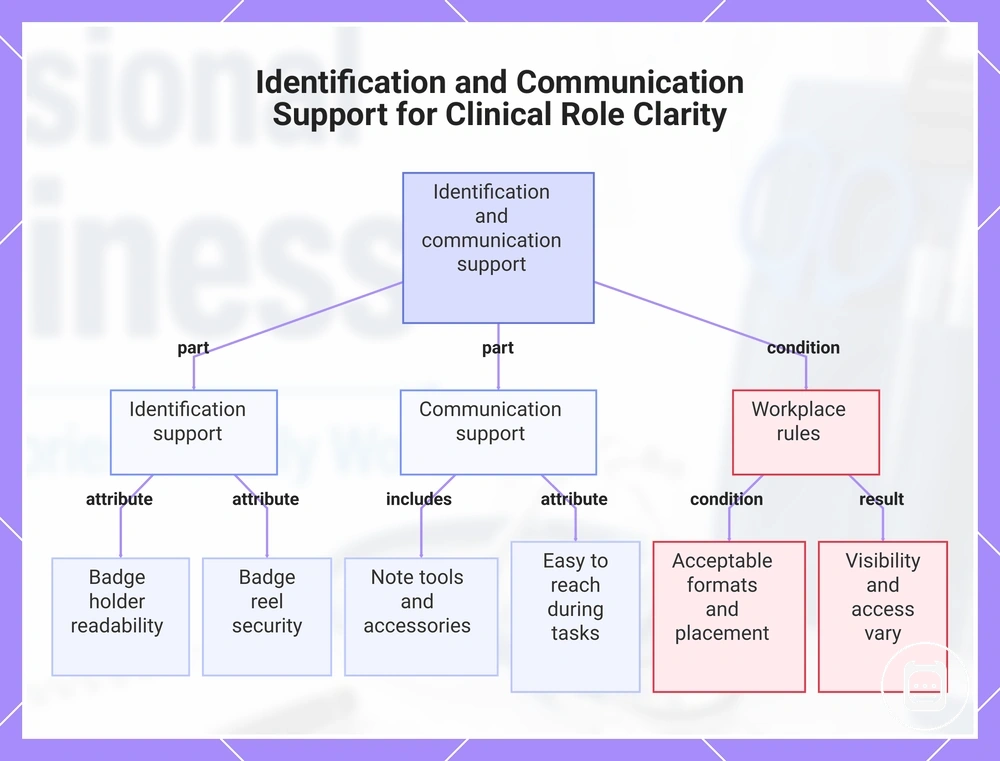
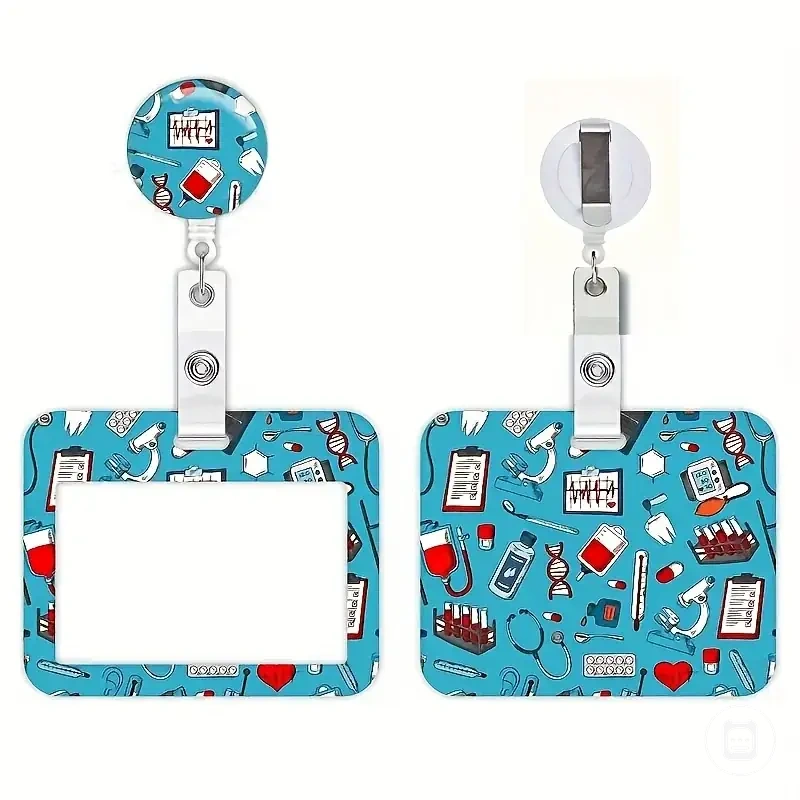
Identification support and communication support help maintain role clarity during clinical work by keeping identifying and coordination-related items visible and accessible. A badge holder supports readable placement, while a badge reel supports secure placement and convenient access to identification items. Together, these attributes help connect identification support with clear role recognition and role clarity.
Communication support can come from note tools, badge accessories, or other coordination support items that remain easy to reach during routine tasks. Readable placement and secure placement help keep these accessories available when communication or coordination is needed. Workplace rules may determine acceptable formats and placement, so visibility and access can vary by setting.
This chart shows the main components of identification and communication support in clinical work, including specific tools, their attributes, and workplace constraints.
Reference, notes, and shift-coordination support
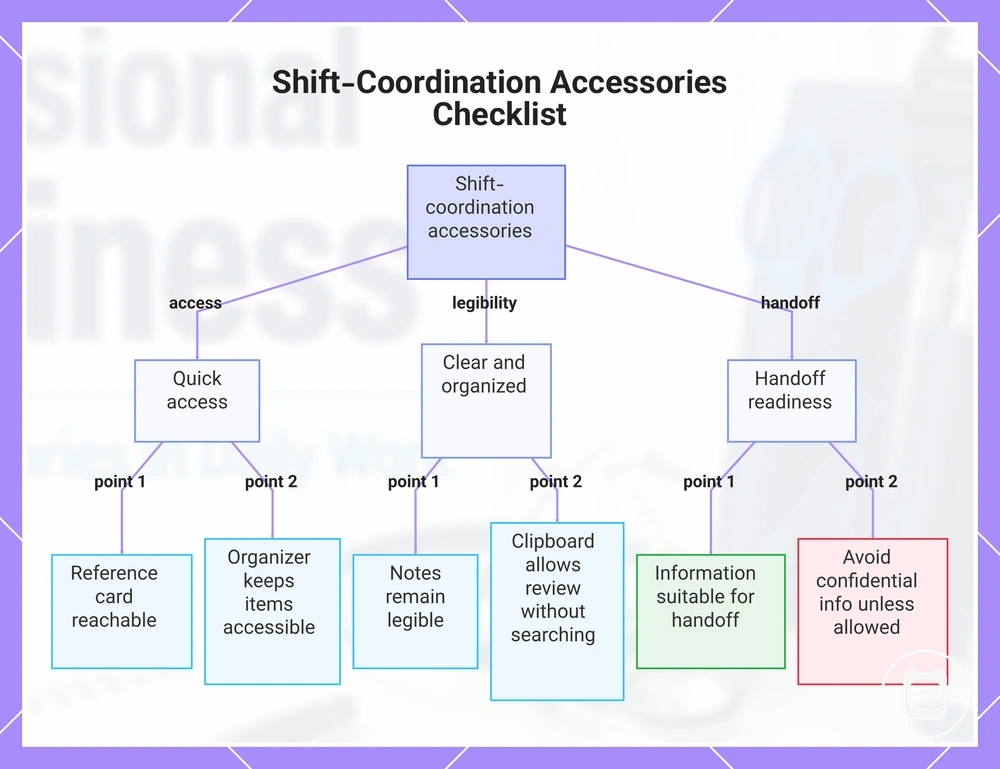
During a busy shift, a notebook, clipboard, organizer, or reference card can help keep important reminders and quick-reference information accessible when tasks move between people or locations. These accessories support legibility, quick review, and organized access to information needed for immediate task handling. In this role, they function as coordination support for shift coordination.
The following checklist can help verify access, legibility, and handoff readiness when using reference, notes, and coordination accessories:
- Reference card is easy to reach for quick-reference task support.
- Notes remain clear and maintain legibility during routine use.
- Clipboard or notebook allows information to be reviewed without unnecessary searching.
- Organizer keeps coordination items accessible during shift coordination.
- Information remains suitable for handoff readiness and immediate task handling.
Quick-reference usefulness depends on workplace expectations and appropriate use. Notes should avoid confidential or inappropriate information unless workplace procedures specifically allow that content and method of use.
This chart shows the key verification categories for ensuring that reference cards, notebooks, clipboards, and organizers support effective shift coordination.
How a nurse readiness kit supports prepared practice
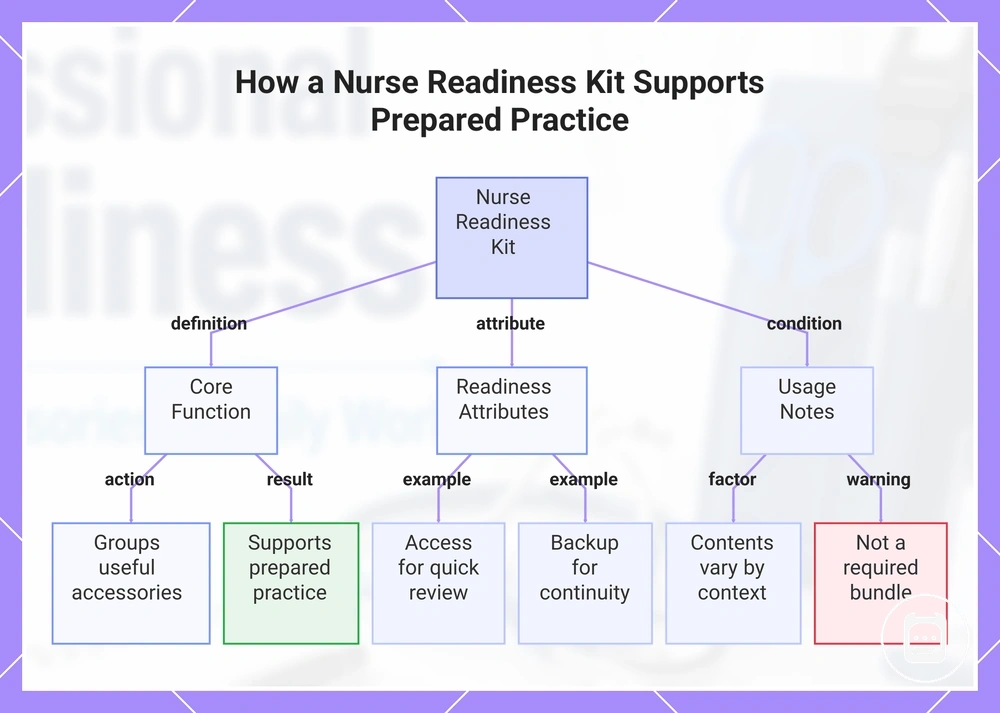
A nurse readiness kit supports prepared practice by grouping useful accessories for predictable clinical tasks and changing shift conditions. The nurse readiness kit organizes support items around access, backup, fit, hygiene, and portability needs. In this context, the kit functions as a grouping method rather than a fixed list of products.
Predictable clinical tasks often involve recurring situations where quick access to support items can improve day-to-day readiness. Shift conditions may change throughout a work period, which can increase the value of backup items, portable accessories, or hygiene-focused supplies. A nurse readiness kit helps organize these support functions so commonly needed items remain easier to locate when relevant conditions arise.
The checklist below shows how a nurse readiness kit can organize support items around readiness attributes and conditions of use. Each example connects a kit item class to a readiness value rather than presenting a required list.
- Reference item → access → when quick review is needed → supports task preparation.
- Backup item → backup → when a primary item is unavailable → supports continuity of use.
- Fit-related item → fit → when comfort or placement matters → supports practical usability.
- Hygiene-focused item → hygiene → when cleanliness considerations apply → supports prepared practice.
- Portable organizer → portability → when items move between locations → supports easier carrying and access.
- Note-support item → access and portability → when reminders or quick-reference information are useful → supports organization during routine work.
Contents may vary because a new nurse, a clinical rotation, and a working nurse can encounter different workplace variation, responsibilities, and shift conditions. A readiness set or nursing work kit may include different item classes depending on context, but the purpose remains the same: grouping useful support items in a way that supports prepared practice without becoming a required bundle or substitute for workplace-issued supplies.
This chart shows how a nurse readiness kit functions as a grouping method for support items, organized around readiness attributes and conditions of use, with examples and usage notes.
Clinical tools and personal-support items in a readiness kit
Clinical-support tools and personal-support items are two functional categories within a readiness kit. Clinical-support tools contribute to task-related readiness value, while personal-support items contribute to backup, comfort, or everyday work support. This distinction keeps both categories aligned with the readiness kit function while separating clinical-support tools from personal-support items.
The table below distinguishes item role, readiness value, and usage condition within a readiness kit. Item classes are examples of support functions rather than items that belong in every clinical setting.
| Item class | Readiness value | Usage condition | Boundary note |
|---|---|---|---|
| Penlight | Clinical-support tool for task readiness | When observational support is relevant to duties | Use depends on role and setting |
| Badge holder | Supports visibility and identification access | When readable placement is needed | Placement may vary by employer rules |
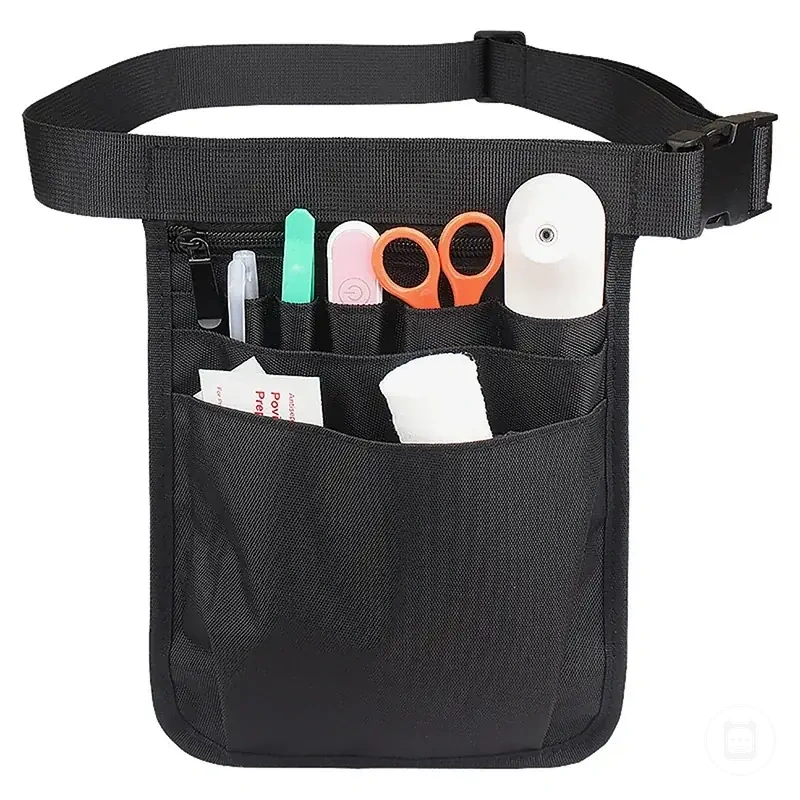
| Organizer | Supports access and portability | When multiple kit items need structured access | Contents may vary by workplace needs |
| Writing tools | Support notes and quick-reference use | When brief task-related information is useful | Appropriate use depends on workplace expectations |
| Backup items | Provide backup support and continuity | When a primary item is unavailable | Inclusion depends on individual work conditions |
Employer rules, hygiene needs, and placement requirements may influence which kit items belong in a readiness kit. For that reason, item selection can vary even when the readiness value remains similar.
Readiness needs for students, new nurses, and working nurses
Readiness needs depend on experience level, clinical context, and workplace exposure. Students, new nurses, and working nurses may require different forms of accessory support because supervision, task range, and day-to-day responsibilities can vary. Experience level is often the main compatibility factor when considering readiness requirements.
The comparison below highlights how readiness needs differ while keeping all groups connected to the same goal of prepared practice. It focuses on requirement, accessory support, and usage limits rather than creating separate checklists.
| User group | Typical readiness need | Accessory support | Condition or limit |
|---|---|---|---|
| Students | Support during supervised learning and clinical rotation activities | Accessible reference and organization items | Use may depend on supervision and placement expectations |
| New nurses | Managing a broader task range and increasing workplace exposure | Organization, access, and backup-focused support | Needs may change as responsibilities expand |
| Working nurses | Maintaining readiness across routine duties and shift conditions | Accessory support that improves access and portability | Selection depends on role expectations and work environment |
Overlap exists across all groups because access, organization, and practical readiness support remain relevant regardless of experience level. Readiness outcomes often improve when accessory support matches the clinical context instead of following a fixed approach.
Differences appear when supervision, task range, and workplace exposure change. Student supervision can affect which accessory support items are appropriate during a clinical rotation, while workplace exposure may shift readiness priorities for new nurses. Working nurses may place greater emphasis on support that remains useful across changing shift conditions and role demands.
Students often operate within more defined supervision conditions, which can influence readiness needs without creating a universal requirement. For a more focused comparison of learner-specific considerations, see student nursing accessories.
Professional-use qualities that make accessories reliable at work
Professional-use qualities determine whether nursing accessories are reliable at work under routine clinical demands. Dependable accessories are usually evaluated by durability, cleanability, visibility, fit, portability, and workplace suitability rather than by appearance or convenience alone. Reliability is the main frame for evaluating professional-use qualities.
The criteria below organize reliability factors into practical evaluation points. Each quality criterion connects an acceptable condition to a readiness value and a reason to qualify the claim when use conditions vary.
| Quality criterion | What to check | Readiness value | When to qualify the claim |
|---|---|---|---|
| Durability | Ability to tolerate routine handling and repeated use | Supports consistent availability during work tasks | Use conditions and handling practices may affect results |
| Cleanability | Surface and design features that can be maintained appropriately | Supports hygiene-related readiness | Requirements may vary by workplace expectations |
| Visibility | Ease of locating, identifying, or viewing the accessory | Supports quicker access and task support | Placement and role requirements may influence usefulness |
| Fit | Suitability for intended carrying or use conditions | Supports practical day-to-day use | Fit depends on user preference and work context |
| Portability | Ease of carrying without creating unnecessary burden | Supports access across changing work locations | Value varies by task range and movement demands |
| Workplace suitability | Alignment with role expectations and work environment | Supports appropriate professional use | Depends on workplace rules and clinical context |
Durability and cleanability often work together as decision signals because an accessory may need to remain usable while also supporting appropriate maintenance practices. An acceptable condition is not defined by appearance alone; the quality criterion should contribute to dependable use and readiness effect within the intended environment.
Visibility, fit, portability, and workplace suitability help distinguish dependable accessories from decorative or low-utility items. These practical criteria contribute to task support when the accessory remains easy to access, comfortable to carry, and appropriate for the work setting.
Decision signals become more useful when multiple criteria are evaluated together rather than in isolation. Readers who want a broader evaluation framework can compare these practical criteria with the accessory-focused buying criteria used for selection decisions.
Trade-offs may occur because a quality that improves portability may not always improve fit, and workplace suitability may depend on role-specific conditions. Professional-use qualities are most useful when they match the intended use case, clinical context, and readiness needs rather than decorative preferences.
Here are product examples that may make comparison easier. Before buying, always review the compatibility criteria, essential features, and product details.

Organization habits that protect professional readiness
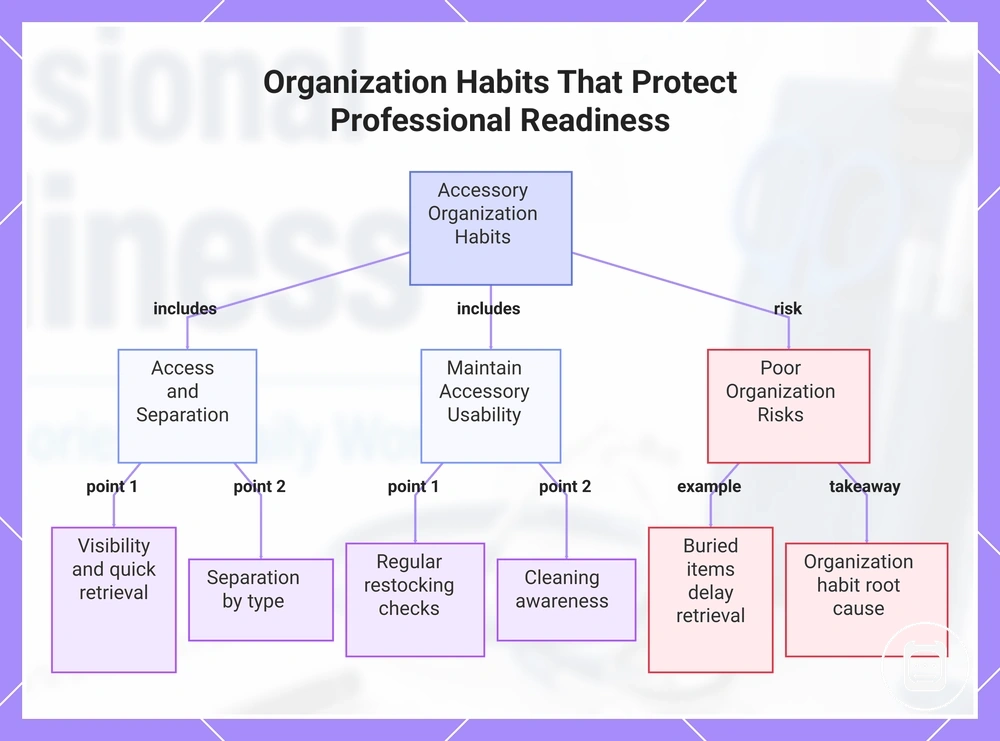
Organization habits help protect professional readiness by keeping accessories usable and accessible when they are needed. Even when the right items are available, poor organization can reduce access, create confusion, or slow quick retrieval during routine tasks. Consistent organization is a readiness habit that supports dependable access.
A practical organization routine can help maintain visibility, separation, restocking awareness, and cleaning awareness without becoming a full storage guide. The mini-checklist below organizes readiness habits around conditions that can affect daily accessory use.
- Keep frequently used items in locations that support visibility and quick retrieval.
- Use separation between different accessory types when workplace conditions make organization important.
- Check restocking needs regularly so commonly used items remain available.
- Maintain cleaning awareness for accessories that may require routine attention.
- Use an organizer or storage method that supports access without creating unnecessary clutter.
Access and separation support different readiness functions. An organizer can improve visibility and quick retrieval, while separation can help prevent accessories from becoming difficult to locate when multiple items are carried together. The readiness effect depends on how the storage method matches the work environment and carried items.
Restocking and cleaning awareness help maintain accessory usability over time. A readiness routine may include checking whether frequently used items remain available and whether accessories continue to be appropriate for workplace conditions. These habits support ongoing access rather than relying on a one-time setup.
Poor organization can reduce readiness even when the correct accessories are present. For example, a needed item may be buried beneath unrelated items inside a storage area, creating delay or confusion when quick retrieval is expected. In that situation, the issue is not the accessory itself but the organization habit surrounding it.
A practical next step is to review whether current organization habits support visibility, separation, restocking, cleaning awareness, and quick retrieval within the intended clinical context. An organizer or storage method can help when it supports these readiness goals, but professional readiness still depends on consistent use and review.
Here are product examples that may make comparison easier. Before buying, always review the compatibility criteria, essential features, and product details.
This chart illustrates key organization habits for maintaining professional readiness, grouped by access, usability, and risks of poor organization.
Where accessories support but do not replace clinical judgment
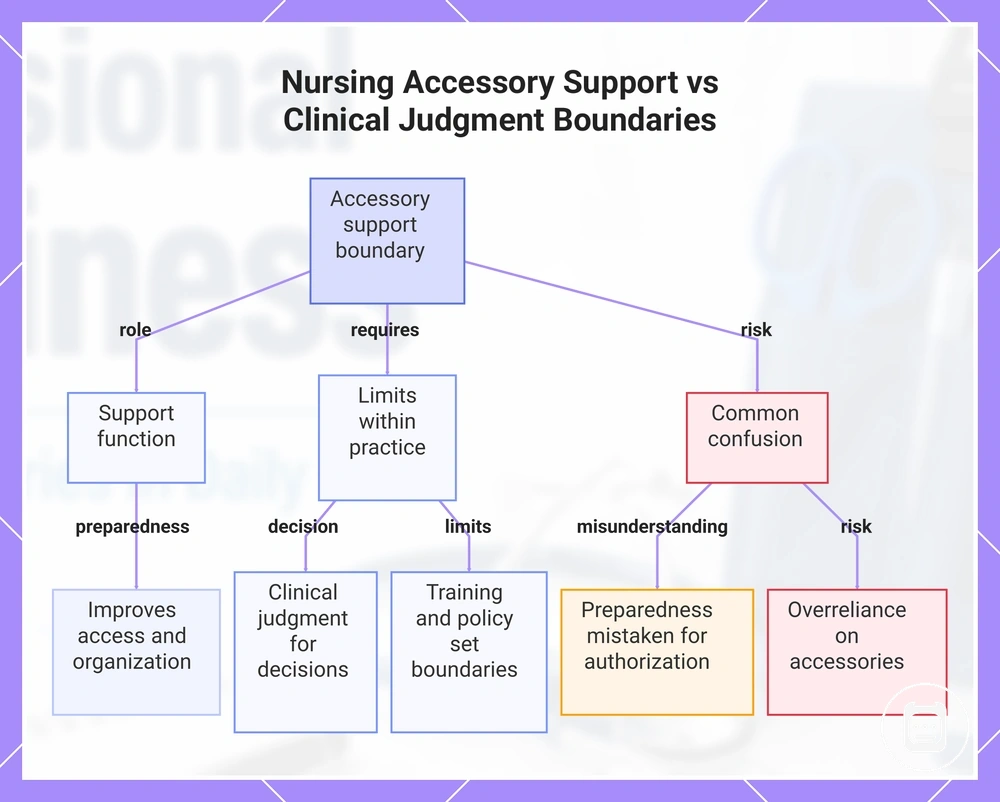
Nursing accessories support preparedness, access, and organization, but they do not replace clinical judgment. Accessories can help make tools and information easier to reach, yet decisions, actions, and interpretations still depend on clinical judgment, training, supervision, and workplace policy. This distinction defines the support-versus-judgment boundary.
Training, supervision, and workplace policy establish limits that accessories cannot overcome. An accessory may support readiness by improving access or organization, but it does not expand authorization, change role limits, or substitute for required guidance. When workplace policy or supervision requirements vary, appropriate use may also vary by setting and responsibility.
Confusion can occur when preparedness is mistaken for authorization or clinical readiness. The checklist below separates accessory support from the boundaries that remain outside accessory function.
- Accessories support preparedness through access and organization.
- Clinical judgment remains necessary when interpreting situations or making decisions.
- Training and supervision guide appropriate use within role limits.
- Workplace policy may influence how accessories are used in a specific setting.
- Overreliance on accessories can create a misunderstanding of readiness or capability.
Being equipped is not the same as being authorized or clinically prepared. A person may have appropriate accessories available, yet clinical judgment, training, supervision, and workplace policy still determine how those accessories fit within safe use boundaries. A safer interpretation is to view accessories as support tools that improve preparedness while recognizing the boundary between readiness support and professional decision-making.
This chart shows how nursing accessories support preparedness while clinical judgment, training, and policy define the limits of safe use.